

Why Design Language Matters
Walk through any showroom, scroll a mood board, or flip through an interiors magazine and you'll encounter a parade of terms - Japandi, biophilic, liminal, wabi-sabi - used as though everyone already knows what they mean. They're not just jargon. Each term names a coherent set of choices about materials, color, proportion, and mood that designers use as shorthand when building a look.
When you understand what these words actually describe, you stop guessing and start making deliberate decisions. This glossary covers 30 terms you're likely to encounter - in store, online, or when working with a designer. For a deeper look at underlying principles like scale and rhythm, see our core design concepts guide.
| Total terms defined | 30 design terms |
| Coverage areas | Style philosophies, spatial concepts, materials & finishes |
| Skill level required | No prior design knowledge needed |
| Primary use case | Decoding magazine, mood board, and showroom language |
| Complementary topic | Core design principles (scale, proportion, balance) |
Style Philosophies: From Japandi to Maximalism
These terms describe overarching design worldviews - the "personality" of a room before a single piece of furniture is chosen.
Japandi
A hybrid aesthetic blending Japanese and Scandinavian design principles. It emphasizes simplicity, natural materials, muted palettes, and handcrafted objects - with a slightly warmer, more wabi-sabi-influenced sensibility than pure Scandinavian minimalism.
Wabi-sabi
A Japanese philosophy that finds beauty in imperfection, impermanence, and incompleteness. In interiors, it shows up as appreciation for worn surfaces, asymmetry, handmade irregularity, and things that show evidence of age or use.
Biophilic design
An approach that incorporates natural elements - living plants, natural light, organic shapes, wood, stone, and water features - to strengthen a room's connection to the natural world. The aim is to support well-being and reduce stress through environmental design.
Eclectic
A style that deliberately mixes periods, origins, and aesthetics. Successfully eclectic rooms are unified by consistent color, scale, or material threads rather than matching sets.
Maximalism
A design philosophy that embraces abundance - bold pattern, color, layered objects, and visual richness. Effective maximalism is intentional, not simply cluttered; it follows an internal logic of collecting and display.
Organic modern
A style combining clean, contemporary lines with natural textures and earthy palettes. Think smooth plaster walls alongside linen sofas and unfinished wood - modern in structure but warm in material.
Transitional style
A middle ground between traditional and contemporary design. Transitional rooms blend classic furniture silhouettes with updated materials and neutral palettes to create spaces that feel timeless rather than trend-specific.
Cottagecore
An aesthetic romanticizing rural, pastoral life through floral patterns, vintage objects, handmade textiles, and an abundance of botanicals. Often layered and soft in palette.
Mid-century modern
A design movement rooted in roughly 1945-1975, characterized by clean lines, tapered legs, organic curves, minimal ornamentation, and the integration of natural and man-made materials. Still widely referenced in contemporary interiors.
Grandmillennial
A contemporary style that reembraces traditionally "old-fashioned" elements - chintz, needlepoint, toile, fringe - with an affectionate, knowing sensibility rather than irony.
Hygge
A Danish concept describing coziness, comfort, and convivial warmth. In design terms, it translates to soft lighting, plush textiles, candles, warm colors, and spaces that feel welcoming and unhurried.
Coastal grandmother
A relaxed, sun-faded aesthetic evoking a seaside home lived in comfortably over decades. Characterized by linen, whitewashed wood, blue-and-white palettes, wicker, and natural light.
If you're drawn to mixing furniture across eras and origins, the logic behind eclectic interiors explains how to keep those combinations cohesive rather than chaotic. And if Japandi and Scandinavian minimalism both appeal to you, our Scandinavian vs. Japandi comparison unpacks the meaningful differences between the two.
Spatial and Structural Terms
These terms describe how a room is organized, proportioned, and experienced - the architecture of design thinking.
- Negative space: The intentionally empty area around and between objects. Far from wasted, it lets the eye rest and makes featured pieces stand out.
- Vignette: A small, curated grouping of objects - a tray, a candle, a book - arranged on a surface to tell a visual story.
- Focal point: The first place the eye travels when entering a room. It could be a fireplace, a large artwork, or an accent wall.
- Layering: Building depth in a room through overlapping rugs, textiles, lighting levels, and objects at varying heights.
- Transitional space: Areas between rooms - hallways, landings - that benefit from design continuity rather than afterthought treatment.
- Liminal: Borrowed from architecture, it describes threshold spaces that feel in-between - neither fully one room nor another. Often used to evoke a dreamy, slightly ambiguous quality in design.
- Flow: How naturally movement and sight lines move through a space. Good flow means furniture placement encourages circulation without obstruction.
- Scale: The size of objects relative to each other and to the room. Mismatched scale - a tiny rug in a large room, for instance - is one of the most common decorating errors.
Scale Is the Most Common Decorating Mistake
Designers consistently identify scale mismatches - especially undersized rugs - as the single most frequent error in residential interiors. A rug should be large enough that at least the front legs of all major seating rest on it. When in doubt, go larger. This one adjustment can dramatically improve a room's sense of proportion.
Before rearranging furniture or committing to a style direction, a room-by-room audit can help you identify what's working structurally and where the real problems lie.
Materials, Texture, and Finish Terms
Much of what makes a room feel polished - or flat - comes down to material and surface choices.
- Patina: The natural aging effect on surfaces - the slight worn quality of old brass, weathered timber, or antique leather. Valued in organic and eclectic interiors for authenticity.
- Tactility: The degree to which surfaces invite touch. Rooms with high tactility mix smooth, rough, soft, and hard textures to engage the senses beyond sight.
- Matte vs. sheen: Matte finishes absorb light and feel understated; sheen finishes reflect it and add energy. Choosing between them affects the mood of a surface at least as much as the color does. For a practical breakdown, our paint finish guide covers how each level behaves on walls.
- Raw vs. refined: A spectrum describing how processed a material appears. Raw concrete or reclaimed wood sits at one end; polished marble or lacquered cabinetry at the other. Mixing the two adds tension and visual interest.
- Upholstery: The fabric, padding, and covering on seating and soft furnishings. Upholstery choices affect durability and cleanability as much as aesthetics.
- Grounding element: A piece or material - often a large rug or dark floor - that anchors lighter furnishings and gives a room a sense of weight and stability.
7
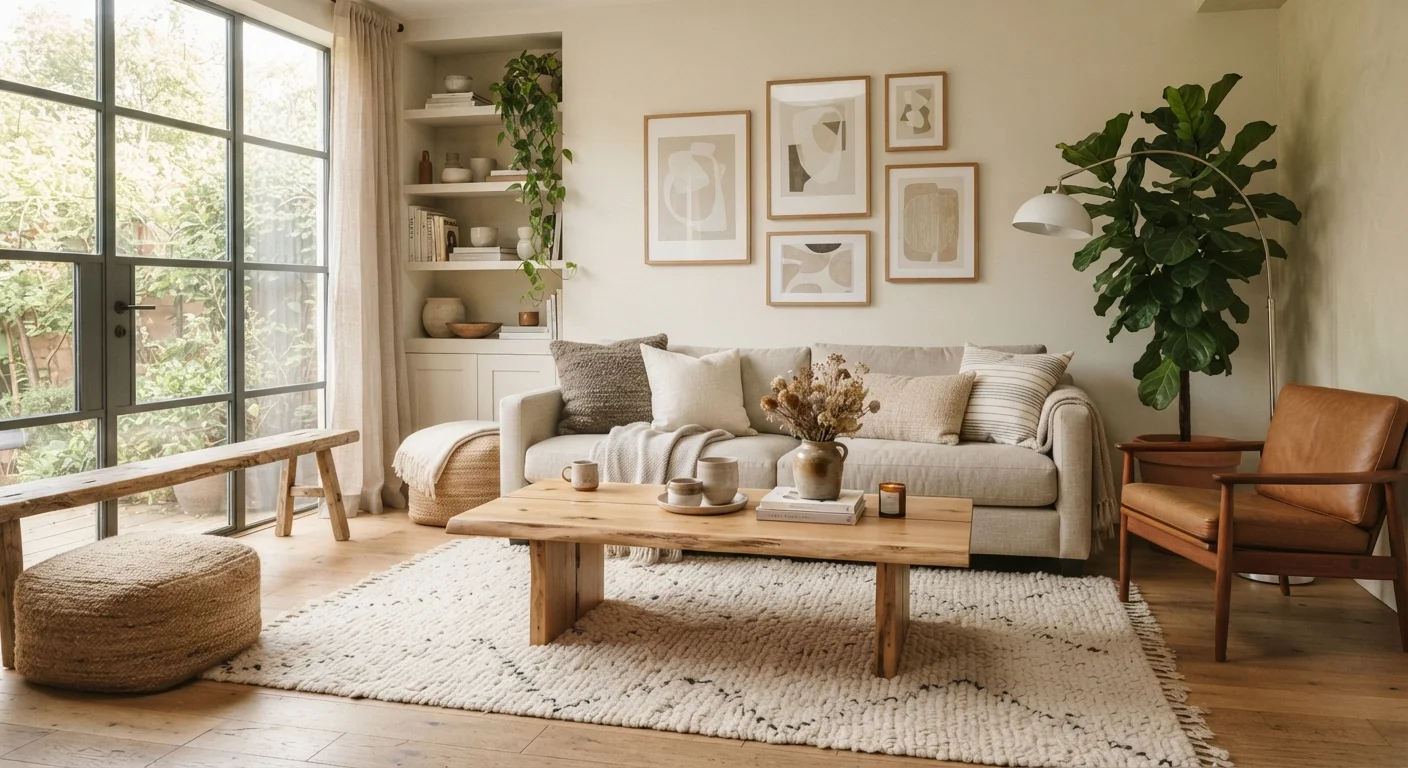
Texture layers in a well-composed room
Interior designers commonly reference layering across rugs, cushions, curtains, walls, lighting, objects, and greenery as a benchmark for tactile depth.
60-30-10
Classic color distribution rule
A widely taught guideline suggesting dominant color covers 60% of a room, secondary 30%, and accent 10% - providing balance without monotony.
If you're starting a room from scratch and aren't sure how to sequence these decisions, our first-timer's decorating guide walks through the process in order.
The content provided on our blog site traverses numerous categories, offering readers valuable and practical information. Readers can use the editorial team’s research and data to gain more insights into their topics of interest. However, they are requested not to treat the articles as conclusive. The website team cannot be held responsible for differences in data or inaccuracies found across other platforms. Please also note that the site might also miss out on various schemes and offers available that the readers may find more beneficial than the ones we cover.