

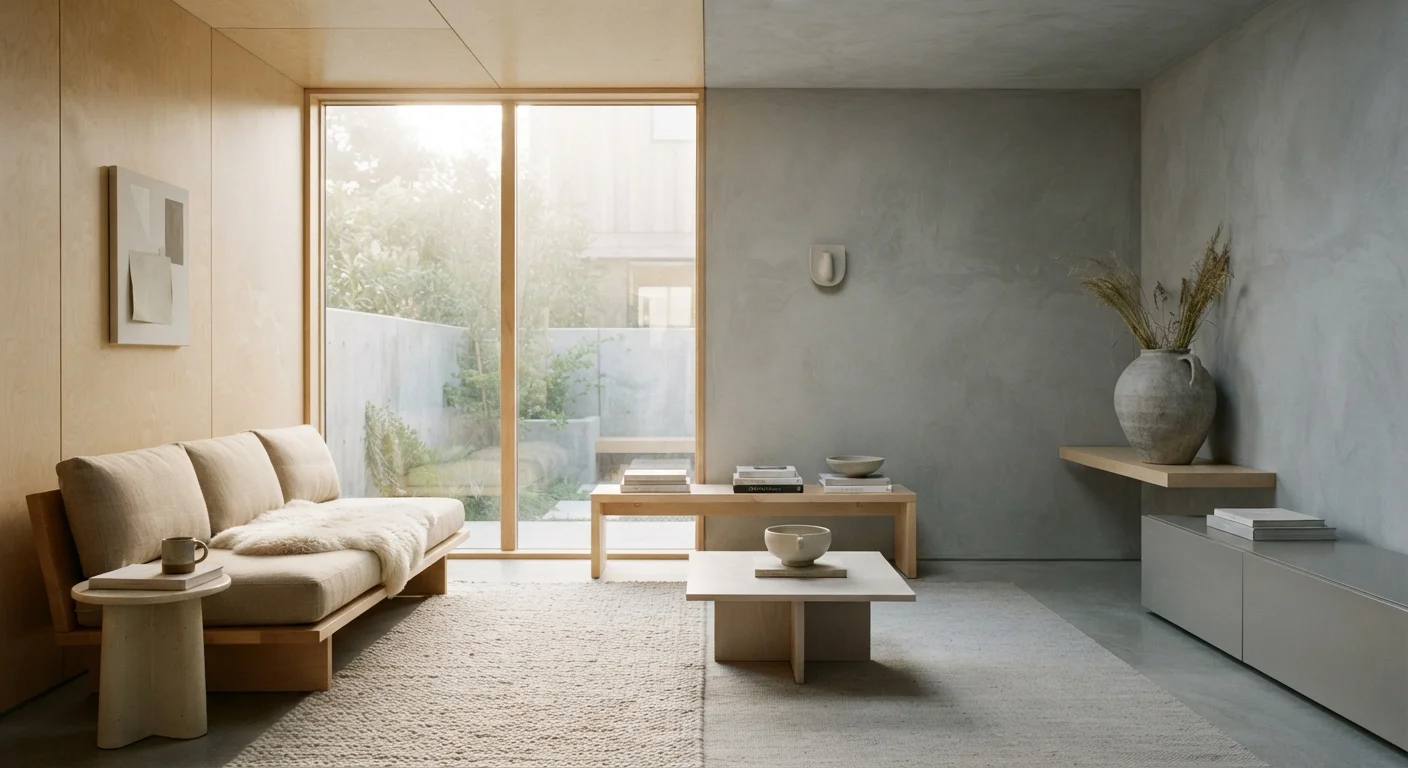
Option A
Scandinavian Design
The warm, functional Nordic tradition.
Best for: Homeowners who want a livable, cozy minimalism with bright, airy rooms and practical everyday comfort.
Option B
Japandi
The refined East-meets-West hybrid aesthetic.
Best for: Those drawn to a quieter, more meditative minimalism rooted in imperfection, craft, and intentional restraint.
Where Each Style Comes From
Understanding these two aesthetics means starting with their origins. Scandinavian design emerged in the early 20th century across Denmark, Sweden, Norway, and Finland, shaped by long winters and a cultural emphasis on democratic, functional beauty. The guiding idea was that well-designed objects should be affordable, practical, and pleasant to live with - a philosophy sometimes captured in the Danish concept of hygge (a sense of coziness and convivial warmth).
Japandi, by contrast, is a more recent hybrid - a term describing interiors that fuse Scandinavian minimalism with Japanese wabi-sabi, the aesthetic philosophy of finding beauty in imperfection, transience, and understatement. Where Scandinavian design was a social and industrial movement, Japandi is primarily a design language, combining the functional clarity of Nordic rooms with the meditative restraint of Japanese interiors.
To understand more foundational design vocabulary behind both styles, see our interior style glossary for definitions of terms like wabi-sabi, biophilic, and more.
Key Differences in Palette, Texture, and Mood
At first glance, both styles appear nearly identical - white walls, wood surfaces, neutral textiles. Look closer, and the divergence becomes clear.
| Criterion | Scandinavian | Japandi |
|---|---|---|
| Colour palette | Whites, warm greys, blond wood | Earthy neutrals, charcoal, deep taupe |
| Mood | Warm, cozy, sociable | Still, meditative, restrained |
| Furniture profile | Tapered legs, comfortable, mid-height | Low-profile, straight lines, minimal |
| Decorative objects | Curated collections, layered accents | Single intentional pieces, negative space |
| Imperfection in materials | Clean, uniform finishes preferred | Handmade irregularity celebrated (wabi-sabi) |
| Guiding concept | Hygge - warmth and togetherness | Wabi-sabi - beauty in imperfection |
| Textile approach | Soft, layered - throws, rugs, cushions | Minimal, natural weave, visible texture |
Colour: Scandinavian rooms rely on whites, soft greys, and warm blond wood tones to maximize light - particularly important in climates with limited daylight. Japandi introduces deeper, earthier shades: charcoal, terracotta, moss green, and warm taupe. The palette feels more grounded and less reflective.
Texture and craft: Japandi places greater emphasis on handmade and artisan objects - a hand-thrown ceramic bowl, a woven rattan tray, linen with visible weave variation. Imperfection is intentional. Scandinavian interiors welcome texture too (chunky knit throws, sheepskin rugs), but the aesthetic tends toward clean uniformity rather than celebrating irregularity.
Mood: A Scandinavian room feels warm and sociable; a Japandi room feels still and contemplative. Both are restful, but they create different emotional registers. For colour direction advice that complements either style, choosing between warm and cool tones is worth exploring before committing to a palette.
Furniture, Form, and Functionality
Furniture silhouettes reveal another meaningful difference. Scandinavian pieces tend to feature tapered, angled legs - a signature mid-century influence - and prioritise ergonomic comfort alongside visual lightness. Chairs are designed to be sat in for long family dinners; sofas are generous and cushioned.
Japandi furniture sits lower to the ground, reflecting Japanese floor-living traditions. Lines are straighter and more horizontal. Storage is concealed or built-in; the surface area visible in a Japandi room is deliberately minimal. Objects on display are chosen with care - a single branch in a vase, one ceramic piece on a shelf - rather than a curated collection of decorative accents.
Japandi and Scandinavian Are Not the Same Thing
The terms are sometimes used interchangeably in US home decor marketing, which can cause confusion. Japandi is a distinct hybrid that incorporates Japanese design philosophy - particularly wabi-sabi - rather than simply being a variant of Scandinavian style. If a room features deeply earthy tones, ultra-low furniture, and handcrafted ceramics, it's almost certainly leaning Japandi rather than pure Scandinavian.
Both approaches work particularly well in compact spaces. The principles of low furniture, limited clutter, and restrained colour overlap with proven strategies for making small rooms feel generous. For more on that, design principles for compact spaces offers practical guidance.
Choosing the Right Fit for Your Home
Neither style is inherently superior - the question is which philosophy aligns with how you actually live and what you want a room to feel like. If your household is active, social, and you want interiors that are easy to maintain and adapt, Scandinavian design's emphasis on livability is a natural fit. If you're inclined toward a slower, more intentional relationship with your space - fewer objects, each one considered - Japandi's meditative restraint may resonate more.
It's also worth noting that the two styles are often blended in practice. Many US interiors incorporate Scandinavian furniture forms with a Japandi-influenced palette and object selection. Understanding the underlying principles of each - as covered in core interior design concepts - helps you make those hybrid choices with confidence rather than by accident.
2019
Year 'Japandi' entered mainstream design vocabulary
Design trend trackers and interior publications began widely using the term around 2019, reflecting growing consumer interest in East-West hybrid aesthetics.
~60%
US homeowners preferring neutral interior palettes
Surveys by US-based interior design associations have consistently found that neutral and greige palettes dominate homeowner colour preferences, aligning with both styles.
The content provided on our blog site traverses numerous categories, offering readers valuable and practical information. Readers can use the editorial team’s research and data to gain more insights into their topics of interest. However, they are requested not to treat the articles as conclusive. The website team cannot be held responsible for differences in data or inaccuracies found across other platforms. Please also note that the site might also miss out on various schemes and offers available that the readers may find more beneficial than the ones we cover.