

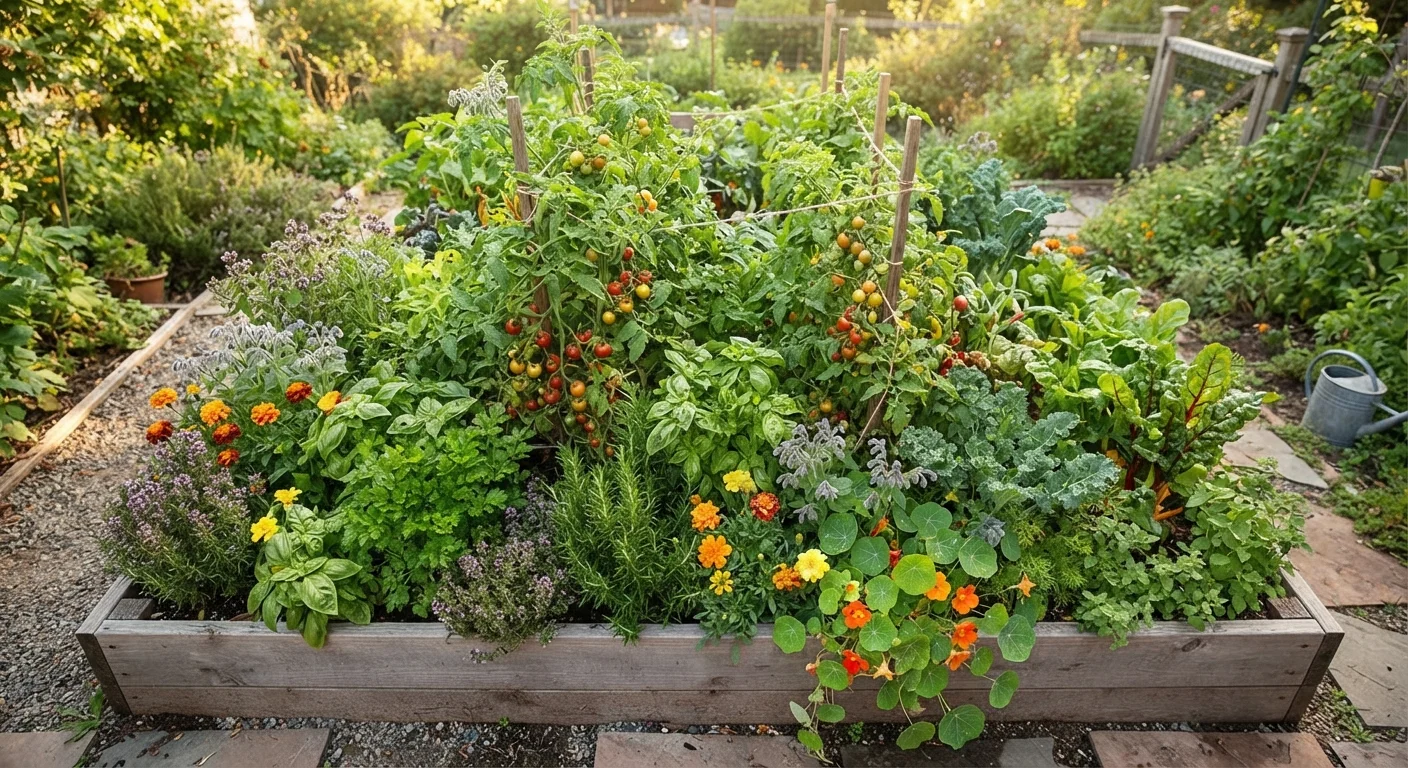
Why Gardeners Grow Plants Together Deliberately
Most gardening advice focuses on what individual plants need - sun exposure, soil type, watering frequency. Companion planting shifts the lens to ask a different question: what happens when plants interact with each other?
The idea is not simply about filling space. It's about designing a planting layout where species support one another's growth, defense, or productivity. If you're starting a vegetable garden from scratch, understanding companion planting early helps you make smarter layout decisions before seeds go in the ground.
Companion planting draws on both traditional agricultural knowledge - particularly from Indigenous farming systems - and an evolving body of horticultural research. Not every folk pairing holds up under scrutiny, but many underlying mechanisms are well understood and practically useful.
A Note on Evidence Quality
Companion planting research is an active but uneven field. Some pairings have been tested in replicated scientific trials; many others rest on generations of agricultural tradition that hasn't been formally studied. Where evidence is limited, treating a pairing as a low-risk experiment rather than a proven technique is the most honest approach. Results can also vary significantly by climate, soil type, and local pest populations.
The Four Main Mechanisms Behind Companion Planting
When companion planting works, it usually does so through one or more of these pathways:
- Pest deterrence: Aromatic plants like basil, rosemary, and certain marigold varieties emit compounds that can confuse or repel specific pest insects. The effect is real but often localized - one basil plant won't protect an entire bed.
- Pollinator attraction: Flowering companions draw bees and other beneficial insects, which improves pollination for nearby fruiting crops like squash and cucumbers.
- Nitrogen fixation: Legumes (beans, peas, clover) host bacteria in their root nodules that convert atmospheric nitrogen into a form plants can use. Grown near heavy feeders like corn or brassicas, they act as a slow-release soil amendment.
- Space and light optimization: Pairing tall plants with low-growing or shade-tolerant species allows more food or flowers to be produced from the same footprint.
Understanding which mechanism a pairing relies on helps you evaluate whether it's likely to work in your specific garden conditions. Soil chemistry also plays a role - companions sharing similar pH preferences will generally coexist more successfully.
Think in Guilds, Not Just Pairs
Rather than focusing on two-plant combinations, experienced companion gardeners often think in 'guilds' - clusters of three or more species that collectively cover different roles: one to fix nitrogen, one to attract pollinators, one to deter pests, and so on. This systems-level thinking produces more resilient beds than any single pairing can achieve alone.
Pairings With Strong Evidence Behind Them
While the companion planting literature contains a wide range of claims, a handful of combinations have accumulated meaningful support:
- The Three Sisters: Corn, Beans, and Squash
- Developed by Indigenous farmers of North America, this trio is one of the most studied examples of polyculture gardening. Corn provides a trellis for beans; beans fix nitrogen; squash's large leaves suppress weeds and retain soil moisture. Research supports multiple benefits of this system when properly spaced.
- Tomatoes and Basil
- Widely practiced and anecdotally popular, though formal evidence of growth benefits is limited. Basil may deter some aphids and thrips. The pairing also makes culinary sense - both plants thrive in similar warm, sunny conditions.
- Brassicas and Nasturtiums
- Nasturtiums are often used as a trap crop, attracting aphids away from cabbage, kale, and broccoli. This is a well-regarded strategy in integrated pest management, though it requires monitoring so the trap crop doesn't become overwhelmed.
- Carrots and Onions
- A traditional pairing where each is said to deter the other's primary pest - carrot fly and onion fly. Evidence is mixed, but the plants share compatible growing conditions and don't compete heavily for resources.
16-29%
Yield increase in Three Sisters polyculture systems
Research published in agricultural journals has found that traditional Three Sisters polycultures can outperform monoculture equivalents in land-use efficiency, with gains varying by site and management.
~40%
Reduction in aphid infestation with trap cropping
Studies on trap-cropping strategies, including nasturtiums alongside brassicas, have reported meaningful reductions in primary-crop aphid load compared to unprotected control plots, though results vary by context.
Plants That Don't Play Well Together
Companion planting isn't only about beneficial pairings - some plants actively suppress their neighbors through a process called allelopathy, in which a plant releases chemical compounds into the soil or air that inhibit germination or growth of nearby species.
Fennel is a notable example in the vegetable garden. It produces compounds that inhibit most common vegetables and herbs and is generally best grown in a dedicated spot away from the main bed. Black walnut trees present a more significant landscaping challenge - they release juglone, a compound toxic to many plants, making planting beneath or near them difficult.
Even without allelopathy, some combinations fail simply due to competition. Tall, fast-growing plants can shade out slower neighbors. Deep-rooted and shallow-rooted plants that overlap can compete for water and nutrients. If you're working with raised beds or in-ground plots, account for root depth and canopy spread before finalizing your layout.
Putting Companion Planting Into Practice
Start small and observe. Choose one or two well-supported pairings in your first season and note whether you see differences in pest pressure, yield, or plant vigor compared to previous years or isolated plants. Good record-keeping makes your garden more informative over time.
Companion planting also layers well with other soil-health practices. Healthy, well-amended soil supports all plants more effectively - see our guide to composting at home for a practical way to build soil quality alongside any planting strategy. For gardeners working with limited space, the space-efficiency benefits of companion planting are especially useful - our small-space growing guide covers how to make the most of a compact plot.
Think of companion planting as one layer of a broader approach rather than a standalone system. Combined with good soil management, appropriate watering, and crop rotation, thoughtful plant pairings can genuinely improve the productivity and resilience of your garden over time.
Frequently Asked Questions
Some pairings have solid scientific support - particularly nitrogen-fixing legumes near heavy feeders, and certain aromatic herbs that measurably reduce pest pressure. Others are based on gardener tradition with limited formal study. Treating companion planting as a useful tool rather than a guaranteed system gives the most realistic expectations.
The Three Sisters (corn, beans, squash) and tomatoes with basil are among the most commonly recommended starting points. Marigolds planted near vegetables are also widely used for their pest-deterring qualities, though results can vary by pest type and garden conditions.
Companion planting can meaningfully reduce pest pressure in some situations, but it rarely eliminates the need for other management strategies entirely. It works best as part of a broader integrated pest management approach that also includes healthy soil, crop rotation, and physical barriers where needed.
Yes. Fennel is notably incompatible with most garden vegetables and is generally best grown in isolation. Allelopathic plants like black walnut release chemicals that suppress neighboring plant growth. Some brassicas can also inhibit nearby plants - spacing and observation matter.
Absolutely. Companion planting doesn't override plants' basic needs for light, water, and root space. Crowding incompatible root systems or blocking light with a taller companion can cause more harm than benefit. Always account for each plant's mature size when planning.
The content provided on our blog site traverses numerous categories, offering readers valuable and practical information. Readers can use the editorial team’s research and data to gain more insights into their topics of interest. However, they are requested not to treat the articles as conclusive. The website team cannot be held responsible for differences in data or inaccuracies found across other platforms. Please also note that the site might also miss out on various schemes and offers available that the readers may find more beneficial than the ones we cover.