

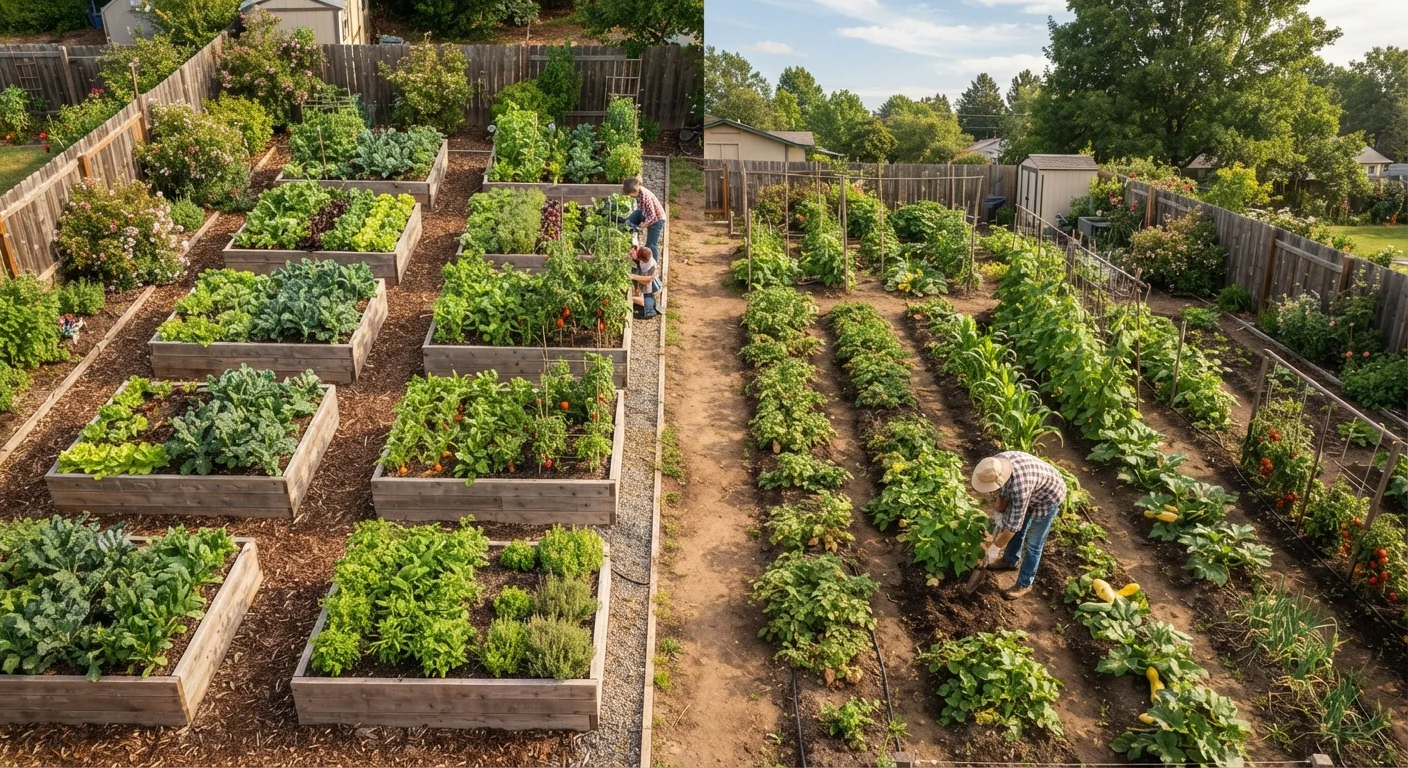
Option A
Raised Beds
The controlled, high-performance growing environment.
Best for: Gardeners with poor native soil, limited mobility, or small defined spaces who want fast results and precise growing conditions.
Option B
In-Ground Planting
The traditional, low-cost approach that works with your land.
Best for: Gardeners with decent existing soil and space who want to grow at scale without significant upfront investment.
The Core Differences at a Glance
Raised beds are contained growing areas - typically framed in wood, metal, or composite material - filled with imported or custom-blended soil. In-ground planting means cultivating directly in your existing garden soil, with preparation limited to digging, amending, and mulching.
The gap between the two isn't just aesthetic. It affects soil temperature, drainage, root depth, weed pressure, water demand, cost, and physical accessibility. Understanding those trade-offs lets you pick the method that fits your actual site rather than the one that looks good in garden media.
| Criterion | Raised Beds | In-Ground Planting |
|---|---|---|
| Upfront cost | Moderate to high (materials + fill) | Low (soil amendment only) |
| Soil control | Full - custom mix | Partial - amend native soil |
| Drainage | Excellent; can dry out fast | Variable; clay soils drain poorly |
| Spring warm-up | Faster - exposed on all sides | Slower - thermal mass of ground |
| Root depth potential | Limited to bed depth | Unrestricted access to subsoil |
| Weed pressure | Lower with quality fill | Higher from native seed bank |
| Water requirements | Higher - dries quickly | Lower in stable climates |
| Accessibility | High when built at working height | Low - requires bending/kneeling |
| Scalability | Limited by cost and space | Easily scaled to any plot size |
For gardens where soil quality is the biggest unknown, our guide to soil pH and nutrient availability is a useful companion - it applies to both methods.
Raised Beds: Strengths and Real Limitations
The main argument for raised beds is control. You choose exactly what goes into the growing medium - a blend of topsoil, compost, and amendments suited to your crops. That control is especially valuable where native ground is poorly draining, compacted, or has a history of chemical contamination (common on older urban lots).
Raised beds also warm faster in spring because the soil mass is exposed on all sides, giving cool-climate gardeners a longer effective growing window. Drainage is generally excellent, which suits root vegetables and Mediterranean herbs that dislike waterlogged roots.
The drawbacks are real, though. Frames and quality growing mix have upfront costs that scale quickly with bed size. Because drainage is efficient, beds dry out faster - in hot summers or dry climates, daily watering may be needed. Soil volume is fixed, which can limit deep-rooted crops like squash, parsnips, or corn unless beds are at least 12-18 inches deep.
12-18 in.
Minimum bed depth for most vegetable crops
Horticultural guidance generally recommends at least 12 inches of growing depth for root crops; shallower beds suit leafy greens and herbs.
2-3x
Yield increase potential with optimized soil
University extension research indicates intensive raised-bed systems can yield significantly more per square foot than unamended in-ground plots, depending on crop type and management.
~6 weeks
Earlier spring planting window in some climates
Raised beds in cooler US climates can be workable several weeks earlier than in-ground soil, which remains cold and waterlogged into late spring.
If accessibility or small-space growing is your driver, see growing food in tight spaces for container and raised-bed strategies suited to urban plots.
In-Ground Planting: Where It Excels and Where It Struggles
In-ground growing is the default for a reason: it costs almost nothing to start, scales to any plot size, and gives plant roots unrestricted downward access into the full soil profile. In regions with rich, loamy native soil, it can outperform raised beds with minimal amendment.
Deep-rooted crops - brassicas, squash, potatoes, sweet corn - often perform better in-ground because roots can chase moisture and nutrients well below the surface. In-ground beds also retain moisture more evenly during drought, which can reduce irrigation needs significantly in hot inland climates.
The limiting factor is soil quality. Clay-heavy or heavily compacted soil drains poorly, suffocates roots, and is exhausting to work. Sandy soils drain too fast and hold few nutrients. Both require sustained amendment programs before they approach the performance of a freshly built raised bed. Weed pressure is typically higher in-ground too, since the disturbed soil brings dormant weed seeds to the surface.
For a method that builds in-ground soil health without repeated digging, no-dig gardening offers a complementary approach worth understanding before you commit to a method.
Choosing Based on Your Specific Situation
Neither method is universally superior - the better choice depends on the combination of your soil, climate, space, physical ability, budget, and goals.
- Poor or unknown soil quality: Raised beds bypass the problem cleanly. If you're gardening on an old lawn, builder's fill, or a property with unknown use history, importing your growing mix is far more predictable than trying to rehabilitate what's there.
- Large growing area on a budget: In-ground wins on cost per square foot. Amending with compost over several seasons is slower but far less expensive than building and filling multiple frames.
- Physical comfort and accessibility: Raised beds built at counter height (24-30 inches) make gardening feasible for people who cannot work at ground level comfortably.
- Crop type: Compact crops - lettuce, herbs, tomatoes, radishes, beans - suit raised beds well. Sprawling or deep-rooted crops often perform just as well or better in-ground.
Many experienced gardeners use both: raised beds for intensively managed edible crops and in-ground beds for perennials, larger vegetables, or ornamental plantings. For ideas on how edible growing areas can integrate with broader garden design, see designing an outdoor living area for layout principles that work alongside productive planting zones.
Combining Both Methods Is Common Practice
Many home gardeners find that a hybrid approach works best: raised beds for intensively managed edibles and in-ground areas for perennials, fruit trees, or larger sprawling crops. There's no rule that says you must pick one. Matching the method to the specific plant, location, and maintenance capacity usually produces better results than a single-system approach across the whole garden.
The content provided on our blog site traverses numerous categories, offering readers valuable and practical information. Readers can use the editorial team’s research and data to gain more insights into their topics of interest. However, they are requested not to treat the articles as conclusive. The website team cannot be held responsible for differences in data or inaccuracies found across other platforms. Please also note that the site might also miss out on various schemes and offers available that the readers may find more beneficial than the ones we cover.