

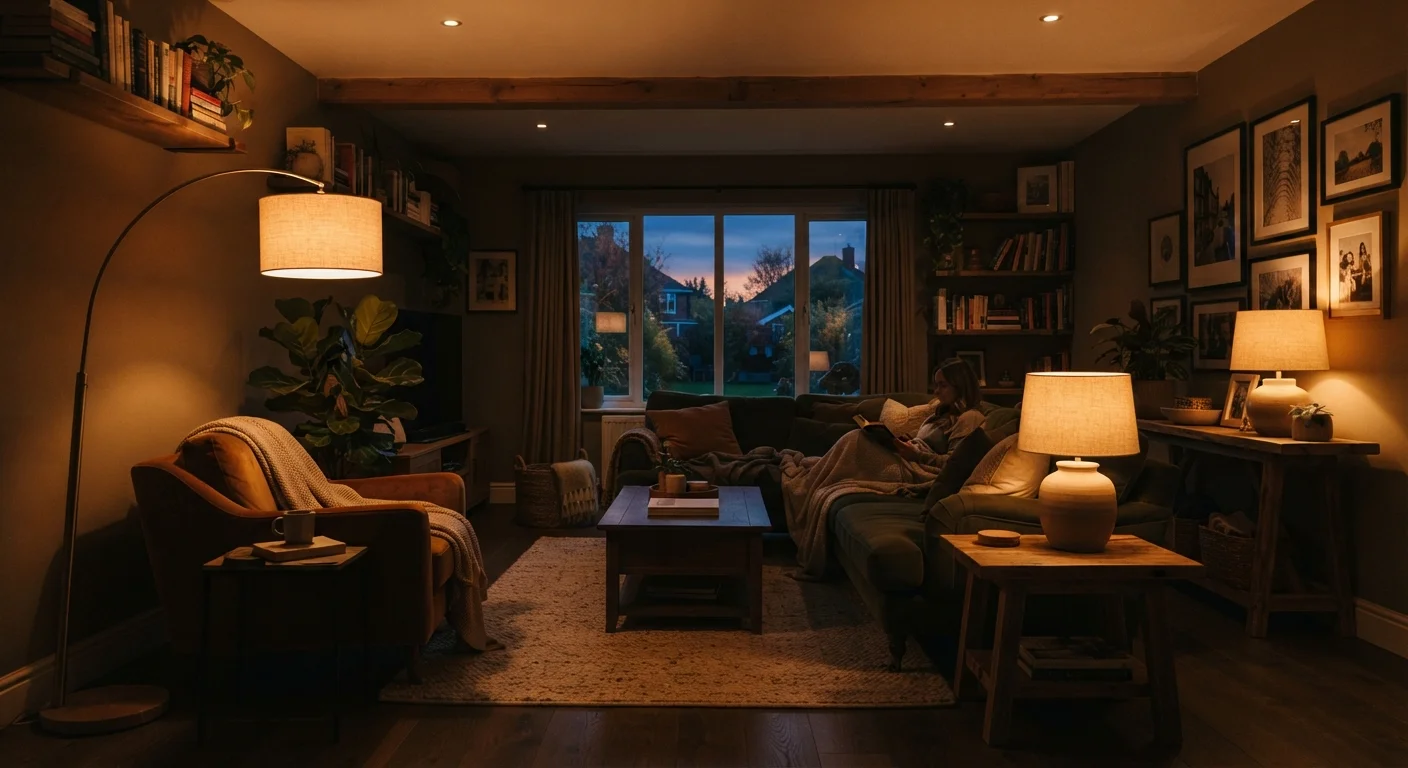
Why Overhead Lighting Alone Falls Short
Most homes default to a single ceiling fixture per room - and that habit works against you once the sun goes down. Overhead lighting casts downward shadows that flatten faces and surfaces, eliminates the sense of depth that makes a room feel layered, and tends to create a stark, institutional quality that fights against relaxation.
The problem isn't brightness itself. It's the absence of variety. A room lit entirely from one source and one direction is a room that feels finished but not designed. Compare that to a well-lit restaurant or a comfortable hotel lobby: multiple light sources at different heights, warm pools of glow, shadows that give objects their form. That quality is replicable at home, and it starts with understanding why single-source lighting fails.
To understand how light interacts with your color choices, see our guide to warm and cool color palettes - the relationship between light color and wall color is tightly connected.
The Three-Layer Framework Every Room Needs
Lighting designers typically organize a room's illumination into three functional layers. Understanding each one helps you make deliberate choices rather than reactive ones.
Ambient Lighting
This is your base layer - the general illumination that replaces daylight. Ceiling fixtures, recessed downlights, and pendant lights all contribute to ambient light. The key upgrade here is dimming: a dimmer switch on your ambient source lets you shift from task-ready brightness to evening softness without changing a single bulb.
Task Lighting
Task lighting is focused and functional - reading lamps beside a sofa, under-cabinet strips in a kitchen, a well-positioned desk lamp. It prevents eye strain by directing light exactly where work happens, rather than forcing overhead fixtures to compensate.
Accent Lighting
Accent lighting is what moves a room from functional to atmospheric. Wall sconces, picture lights, LED strip lighting behind furniture, and table lamps placed in corners all count. Accent sources draw the eye, create visual interest, and break up flat walls. They're especially effective in rooms with darker paint colors, where they add warmth without fighting the depth of the wall.
Install dimmer switches on your primary ambient light sources.
Fixed-brightness overhead lights force you to choose between too bright and no light at all. Dimmers give you a continuous range, letting the same fixture serve daytime tasks and evening relaxation. They're among the most affordable electrical upgrades a homeowner can make, though any wiring work should be done by a qualified electrician.
Add at least one light source below eye level in every main living space.
Most homes light from above, which creates a ceiling-down effect that feels flat and somewhat clinical. Introducing a floor lamp, low table lamp, or even LED strips behind a media console shifts the room's visual center of gravity and creates more natural-feeling pools of light.
Match bulb color temperature to the room's purpose and time of use.
Cool light (4000K+) promotes alertness, which helps in kitchens and workspaces during the day but works against relaxation in the evening. Warm bulbs (2700K-3000K) create a cozier, more restful environment that suits living rooms and bedrooms after dark.
Use accent lighting to highlight architecture or objects, not just to fill space.
Accent lighting that points at something - a piece of art, a textured wall, a bookcase - does double duty. It adds visual interest and makes the room feel more considered. Undirected accent lights can muddy a space; intentional placement is what separates atmosphere from clutter.
Vary the height of your light sources throughout the room.
Light at only one height - whether high or low - creates a monotonous visual plane. Combining ceiling fixtures, mid-height sconces or table lamps, and low floor lamps creates visual rhythm and makes a room feel more fully inhabited.
Color Temperature: The Detail Most People Overlook
Bulb brightness (measured in lumens) gets most of the attention, but color temperature - measured in Kelvin (K) - has an equally powerful effect on how a room feels. Bulbs in the 2700K-3000K range produce warm, amber-tinted light associated with relaxation and intimacy. Bulbs above 4000K shift toward cool, blue-white light that signals alertness and activity.
For living rooms, bedrooms, and dining areas, stick to the warmer end of that range after dark. Kitchens and home offices can tolerate slightly cooler temperatures during working hours, but consider warmer alternatives for evening use. Research on light and circadian rhythm suggests that blue-rich light in the evening can interfere with the body's wind-down process - something worth factoring into bedroom and common area choices. For more on how lighting affects sleep, our overview of sleep and mood covers the underlying science.
A Simple Rule for Bulb Shopping
When selecting bulbs for living spaces and bedrooms, look for a color temperature of 2700K to 3000K on the packaging. This range is commonly labeled 'soft white' or 'warm white' and produces light closest to traditional incandescent bulbs. Avoid anything labeled 'daylight' (5000K-6500K) in rooms where you want to unwind after dark.
Quick Wins and Practical Next Steps
You don't need to rewire your home to see a meaningful difference. Many of the most impactful lighting changes involve repositioning existing lamps, swapping bulbs, or adding a single new source in a neglected corner.
For outdoor extensions of these principles - where layered lighting matters just as much for ambiance and safety - the same three-layer approach applies. Our guide to outdoor living areas covers how lighting integrates into patio and deck design. And if you're exploring how texture and material choices interact with your lighting plan, layering textiles and texture is a natural next step.
The content provided on our blog site traverses numerous categories, offering readers valuable and practical information. Readers can use the editorial team’s research and data to gain more insights into their topics of interest. However, they are requested not to treat the articles as conclusive. The website team cannot be held responsible for differences in data or inaccuracies found across other platforms. Please also note that the site might also miss out on various schemes and offers available that the readers may find more beneficial than the ones we cover.