

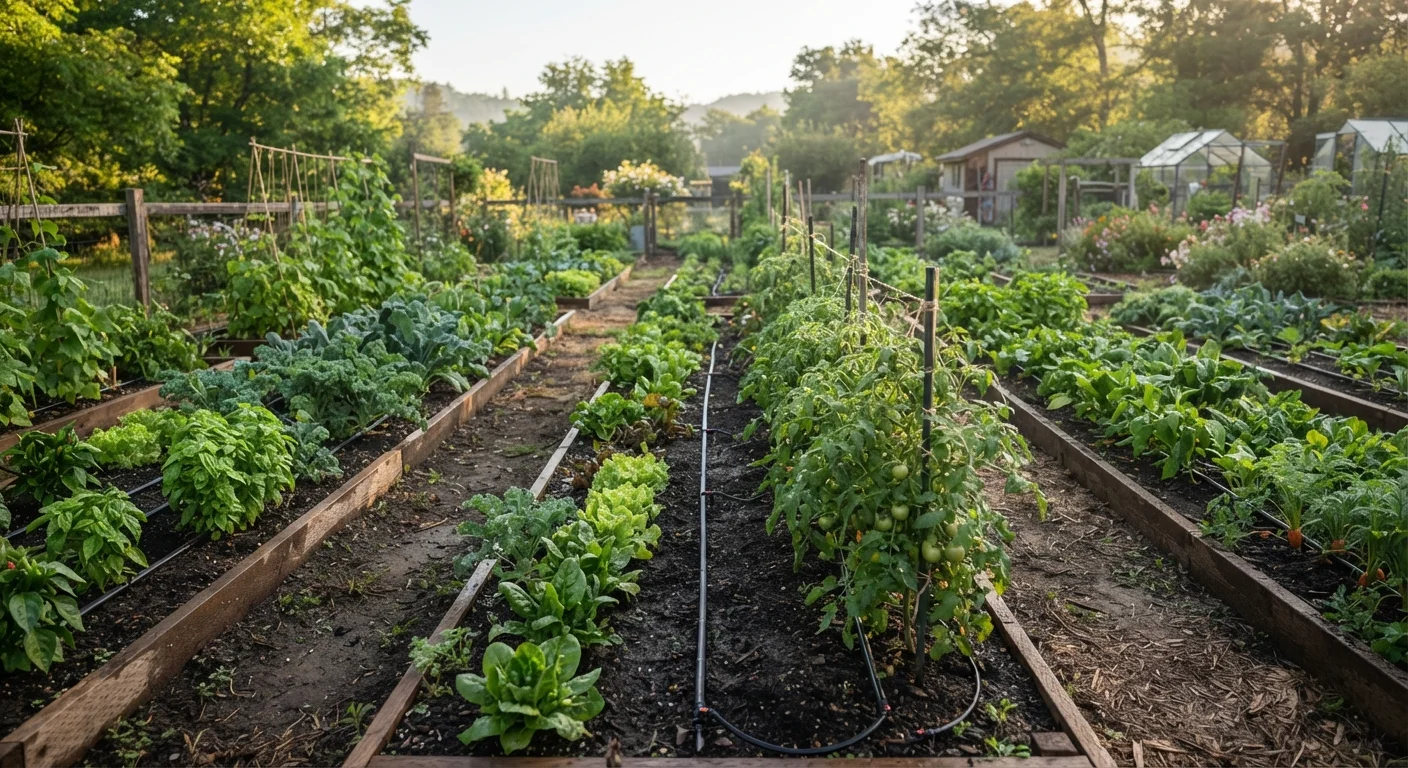
The Four Core Watering Methods
Every garden watering approach involves a trade-off between precision, cost, convenience, and water efficiency. Understanding each method at a basic level makes it easier to match your technique to your plants, layout, and schedule. Whether you're managing a raised bed, an in-ground border, or a container collection, one of the four methods below is likely the right fit - or a combination of them.
For a deeper look at how your bed type affects irrigation needs, see our guide on raised beds vs. in-ground planting.
Drip Irrigation
Drip irrigation delivers water slowly and directly to the root zone through a network of tubes and emitters. Water seeps into the soil at a controlled rate, minimizing runoff and surface evaporation.
- Best for: Vegetable gardens, fruit trees, shrub borders, and any planting where consistent deep moisture is important.
- Water efficiency: High - water goes exactly where roots need it, with little lost to evaporation or wind drift.
- Setup effort: Moderate to high - requires planning emitter placement and regular maintenance to clear clogged lines.
- Key limitation: Upfront installation cost; above-ground lines can be displaced by garden activity or wildlife.
Drip systems pair well with timers, making them a strong option for gardeners who travel or want to automate watering schedules.
Soaker Hoses
Soaker hoses are porous tubes that "weep" water along their entire length. Laid at the base of plants or buried shallowly under mulch, they provide slow, steady delivery directly to the soil surface and root zone.
- Best for: Row crops, densely planted beds, and established perennial borders.
- Water efficiency: High when combined with mulch, which further reduces evaporation.
- Setup effort: Low to moderate - flexible hoses are easy to lay and reposition.
- Key limitation: Uneven water distribution over long runs; hoses can degrade faster in intense UV exposure.
Soaker hoses are often an affordable entry point into low-pressure, targeted irrigation. They work especially well in no-dig garden beds, where surface disturbance should be minimal.
Sprinklers
Sprinkler systems - whether fixed, oscillating, or in-ground - broadcast water over a wide area by spraying it into the air. They mimic rainfall and cover large zones efficiently.
- Best for: Lawns, large open beds, and groundcovers where broad, even coverage matters more than pinpoint delivery.
- Water efficiency: Lower than drip or soaker methods; wind, heat, and leaf interception increase losses.
- Setup effort: Low for portable units; high for in-ground systems that require professional installation and permitting.
- Key limitation: Wet foliage can encourage fungal disease; poor timing (evening watering) compounds the risk.
Morning watering is generally recommended with sprinklers so foliage dries before temperatures drop. If you rely on sprinklers, be alert to signs of overwatering, which can develop quickly in dense or clay-heavy soils.
Check Local Water Use Rules Before Installing
Many US municipalities have irrigation ordinances, watering-day restrictions, or backflow-preventer requirements for in-ground systems. Before installing any fixed sprinkler system, contact your local water utility or building department to understand what permits or inspections may apply. Regulations vary widely by region and can change during drought conditions.
Hand Watering
Hand watering - using a watering can or a hose with a wand - gives the gardener the most direct control over where, when, and how much water each plant receives.
- Best for: Containers, seedlings, transplants, and plants with specific individual needs.
- Water efficiency: Variable - attentive hand watering can be highly efficient; rushed watering is often not.
- Setup effort: None - no equipment beyond a hose or can.
- Key limitation: Time-intensive and inconsistent for large gardens; relies entirely on the gardener's availability and judgment.
Hand watering remains invaluable even in gardens with automated systems - for nursing new plants, spot-treating dry areas, or watering during system maintenance. It also keeps you closely observant of your plants, which helps catch early signs of stress or disease.
Whatever methods you combine, pairing them with appropriate plant choices keeps the workload manageable. Low-maintenance perennials often have moderate, predictable water needs that suit soaker hoses or drip irrigation well.
Emitter
A small fitting attached to drip irrigation tubing that controls the flow rate of water delivered to each plant. Emitters are rated by gallons per hour (GPH) and can be selected to match a plant's moisture needs.
Root zone
The area of soil where a plant's active roots absorb water and nutrients. Targeting this zone directly - rather than the surface or foliage - is the goal of both drip and soaker-hose systems.
Soaker hose
A porous rubber or recycled-material hose that releases water slowly along its entire length. It is designed to be laid along planting rows rather than overhead.
Backflow preventer
A device installed between an outdoor spigot and an irrigation system to stop contaminated water from flowing back into the household water supply. Many local codes require one on any in-ground irrigation connection.
Mulch
A layer of material - such as wood chips, straw, or shredded leaves - spread over soil to slow evaporation, regulate temperature, and suppress weeds. Mulch significantly increases the effectiveness of soaker hoses and drip lines.
The content provided on our blog site traverses numerous categories, offering readers valuable and practical information. Readers can use the editorial team’s research and data to gain more insights into their topics of interest. However, they are requested not to treat the articles as conclusive. The website team cannot be held responsible for differences in data or inaccuracies found across other platforms. Please also note that the site might also miss out on various schemes and offers available that the readers may find more beneficial than the ones we cover.