

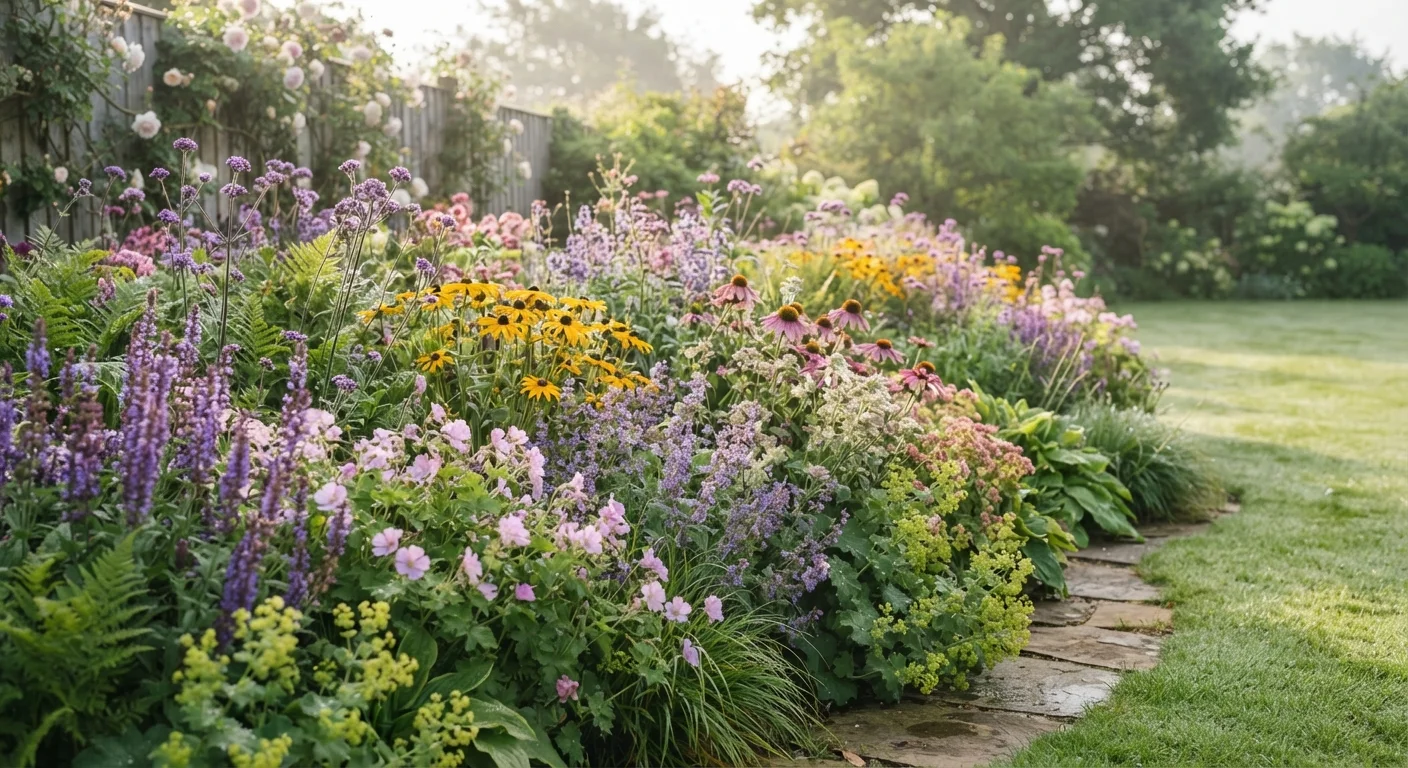
Why Perennials Make Sense for the Everyday Gardener
Annual plants deliver immediate color but require replanting every season - a recurring investment of time, money, and effort. Perennials, by contrast, establish their root systems in the first year and return reliably each spring, often expanding into fuller, more resilient clumps over time. For gardeners who want beauty without constant intervention, they represent a strong foundation.
The key is choosing plants suited to your specific conditions. Before selecting any perennial, it's worth understanding your USDA Plant Hardiness Zone - the standard measure of average annual minimum winter temperatures that tells you which plants are likely to survive your winters. Learn how hardiness zones work before committing to new plants, as a mismatch in zone rating is one of the most common reasons perennials fail to return.
The perennials below are recognized for their adaptability, resilience, and relatively modest care requirements across a wide range of US growing conditions. None are entirely care-free - all living plants have needs - but these are among the most forgiving options available.
Coneflower (Echinacea purpurea)
One of the most adaptable native perennials in North American gardens, coneflower tolerates heat, drought, and a wide range of soil conditions once established. It thrives in full sun and produces daisy-like blooms with raised, spiky centers from midsummer into fall. The seed heads that follow are valuable food sources for finches, making it a genuine two-season plant.
Coneflower spreads gradually by self-seeding and occasional clump division, so a small initial planting can expand over years. It's reliably hardy from Zones 3-9, covering most of the continental US.
Coneflower tolerates heat, drought, and poor soils - few perennials are as genuinely forgiving.
Black-Eyed Susan (Rudbeckia hirta)
Black-eyed Susan is a cheerful, golden-flowered perennial (though some varieties behave as short-lived perennials or biennials) that naturalizes readily in sunny borders and meadow-style plantings. It tolerates clay, poor drainage, and dry spells that would stress less rugged plants. Bloom time typically runs from midsummer through early fall.
Because it self-seeds freely, it can fill in gaps in a planting over time. It's a strong choice for gardeners transitioning to a more naturalistic, low-intervention garden style.
Black-eyed Susan self-seeds freely, gradually filling garden gaps without any replanting effort.
Daylily (Hemerocallis spp.)
Despite the name, daylilies are not true lilies and are among the most unfussy perennials available. They adapt to nearly any well-drained soil, tolerate both sun and partial shade, and spread into dense, weed-suppressing clumps over time. Individual flowers last only one day, but healthy plants produce dozens of buds per stem across a multi-week bloom period.
Daylilies benefit from division every four to five years when clumps become congested and blooms diminish - a straightforward task that also gives you new plants for other parts of the garden.
Daylily clumps suppress weeds naturally, reducing the need for regular bed maintenance.
Salvia (Salvia nemorosa and related species)
Hardy salvias produce upright spikes of violet, blue, or pink flowers that are highly attractive to bees and butterflies. They prefer full sun and well-drained soil and have strong drought tolerance once established. Deadheading (removing spent flower spikes) often triggers a second flush of bloom later in the season.
Perennial salvias stay compact and tidy, rarely requiring staking or aggressive pruning. Most are hardy through Zone 4 or 5, and some selections extend into Zone 3 with adequate drainage.
Hardy salvias rebloom when deadheaded and rarely need staking, fitting naturally into low-effort borders.
Sedum / Stonecrop (Hylotelephium spp.)
Upright sedums - now reclassified under Hylotelephium in botanical literature, though often still sold as sedum - offer some of the best late-season color available in perennial gardening. Their flat-topped flower clusters open in shades of pink, rose, and burgundy from late summer into fall, and the dried seed heads persist attractively through winter, providing structure and wildlife habitat.
These plants excel in poor, dry soils where more demanding perennials struggle. Excellent drainage is their main requirement. They are a natural fit for no-dig garden beds built over free-draining ground.
Sedums thrive in poor, dry soil and deliver ornamental interest from late summer well into winter.
Russian Sage (Perovskia atriplicifolia)
Russian sage is not a true sage but earns its place in any low-maintenance border through sheer staying power. Its silver-gray stems and airy lavender-blue flower spikes persist for months, tolerating intense heat, drought, and wind without complaint. It performs best in full sun and sharply drained soil - waterlogged conditions in winter are its main vulnerability.
Pruning is simple: cut stems back hard in early spring before new growth emerges. Beyond that, it asks for very little. Hardy from Zones 4-9, it works across a broad geographic range.
Russian sage handles heat, drought, and wind for months - a genuinely resilient border plant.
Building a Garden That Works for You
Once you have a few dependable perennials established, you can layer them thoughtfully to extend your garden's season. Consider pairing early bloomers like coneflowers with late-season performers like black-eyed Susans so something is always in flower from late spring through fall. Companion planting principles can also help - some perennials actively support their neighbors by deterring pests or improving soil conditions.
Dividing Perennials Extends Their Life
Most perennials benefit from being divided every three to five years, typically in early spring or fall. Division refreshes the plant's vigor, prevents overcrowding, and gives you additional plants at no cost. Use a garden fork to lift the clump, split it into sections with healthy roots and shoots, and replant immediately. Water thoroughly after replanting and keep the soil consistently moist for the first few weeks. Understanding when to cut back applies to perennials too - timing matters.
Watering strategy matters most in the establishment year. Once roots are settled - typically after the first full growing season - most of the perennials listed here are considerably more drought-tolerant. Review efficient watering methods to make the most of that critical first season without overwatering, which can be just as damaging as drought for many of these species.
At the end of the growing season, a light tidy-up is all most perennials need. A seasonal winter prep checklist can walk you through what to cut back, what to leave standing for wildlife, and how to protect more tender crowns before the first hard frost.
The content provided on our blog site traverses numerous categories, offering readers valuable and practical information. Readers can use the editorial team’s research and data to gain more insights into their topics of interest. However, they are requested not to treat the articles as conclusive. The website team cannot be held responsible for differences in data or inaccuracies found across other platforms. Please also note that the site might also miss out on various schemes and offers available that the readers may find more beneficial than the ones we cover.