

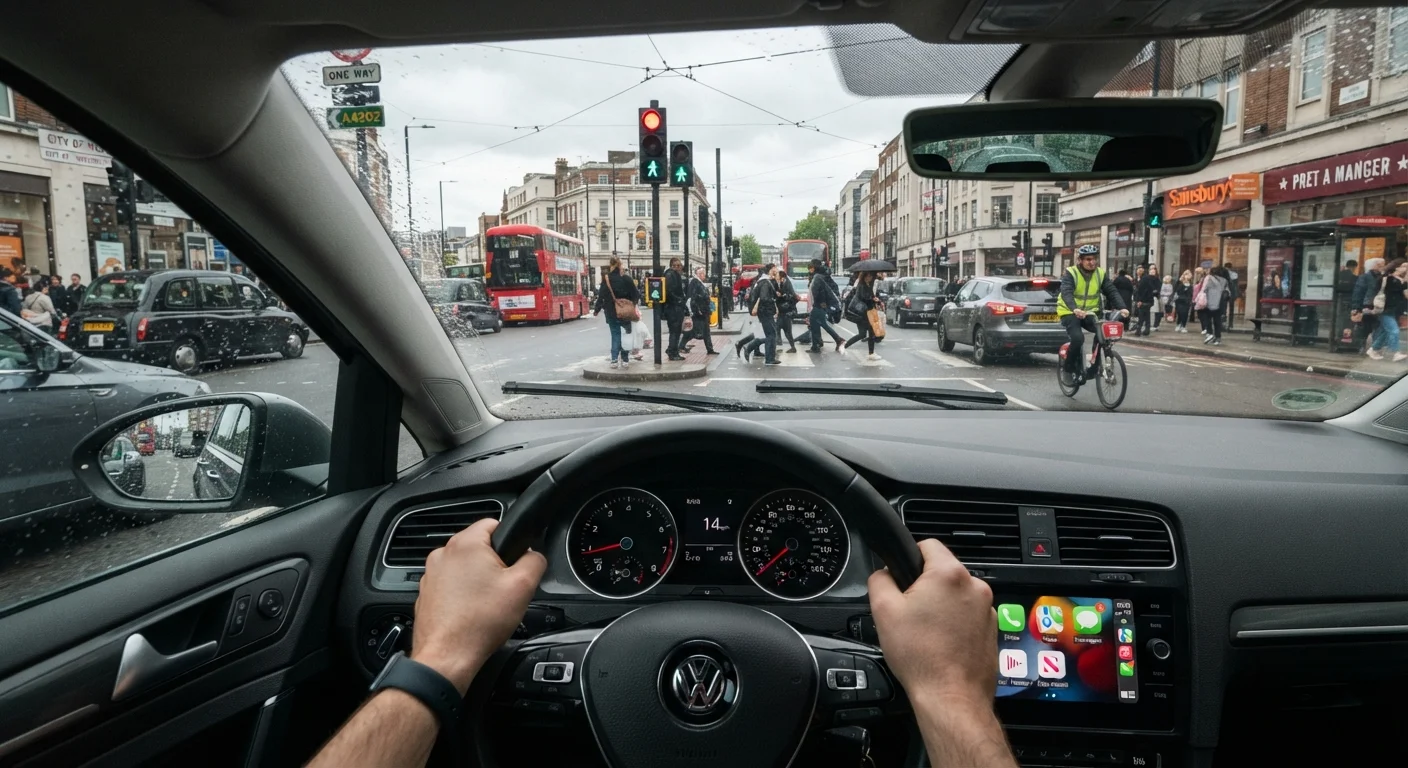
Reaction vs. Anticipation: Why the Difference Matters
Most drivers believe they're safe because they react quickly. But reaction time only kicks in after a hazard has already materialized - and by that point, your options are limited. The drivers who consistently avoid collisions are the ones who spotted the potential hazard several seconds earlier and had already begun adjusting.
Hazard perception is the ability to read developing situations and predict where danger might come from. It's a cognitive skill as much as a physical one, and it improves with deliberate practice rather than simply logging more miles. Driving the same commute for years doesn't automatically sharpen your hazard awareness - it often dulls it, because familiarity breeds inattention.
This distinction matters because it changes how you approach every trip. A reactive driver waits to see what happens. An anticipatory driver is already asking: what could go wrong here, and what would I do if it did? That mental posture is what separates cautious drivers from drivers who just haven't had an accident yet. For a broader framework on this mindset, see our complete guide to defensive driving.
How Experienced Drivers Read the Road
One of the clearest markers of driving experience is where a driver looks. Novice drivers tend to focus on what's directly in front of them. Experienced drivers scan further ahead - reading the horizon, watching the gaps between vehicles, noticing where sightlines are blocked, and tracking the body language of pedestrians who might step off a curb.
~94%
Crashes involving human choice or error
According to the National Highway Traffic Safety Administration (NHTSA), approximately 94% of serious crashes involve a critical human factor - decisions, recognition failures, or performance errors.
1.5 sec
Average driver perception-reaction time
Transport research commonly cites 1.5 seconds as a typical perception-reaction time; at 60 mph this translates to around 132 feet traveled before braking even begins.
Key cues that experienced drivers track include:
- Parked vehicles: A car with its wheels turned toward traffic may be about to pull out. Children near parked cars are a sign someone could run into the road.
- Road geometry: A blind bend or crest means you can't see what's coming - slow down before you need to, not after.
- Other drivers' behaviour: Brake lights three or four cars ahead signal something you can't see yet. A driver drifting in their lane may be distracted.
- Environmental conditions: Wet roads, low sun, and frost all change the hazard landscape. Our piece on wet weather driving myths explains how rain specifically affects what you need to watch for.
Reading these cues isn't a natural talent - it's a trained habit. You can start building it by narrating your observations aloud as you drive, a technique known as commentary driving.
Best Practices for Sharpening Hazard Perception
Improving hazard perception requires moving from passive driving to active observation. The following practices give you a structured way to do that.
Scan at least 12 seconds ahead, not just the vehicle in front
Focusing only on the car ahead gives you a fraction of a second to respond to anything beyond it. Scanning further forward gives your brain time to process, predict, and plan. It also naturally smooths out braking and acceleration, reducing fatigue.
Identify an escape route before you might need one
When a hazard develops suddenly, drivers who haven't thought ahead tend to brake and freeze. Knowing where you'd go - a shoulder, a gap, an adjacent lane - means you act rather than react. This habit takes seconds per situation but can be decisive.
Treat unfamiliar roads with heightened alertness, not the same habits as your commute
Routine breeds complacency. Familiar roads account for a disproportionate share of collisions precisely because drivers lower their guard. Unknown roads force active attention; familiar ones require you to consciously maintain it.
Watch for behavioural cues from other road users, not just their position
Where a vehicle or pedestrian is right now tells you less than what they appear to be about to do. Posture, speed changes, and vehicle orientation are early signals that give you more time to respond than waiting for movement to confirm your suspicion.
Adjust your following distance to preserve your sightlines
Driving too close to the vehicle ahead limits what you can see beyond it. A larger gap doesn't just improve stopping distance - it opens up your field of view, so you can see brake lights, road conditions, and hazards several vehicles ahead.
Try Commentary Driving at Low Stakes First
Commentary driving - narrating what you observe as you drive - is a technique used in professional driver training to build active scanning habits. Start on a quiet, familiar road where you can focus on the narration without pressure. Over time, the observations that once required conscious effort will become automatic. It feels awkward at first; that's normal and it means it's working.
Quick Wins You Can Apply on Your Next Drive
You don't need a formal driving course to start improving. These small adjustments deliver real benefits from the moment you apply them.
If you'd like to extend these habits to more demanding environments, our guide on motorway driving confidence covers how hazard perception applies at higher speeds. And since reduced visibility amplifies every risk, it's also worth reading about what safe night driving actually requires.
Overconfidence Can Undermine These Habits
Hazard perception skills can erode if a driver becomes overconfident in their own awareness. Research consistently shows that drivers who consider themselves above average are often less vigilant, not more. Our related piece on overconfidence behind the wheel explores how this bias develops and how to check for it honestly.
The content provided on our blog site traverses numerous categories, offering readers valuable and practical information. Readers can use the editorial team’s research and data to gain more insights into their topics of interest. However, they are requested not to treat the articles as conclusive. The website team cannot be held responsible for differences in data or inaccuracies found across other platforms. Please also note that the site might also miss out on various schemes and offers available that the readers may find more beneficial than the ones we cover.