

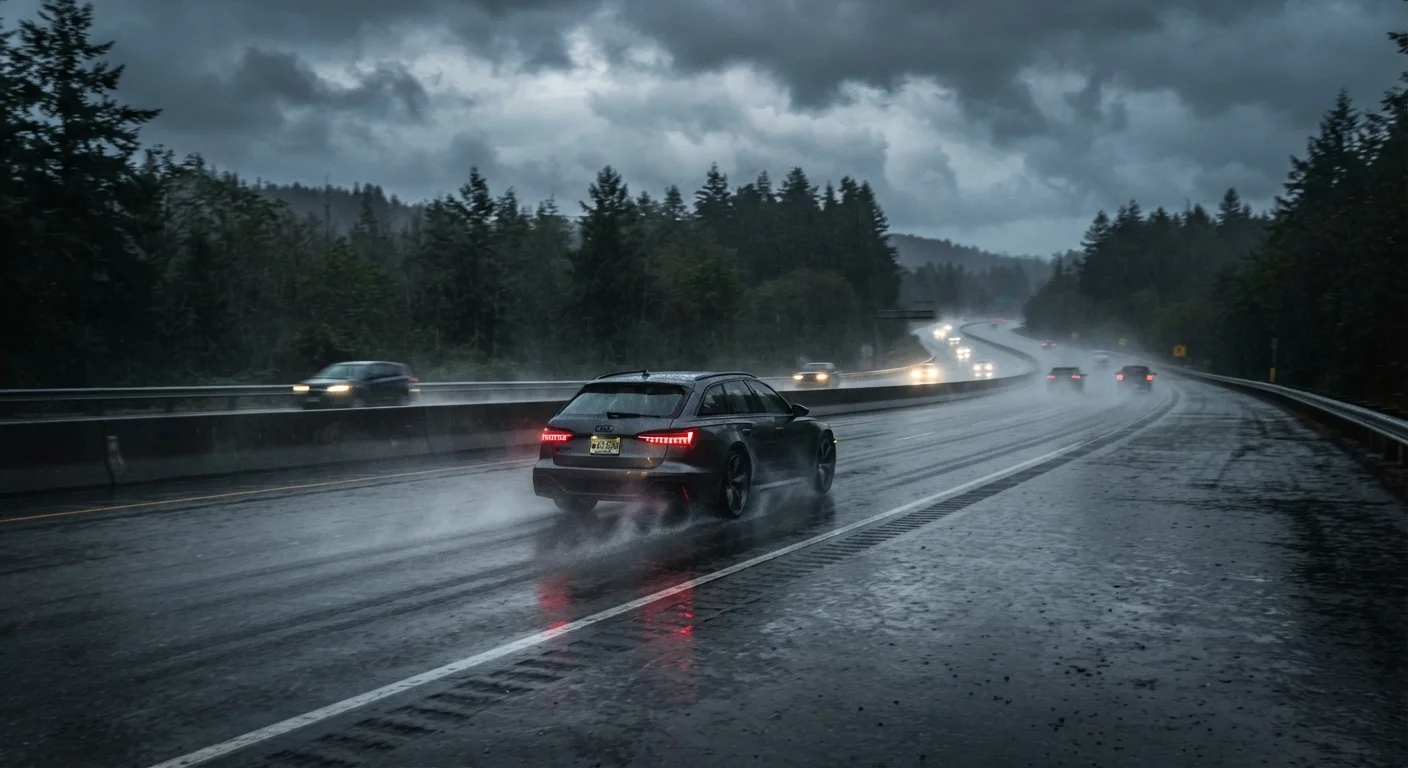
Why Rain Exposes the Gaps in What Drivers Think They Know
Most drivers have logged hours in wet conditions without incident, and that familiarity breeds a quiet confidence that isn't always warranted. Rain changes the physics of driving in fundamental ways - longer stopping distances, reduced tire grip, reduced visibility - but many of the habits drivers rely on are built around myths rather than evidence.
This isn't just an issue for new drivers. Experienced drivers carry their own set of firmly held beliefs that can be just as dangerous. As our colleagues have noted in pieces on car ownership myths, confidence and experience do not always translate into accuracy. The same pattern shows up behind the wheel in the rain.
Below, we address the most widely repeated wet-weather driving myths - and what the evidence actually shows.
Myth
All-wheel drive (AWD) keeps you safe in the rain, so you can drive normally.
Fact
AWD improves your ability to accelerate and maintain traction, but it does not significantly shorten your braking distance on wet roads.
All-wheel drive distributes engine power to all four wheels, which helps you pull away from stops and hold traction on slick surfaces. However, braking performance depends on tires and the road surface - not on how many wheels are driven. An AWD vehicle with worn tires will stop no faster than a front-wheel-drive car with the same tires. Drivers who overestimate AWD capability tend to maintain higher speeds in wet conditions, which increases collision risk. The same care around speed and following distance applies regardless of your drivetrain configuration.
Myth
Turning on your hazard lights in heavy rain makes you safer and more visible.
Fact
Using hazard lights while a vehicle is moving in rain can actually mislead other drivers about your intentions and may be illegal in some U.S. states.
Hazard lights are designed to signal a stationary or disabled vehicle. When a moving vehicle runs hazard lights in rain, it disables the turn signals - meaning other drivers cannot tell when you intend to change lanes or turn. It can also cause confusion about whether you're stopped or moving. Many drivers adopt the habit believing it increases visibility, but traffic safety guidance generally advises against using hazards while moving. If visibility is so poor that you feel you need hazards, the safer response is to reduce speed and, if necessary, exit the road and wait safely. Check your state's specific rules, as regulations vary.
Myth
A little rain barely affects stopping distances - real danger only comes in heavy downpours.
Fact
Even light rain dramatically increases stopping distances; a wet road can more than double the distance needed to stop compared to a dry one.
Water acts as a lubricant between tire rubber and asphalt, reducing friction significantly. General road safety guidance from organizations such as the NHTSA consistently notes that wet conditions require substantially longer following distances. Critically, the first 20-30 minutes of a rain shower after a long dry spell can be particularly treacherous: accumulated oil and dust mix with fresh rain to form an especially slick surface before it washes away. Maintaining greater following distance from the outset - not just in a downpour - is the practical response.
Myth
As long as you slow down a little, your regular driving habits are fine in the rain.
Fact
Safe wet-weather driving requires active adjustments to speed, following distance, steering inputs, and braking technique - not just a minor speed reduction.
Wet roads demand a broader set of behavioral changes. Sharp steering inputs can cause skids; braking hard into a corner on a wet surface can overwhelm a tire's grip well below the speed it would on a dry road. Smooth, gradual inputs - for acceleration, steering, and braking - give tires the best chance of maintaining contact with the road. Drivers should also watch for standing water that can trigger aquaplaning (also called hydroplaning), where the tire rides on a film of water and loses contact with the road surface entirely. If you feel aquaplaning begin, ease off the accelerator gradually and steer straight until grip returns. Do not brake sharply.
Myth
Newer cars have so many safety features that rain is much less of a concern than it used to be.
Fact
Electronic safety aids like ABS and stability control help in specific scenarios but cannot fully compensate for excessive speed or poor tire condition on wet roads.
Anti-lock braking systems (ABS) prevent wheel lockup, and electronic stability control can help correct a skid - but both work within physical limits. They cannot generate grip that simply isn't there. Tire tread depth is especially critical in wet conditions: tread channels are designed to evacuate water from under the contact patch. Worn tires lose this capability rapidly. Technology makes errors more survivable in some cases, but it is not a substitute for appropriate speed, tire maintenance, and driver attention. For more on tire and vehicle upkeep, see the Car Maintenance hub.
Putting Wet-Weather Knowledge Into Practice
Knowing the myths is only half the work. The other half is building habits that hold up when conditions deteriorate quickly. A few principles apply consistently:
- Increase following distance significantly. The standard three-second rule for dry conditions is generally insufficient in rain. Consider doubling it.
- Check your tires regularly. Tread depth and tire pressure both affect wet-road performance. The tire pressure warning light is worth taking seriously before any long drive, but a physical tread check is more reliable still. See more on vehicle upkeep at the Car Maintenance hub.
- Smooth inputs matter more than speed alone. Gradual braking, gentle steering, and measured acceleration all help maintain tire contact with the road surface.
Wet-weather driving also rewards the kind of forward thinking that separates cautious drivers from reactive ones - scanning further ahead, anticipating where water is likely to pool, and identifying potential hazards before they become emergencies. The hazard perception guide explores those skills in depth. And if you find yourself on the road after dark in rain, the challenges compound - see night driving safety for guidance specific to low-visibility conditions.
Worn Tires Undermine Every Other Precaution
No amount of careful driving fully compensates for tires that cannot effectively channel water away from the contact patch. Tread depth below 2/32 of an inch is the legal minimum in most U.S. states, but wet-road performance degrades noticeably before that point. If you notice your vehicle feeling loose or slow to respond in rain, have your tires inspected by a qualified mechanic promptly. This is not a maintenance item to defer.
The content provided on our blog site traverses numerous categories, offering readers valuable and practical information. Readers can use the editorial team’s research and data to gain more insights into their topics of interest. However, they are requested not to treat the articles as conclusive. The website team cannot be held responsible for differences in data or inaccuracies found across other platforms. Please also note that the site might also miss out on various schemes and offers available that the readers may find more beneficial than the ones we cover.