

Why a Basic Cage Falls Short
Walk into most pet stores and you'll find rabbit cages marketed with cheerful packaging - but the footprint of many of them would barely allow a medium-sized rabbit to turn around comfortably. The gap between what's commonly sold and what rabbits actually need is significant, and it affects both physical health and quality of life.
Rabbits are built to move. In the wild, European rabbits (the ancestors of most domestic breeds) can cover several miles in a single day. Their musculoskeletal system, digestive function, and emotional wellbeing are all tied to regular, sustained movement. A rabbit that spends the majority of its time in a small enclosure is at real risk of muscle atrophy, gastrointestinal slowdown, obesity, and chronic stress.
If you're evaluating your current setup - or planning ahead - our practical rabbit preparation checklist can help you cover the essentials before your rabbit arrives.
8 sq ft
Minimum recommended enclosure space
The House Rabbit Society recommends at least 8 square feet of living space as a baseline for a single rabbit, separate from exercise area.
24 sq ft
Minimum daily exercise area needed
Most rabbit welfare organizations recommend rabbits have access to at least 24 square feet of exercise space for several hours each day.
70%+
Of diet that should be hay
Veterinary guidance consistently indicates that hay should make up the majority of a rabbit's daily diet, supporting both digestive and dental health.
Space Requirements: The Real Numbers
Welfare organizations including the House Rabbit Society generally recommend at minimum 8 square feet of enclosure space combined with at least 24 square feet of supervised daily exercise area. For context, that exercise space is roughly the size of a small bathroom - and it should be available for several hours every day, not just on weekends.
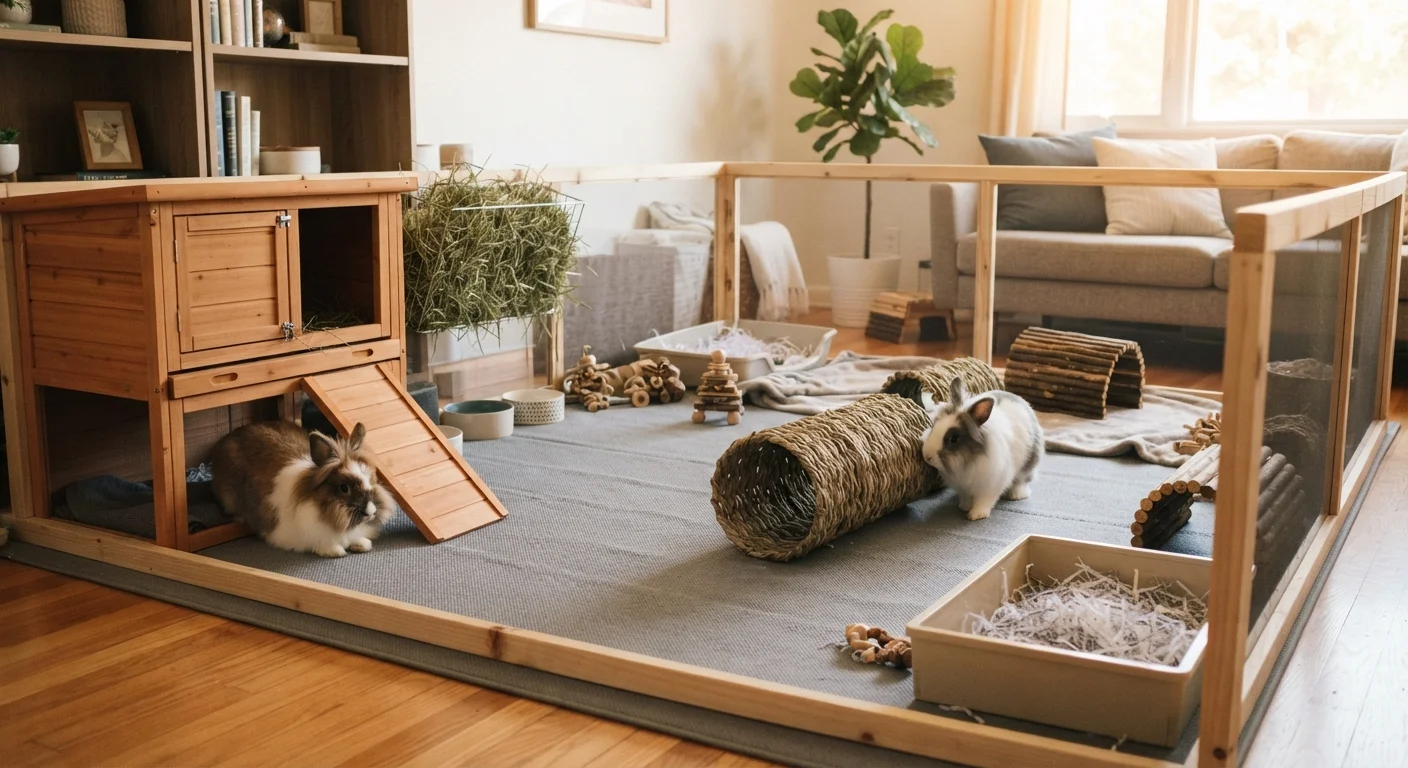
Enclosure style matters too. X-pen setups (modular wire panels arranged in a large pen), room dividers, or purpose-built rabbit runs typically offer far more usable square footage than traditional small cages. Many owners who make the switch to a larger pen find their rabbit's personality visibly changes - more curiosity, more activity, fewer destructive behaviors driven by frustration.
Height matters as well. Rabbits stand on their hind legs frequently, both to observe their surroundings and to stretch. An enclosure should be tall enough - generally at least 24 to 36 inches - to allow this without the rabbit hitting a ceiling or roof panel.
Safe Flooring: A Detail That Affects Long-Term Health
Wire-bottomed cages remain common, but they pose a genuine welfare concern. The wire mesh puts sustained pressure on a rabbit's hind feet, which have no protective pads like a dog's paw. Over time this can lead to sore hocks - a painful condition where the skin breaks down, sometimes progressing to infection. Some larger breeds are particularly vulnerable.
Safe flooring options include:
- Solid untreated wood panels
- Fleece blankets or fleece liners (washed regularly)
- Interlocking foam tiles covered with non-slip fabric
- Low-pile carpet remnants
- Generous layers of hay, which also encourages foraging
If your existing enclosure has a wire floor, adding a solid insert or thick mat across most of the surface area significantly reduces the risk. Outdoor hutches should also have a sheltered, solid-floored sleeping area even if the run section uses a different surface.
Check Your Current Setup
Place your rabbit in their enclosure and watch whether they can take three consecutive hops and stand fully upright without restriction. If either is impossible, the space is too small for their welfare. An X-pen or room divider setup is an affordable way to expand quickly without replacing an entire hutch.
Enrichment: Meeting the Instinct to Dig, Forage, and Chew
A rabbit with nothing to do is not a contented rabbit. Boredom in rabbits often shows up as destructive chewing, thumping, fur pulling, or - in more serious cases - repetitive behaviors called stereotypies that signal chronic stress. Enrichment isn't an optional extra; it's part of meeting the animal's basic behavioral needs.
Practical enrichment ideas that work for most living situations include:
- Hay foraging: Hiding hay in paper bags, cardboard tubes, or a designated dig box gives rabbits a purpose-driven activity that also supports digestion.
- Tunnels and hides: Rabbits instinctively seek cover. Cardboard tunnels, wooden hides, and willow domes give them safe spaces to retreat and explore.
- Chew toys: Untreated willow, apple wood sticks, and compressed hay sticks satisfy the urge to gnaw and help maintain dental health.
- Digging areas: A box filled with shredded paper or compressed hay allows rabbits to express digging behavior safely indoors.
For a deeper look at why enrichment matters for small mammals, see our article on enrichment for small mammals.
Social Needs and the Case for Companionship
Rabbits are naturally social animals. In the wild, they live in structured groups, and isolation - while survivable - is not ideal for their wellbeing. A bonded rabbit pair will groom each other, sleep pressed together, and provide companionship during the many hours owners cannot be present.
Bonding two rabbits takes patience and should be done gradually, ideally with guidance from a rabbit-savvy rescue or veterinarian. Both rabbits should be spayed or neutered before bonding is attempted, which also reduces hormonal aggression and certain health risks. Mixed-sex pairs (both altered) typically bond most successfully.
A solo rabbit can still live a good life - particularly with an owner who provides substantial, consistent daily interaction and enrichment. But owners who travel frequently or work long hours should honestly assess whether a companion rabbit would better meet their pet's social needs. Our comparison article on guinea pigs vs. rabbits covers social needs in more detail if you're still deciding on the right pet fit.
This article is for general informational purposes only and is not a substitute for advice from a qualified veterinarian. Always consult a vet familiar with rabbits for guidance specific to your pet's health and housing needs.
Frequently Asked Questions
Most welfare organizations recommend at least 8 square feet of enclosure space and a minimum of 24 square feet of daily exercise area. The general rule is that a rabbit should be able to take three full hops and stand fully upright on its hind legs without touching the ceiling. Larger is always better.
No - rabbits should not be confined to a cage around the clock. They need several hours each day to move, explore, and stretch. Prolonged confinement can lead to muscle deterioration, obesity, boredom-driven behavior problems, and stress.
Solid flooring is strongly preferred. Wire-bottomed cages put pressure on a rabbit's feet and can cause sore hocks, a painful and chronic condition. Safe surface options include untreated wood, fleece blankets, hay, interlocking foam mats covered with a non-slip fabric, or low-pile carpet.
Rabbits are social animals and most do better with a bonded companion of the same species. A solo rabbit can thrive with substantial human interaction and enrichment, but left alone for long periods without stimulation, single rabbits are at greater risk of loneliness and stress. Consult a rabbit-savvy vet or rescue about the bonding process.
Free-roaming can work well when the space is thoroughly rabbit-proofed. This means covering electrical cords, blocking access to toxic houseplants, securing cabinet gaps, and removing chewable hazards at floor level. Many rabbit owners designate a single rabbit-proofed room rather than opening the entire home.
Rabbits benefit from activities that encourage digging, foraging, chewing, and exploring - behaviors natural to their species. Hay should make up the majority of their diet and doubles as enrichment. Tunnels, cardboard boxes, untreated willow chews, and foraging boxes filled with hay and herbs are all practical options.
The content provided on our blog site traverses numerous categories, offering readers valuable and practical information. Readers can use the editorial team’s research and data to gain more insights into their topics of interest. However, they are requested not to treat the articles as conclusive. The website team cannot be held responsible for differences in data or inaccuracies found across other platforms. Please also note that the site might also miss out on various schemes and offers available that the readers may find more beneficial than the ones we cover.