

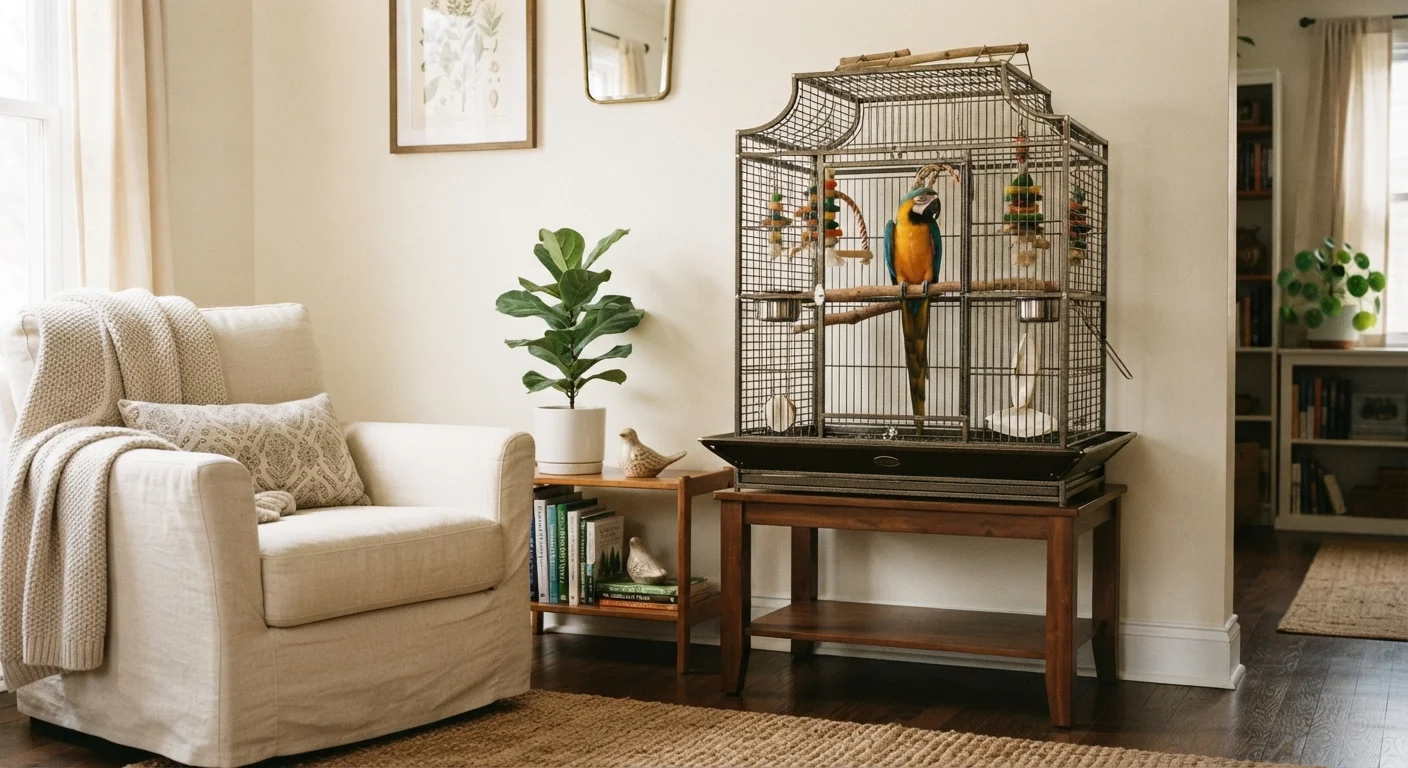
Why placement matters more than most owners expect
A bird's cage is its entire territory. Unlike a dog that can retreat to another room or a cat that can seek out a sunny windowsill, a caged bird lives within a fixed boundary. That makes the location and layout of the cage one of the most consequential decisions an owner makes - and one that is often treated as an afterthought.
Poor placement contributes to chronic low-level stress, which over time can suppress the immune system, trigger feather-destructive behaviors, and cause a bird to become either withdrawn or persistently loud. On the other hand, a thoughtfully placed cage reduces the adjustment period for a new bird and creates the stable environment they need to display natural behaviors and bond with their owners.
This is especially relevant for compact companion birds - budgerigars, cockatiels, lovebirds, and similar species - that are sometimes assumed to be low-maintenance simply because of their size. Their sensitivity to environment is no less than that of larger parrots.
What you will need
For owners setting up a small pet space for the first time, it's worth reading our guide on feeding pet birds well alongside this setup guide, since diet and environment together form the foundation of good bird care.
Step-by-step: setting up the cage correctly
Choose the right room
Select a room where the family spends regular time - living rooms and home offices work well. Birds are social animals and thrive on activity and interaction. Avoid the kitchen entirely: cooking fumes, non-stick cookware off-gassing, and temperature spikes pose genuine health risks to birds. Bathrooms and garages are equally unsuitable due to humidity extremes and chemical exposure.
Find the safest spot within that room
Place the cage against a solid wall - not in the middle of the room. This gives the bird a protected back, reducing anxiety from perceived threats on all sides. Keep the cage away from exterior doors, windows that create strong drafts, and air conditioning or heating vents. Direct sunlight through glass can raise cage temperatures rapidly, even in mild weather.
Set the cage at the right height
Position the cage so the highest perch sits approximately at eye level with a standing adult - roughly chest to shoulder height. This signals social equality rather than dominance (which a very high cage can encourage) or vulnerability (a low cage on the floor). A purpose-built cage stand is the most stable and adjustable solution.
Install varied perches at different heights
Fit at least two different perch types: a natural wood perch (ideally with varying diameter along its length) and a softer option such as rope. Place perches at different heights so the bird can choose its comfort level. Avoid positioning perches directly above food or water dishes - droppings contaminate both quickly.
Position food and water dishes correctly
Attach food and water dishes to the cage at a mid-height level - accessible without the bird having to climb awkwardly, but not positioned below any perch. Where possible, use dishes on opposite sides of the cage to encourage movement. Check that the dishes lock securely; flimsy attachments lead to spilled water and spoiled seed.
Add enrichment without overcrowding
Include one or two toys appropriate for your bird's size and species - foraging toys, shreddable items, or mirrors depending on preference. Avoid filling the cage so densely that movement is restricted. Leave clear flight space between perches if the cage is large enough. Rotate toys every one to two weeks to maintain novelty.
Establish a consistent light and dark routine
Birds regulate their internal rhythms by light cycles. Aim for 10-12 hours of darkness each night using a cage cover or by keeping the room dark at a predictable time. Inconsistent light cycles can contribute to hormonal imbalances and behavioral problems over time. A timer-controlled lamp in the room can help maintain consistency.
Once the cage is set up, give your bird time to adjust before expecting interaction. A newly arrived bird may sit quietly for several days - this is normal exploratory caution, not illness. Our article on socialising a timid or nervous small pet offers practical guidance on building trust at the bird's own pace.
Cage with appropriate bar spacing
Prevents escape and injury - bar spacing should match the species; too wide risks head entrapment.
Cage stand or sturdy surface
Raises the cage to a comfortable, social height (roughly chest level) and keeps it stable.
Natural wood perches
Varying diameters exercise the feet and mimic wild perching conditions.
Rope or soft perch
Provides a comfortable resting surface that eases pressure on feet.
Cage cover or blackout cloth
Used at night to provide the bird with consistent, uninterrupted darkness for sleep.
Digital thermometer/hygrometer
Monitors temperature and humidity near the cage to keep conditions within a safe range.
Ongoing maintenance and what to watch for
Cage setup is not a one-time task. Droppings, food debris, and feather dust accumulate quickly. Wipe down perches and dish surfaces daily, and do a full cage clean - removing and washing all components - at least once a week using a bird-safe, unscented cleaner. Rinse thoroughly and allow surfaces to dry before the bird is returned.
Clean Little and Often
Daily spot-cleaning takes less than five minutes and prevents the buildup that makes weekly cleans much harder. Replace cage liner paper daily - it makes it easy to monitor droppings for changes in color or consistency, which can be an early health indicator.
Watch for any changes in where your bird prefers to sit. A bird that suddenly spends most of its time on the cage floor - rather than on perches - may be unwell and warrants a veterinary check. Similarly, a bird that moves persistently away from one side of the cage may be responding to a draft or noise source that isn't immediately obvious.
Common Household Hazards Near Cages
Scented candles, air fresheners, aerosol sprays, and cigarette smoke are all harmful to birds even in small concentrations. Birds have highly efficient respiratory systems that make them unusually vulnerable to airborne chemicals. Keep all such products well away from any room where a bird is housed.
Like the setup process for other small pets, consistency and observation are the most valuable tools you have. Owners setting up enclosures for other species may find our guide on rabbit housing needs a useful parallel - the principles of security, space, and enrichment translate broadly across small companion animals.
This article is for general informational purposes only and does not constitute veterinary advice. Consult a qualified avian veterinarian for concerns about your bird's health or behaviour.
The content provided on our blog site traverses numerous categories, offering readers valuable and practical information. Readers can use the editorial team’s research and data to gain more insights into their topics of interest. However, they are requested not to treat the articles as conclusive. The website team cannot be held responsible for differences in data or inaccuracies found across other platforms. Please also note that the site might also miss out on various schemes and offers available that the readers may find more beneficial than the ones we cover.