

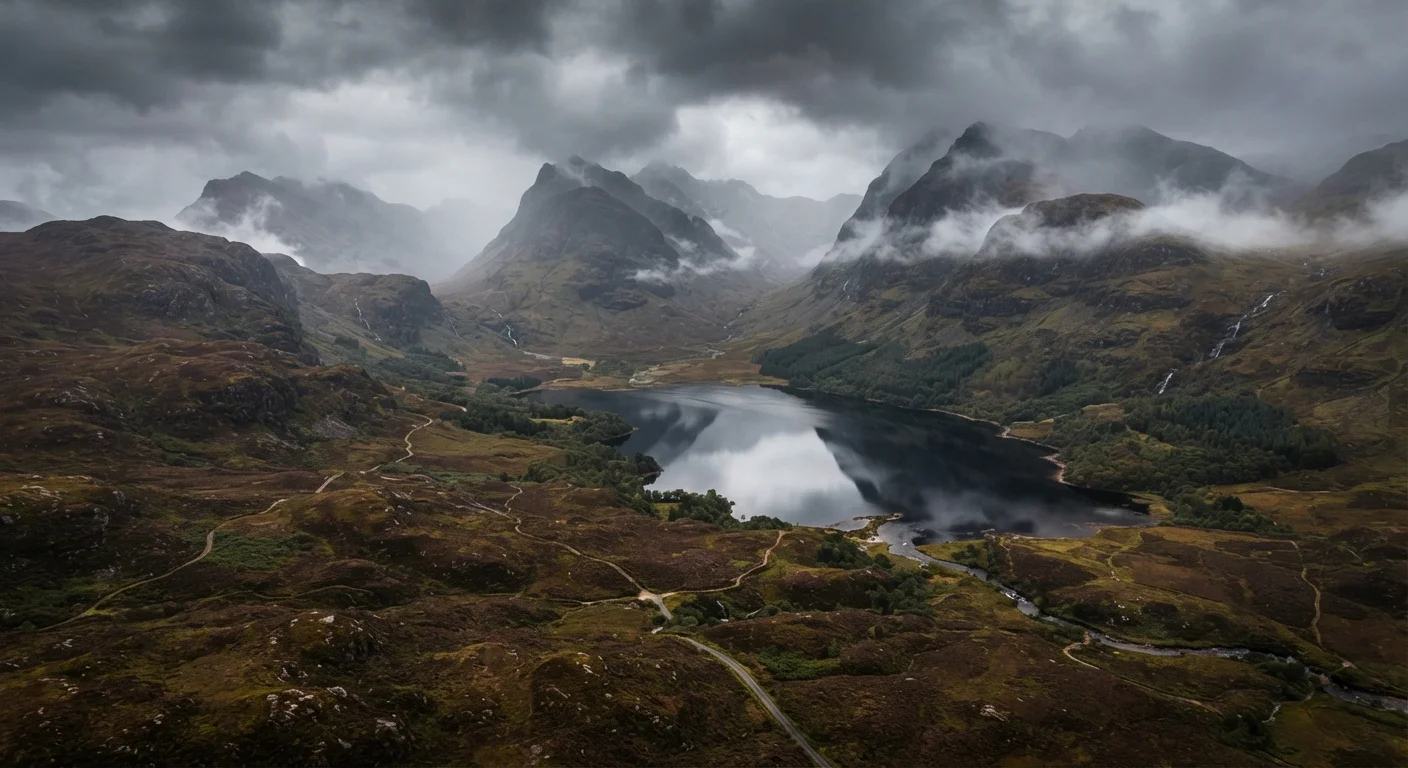
Terrain and Geography: What the Land Actually Looks Like
The Scottish Highlands occupy roughly the northern half of Scotland - a vast, sparsely populated territory shaped over millions of years by volcanic activity, glaciation, and Atlantic weather. The defining geographical divide is the Highland Boundary Fault, a geological line running northeast to southwest that separates the rugged Highlands from the lowland belt to the south.
| Location | Northern Scotland, UK |
| Approximate area | ~16,000 sq miles (41,440 sq km) |
| Highest point | Ben Nevis - 4,413 ft (1,345 m) |
| Main gateway city | Inverness |
| Population density | Among the lowest in Europe - approx. 9 people per sq km |
| Primary languages | English; Scottish Gaelic in parts of the west and islands |
| Best travel months | May-June and September (milder, fewer midges) (General traveller consensus) |
| Currency | Pound Sterling (GBP) |
Glaciers carved the region's most recognisable features: deep glens (valleys), long narrow lochs (lakes), and rounded mountain summits called Munros - any peak exceeding 3,000 feet (914 m). Loch Ness, famous worldwide, is actually one of many; Loch Lomond and Loch Torridon are equally dramatic and arguably less crowded. Ben Nevis, at 4,413 feet (1,345 m), is the UK's highest point and sits near Fort William in the western Highlands.
The west coast is dramatically indented with sea lochs and contains some of Scotland's most photogenic coastline. The eastern Highlands - including the Cairngorms plateau - are drier, more open, and home to subarctic ecosystems rare in the British Isles. Travellers often underestimate how different the western and eastern Highlands feel from each other.
Climate, Seasons, and What Visitors Should Expect
The Highlands have a maritime subarctic to oceanic climate, which in practical terms means frequent rain, rapidly shifting weather, and surprisingly mild winters for such a northerly latitude. Snow is common on high ground from November through April, but coastal areas rarely freeze. Summers are cool - average highs in July hover around 17-19°C (63-66°F) - and daylight in June can stretch past 10 pm at northern latitudes.
Midges: The Highland's Uninvited Guests
Scottish midges are tiny biting insects that swarm in warm, humid, windless conditions - most intensely between June and August on the west coast and near lochs. They pose no serious health risk but can make outdoor activities miserable without protection. Insect repellent containing DEET or Saltidin (Picaridin) and fine-mesh midge head nets are widely available locally and are worth packing for any summer visit.
Midges - tiny biting insects - are a genuine consideration for summer visitors, particularly in July and August on the western coast and around still lochs. They are most active at dawn, dusk, and in calm, humid conditions. Insect repellent and midge-proof head nets are standard kit for hikers during peak season.
May, June, and September are generally favoured by experienced travellers: lower midge populations, reasonable daylight, and fewer crowds than peak summer. Winter visits offer stark, atmospheric scenery and the chance of seeing the aurora borealis (northern lights) at higher latitudes - though road conditions and limited daylight require careful planning. Always check current road and weather conditions through official Scottish sources before travelling remote routes.
Culture, History, and the Clan Legacy
Highland culture is inseparable from the clan system - a social structure based on kinship and shared territory that defined Highland life for centuries. Clans had their own tartans, mottos, and hereditary chiefs; battles between clans, and later between Highland Scots and the British Crown, left deep marks on the landscape and psyche of the region.
Munro
Any Scottish mountain summit exceeding 3,000 feet (914 m) in height. There are 282 Munros in Scotland, and 'Munro bagging' - the goal of climbing all of them - is a popular long-term pursuit among hikers.
Glen
A glacially carved valley, typically long and narrow, found throughout the Scottish Highlands. Glens often contain rivers, lochs, and traditional settlements.
Clan System
A social and political structure based on extended kinship groups, each tied to a specific territory and led by a hereditary chief. It dominated Highland society for several centuries before being largely dismantled after 1746.
Highland Clearances
A period of mass forced eviction of tenant farmers from Highland land, primarily in the 18th and 19th centuries, to make way for sheep farming. The Clearances caused widespread emigration and remain a defining event in Scottish history.
Scottish Gaelic
A Celtic language indigenous to the Scottish Highlands and Islands. Today spoken by a small community, primarily in the Western Isles, and recognised as an official language of Scotland alongside English.
Loch
The Scottish term for a lake or sea inlet. Freshwater lochs were formed by glacial activity; sea lochs are arms of the Atlantic Ocean reaching deep into the Highland coastline.
The Jacobite uprisings of the 17th and 18th centuries - culminating in the Battle of Culloden in 1746 - ended with catastrophic consequences for Highland society. The subsequent Clearances forcibly removed thousands of tenant farmers from their land to make way for sheep farming, scattering Highland Scots to the Americas, Australia, and beyond. Culloden Moor near Inverness is now a carefully preserved memorial site managed by the National Trust for Scotland.
Gaelic, the indigenous language of the Highlands, is still spoken by a small but active community - particularly in the Outer Hebrides. Road signs in many parts of the region appear in both English and Scottish Gaelic. Traditional music (fiddle, bagpipes, clàrsach harp), Highland Games, and whisky distilling continue as living cultural expressions rather than purely tourist performances. For another European destination where geography and isolation have shaped a fiercely distinct culture, see our piece on The Faroe Islands.
Practical Considerations for Visitors
Getting around the Highlands requires forethought. Public transport exists - trains connect Inverness, Kyle of Lochalsh, and Thurso, and the Caledonian Sleeper links London to several Highland stations - but many of the region's most rewarding areas are accessible only by car or organised tour. Single-track roads with passing places are the norm outside main arteries; local etiquette and road safety norms apply and should be respected.
The North Coast 500, a 516-mile scenic driving route looping around the north of Scotland, has become a popular framework for exploring the region. It passes through Inverness, Torridon, Cape Wrath, and John o' Groats. Travellers should be aware that accommodation along the route is limited and books up quickly in summer - planning ahead is essential.
Entry requirements and travel advisories can change; always verify current visa, insurance, and health guidance through official UK government sources and your own country's foreign travel advisories before departure. For a broader sense of how remote, landscape-driven destinations compare, New Zealand's South Island vs North Island offers useful context on navigating vast, varied terrain.
This article is for general informational purposes. Travel conditions, road access, entry requirements, and safety considerations can change; verify current details with official sources before your trip.
The content provided on our blog site traverses numerous categories, offering readers valuable and practical information. Readers can use the editorial team’s research and data to gain more insights into their topics of interest. However, they are requested not to treat the articles as conclusive. The website team cannot be held responsible for differences in data or inaccuracies found across other platforms. Please also note that the site might also miss out on various schemes and offers available that the readers may find more beneficial than the ones we cover.