

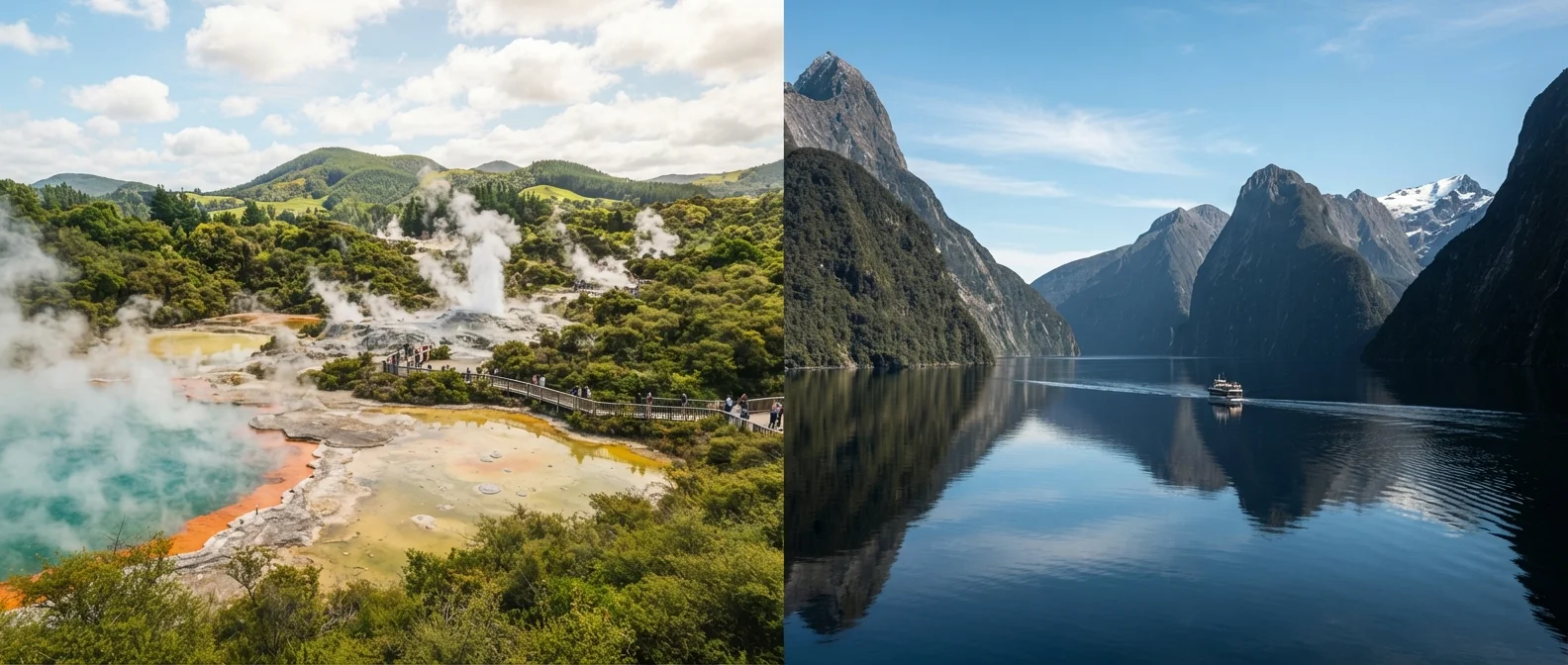
Option A
North Island
The culturally vibrant, geothermally alive island.
Best for: Travellers drawn to Māori heritage, volcanic landscapes, cosmopolitan city life, and wine country.
Option B
South Island
The dramatic, alpine wilderness escape.
Best for: Outdoor adventurers and scenery seekers after fiords, glaciers, and mountain trails.
What Defines Each Island
New Zealand sits in the southwestern Pacific as two main landmasses separated by the Cook Strait - and those two islands feel remarkably different once you're on the ground. The North Island is shaped by volcanic activity: boiling mud pools, geysers, and steaming lakes define the central plateau around Rotorua and Taupō. It's also where roughly three-quarters of New Zealand's population lives, giving it a more urban, connected energy. Wellington, the compact and culturally lively capital, sits at its southern tip.
The South Island, by contrast, is defined by its mountains. The Southern Alps run almost the entire length of the island, feeding glaciers on the West Coast and creating the rain shadow conditions that produce the sunbaked vineyards of Marlborough and Central Otago. Fiordland, in the southwest, contains some of the most remote and spectacular scenery on the planet - deeply carved fjords (the correct geological term, though "fiord" is the local spelling convention) flanked by waterfalls and ancient rainforest.
| Criterion | North Island | South Island |
|---|---|---|
| Signature Landscape | Geothermal fields, volcanoes, harbours | Alps, fjords, glaciers, plains |
| Cultural Highlight | Māori heritage, Waitangi Treaty Grounds | Gold rush history, Scottish settler legacy |
| Major City | Auckland, Wellington | Christchurch, Queenstown |
| Top Day Hike | Tongariro Alpine Crossing | Milford Track / Routeburn Track |
| Adventure Activity | White-water rafting, surfing, fishing | Skiing, bungee, glacier walks |
| Climate | Mild, subtropical in the north | Variable; alpine, cooler overall |
| Wine Regions | Hawke's Bay, Marlborough (border region) | Marlborough, Central Otago |
| Best Travel Pace | Suits city stays with day trips | Suits road trips and multi-day hikes |
Culture, History, and Human Geography
Māori culture is woven throughout all of New Zealand, but the North Island is where it is most visibly centered. Northland's Bay of Islands is the site of Waitangi, where New Zealand's founding treaty was signed in 1840. Rotorua has long been a hub of Māori performing arts, carving, and traditional cuisine. Travellers genuinely interested in engaging with indigenous culture - not just as a backdrop, but as living tradition - will find the North Island particularly rewarding.
The South Island has its own distinct character, shaped by its gold rush past, Scottish settler heritage in Otago, and the farming communities that stretch across Canterbury. Christchurch, rebuilding with creative energy after the 2011 earthquakes, has emerged as a genuinely interesting city with innovative architecture and a thriving arts scene. The South Island's human story is quieter but no less compelling - it just takes a little more seeking out.
9
New Zealand Great Walks
New Zealand's Department of Conservation designates nine Great Walks nationwide; the majority of the most celebrated routes are located on the South Island.
~3 hrs
Cook Strait ferry crossing time
The ferry between Wellington and Picton takes approximately three hours, making an inter-island itinerary practical even on shorter trips.
1840
Year of the Treaty of Waitangi
Signed at the Bay of Islands on the North Island, the Treaty of Waitangi remains the founding constitutional document of New Zealand.
Landscapes, Activities, and What to Expect
For outdoor adventurers, the South Island is hard to beat. The Milford Track and Routeburn Track are two of New Zealand's nine Great Walks and are frequently cited among the world's finest multi-day hikes. Queenstown anchors an adventure tourism scene that includes skiing, bungee jumping, and jet boating. Franz Josef and Fox Glaciers on the West Coast offer guided glacier experiences, though their reach has diminished significantly due to climate change - always verify current access conditions before planning.
The North Island's outdoor offerings are different in character. Lake Taupō, sitting inside a supervolcano caldera, is a centre for trout fishing and water sports. The Tongariro Alpine Crossing - a full-day volcanic traverse past crater lakes and steaming vents - is consistently rated among the finest day hikes in the world. Wine lovers will find Hawke's Bay and Martinborough producing excellent Syrah and Pinot Noir.
Travel pace matters enormously here. If you're weighing how to spread your time, our look at slow travel vs. destination hopping may help you decide whether going deep on one island suits your style better than a faster loop of both.
Verify Great Walk Availability Early
New Zealand's most popular multi-day trails - including the Milford Track and Routeburn Track - require advance booking through the Department of Conservation. Hut passes for peak season (November-April) regularly sell out months ahead. Check doc.govt.nz for current availability and booking windows before finalising your itinerary.
Practicalities: Getting Around and When to Go
Getting between the islands is relatively simple. The Interislander and Bluebridge ferries cross the Cook Strait between Wellington and Picton in roughly three hours - a scenic journey in its own right. Domestic flights connect major centres in under an hour. Most travellers self-drive using rental cars or campervans, which give the greatest flexibility on both islands.
Seasonality matters. December through February (Southern Hemisphere summer) brings long days and the best weather across both islands - and the most visitors. March through May offers pleasant temperatures and thinner crowds, particularly on the South Island. Winter (June-August) is ski season in the South, while the North Island remains relatively mild year-round. Always check Great Walk booking windows early; hut passes for popular trails like the Milford Track sell out months in advance.
For lovers of dramatic, edge-of-the-world scenery who want to understand another island known for its remote intensity, our guide to life on the Faroe Islands draws some interesting parallels in landscape and isolation. And if highlands wilderness is a recurring draw for you, the Scottish Highlands guide explores similar terrain-driven travel in a very different cultural context.
The content provided on our blog site traverses numerous categories, offering readers valuable and practical information. Readers can use the editorial team’s research and data to gain more insights into their topics of interest. However, they are requested not to treat the articles as conclusive. The website team cannot be held responsible for differences in data or inaccuracies found across other platforms. Please also note that the site might also miss out on various schemes and offers available that the readers may find more beneficial than the ones we cover.