

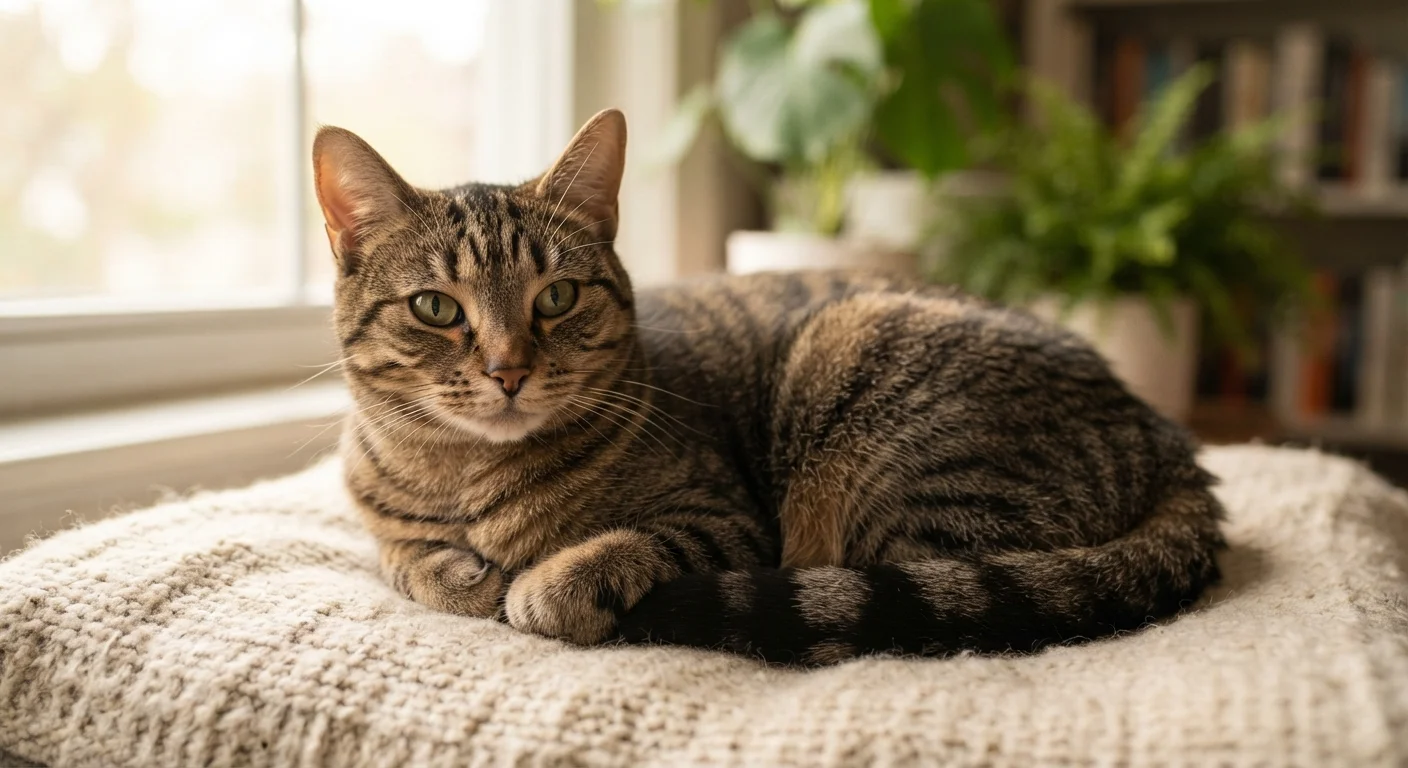
Why Cat Body Language Matters
Cats are not aloof by nature - they are highly communicative animals whose signals are simply different from a dog's. Misreading those signals can lead to unnecessary stress for your cat and frustration for you. Once you learn the vocabulary of tail positions, ear angles, and eye behavior, everyday interactions become far easier to navigate.
Unlike vocalizations, which cats largely developed to communicate with humans, body language is the channel cats use with one another. Reading it correctly gives you genuine insight into how your cat is feeling at any given moment. It also helps you notice when something is off - particularly since cats are wired to mask discomfort. See our guide to subtle pain signals in cats for what to watch for beyond everyday communication.
| Primary communication channel | Body language (posture, tail, ears, eyes) |
| Tail-up greeting meaning | Confident, friendly approach |
| Slow blink significance | Trust signal; can be reciprocated by owner |
| Piloerection trigger | Fear or aggressive arousal |
| Belly exposure | Deep trust - not always a touch invitation |
| Ears pinned flat | Extreme fear or active aggression - do not approach |
Tail Signals: Your Cat's Mood Barometer
The tail is one of the most expressive parts of a cat's body. Its position and movement shift rapidly to reflect emotional state.
- Tail held high, tip slightly curved: Confident, content, and greeting you warmly. This is the feline equivalent of a friendly wave.
- Tail straight up, fully erect: Very happy or highly stimulated - common when a cat trots toward its food bowl or a favorite person.
- Tail tucked low or beneath the body: Anxiety, submission, or fear. Something in the environment is causing stress.
- Puffed-out tail (piloerection): Fear or aggression. The cat is trying to appear larger. Combine this signal with other body cues to determine which emotion is driving it.
- Slow, wide tail lash: Irritation or intense focus. Often a warning that overstimulation is near.
- Rapid tip flicker: Mild interest or light annoyance - context matters here.
Piloerection
Involuntary bristling of the fur, caused by tiny muscles raising the hair follicles. In cats, it typically occurs along the tail and spine during fear or aggressive arousal, making the cat appear larger.
Slow blink
A deliberate, unhurried closing and reopening of the eyes directed at a person or other cat. It is widely recognized as a feline signal of trust and non-threat, sometimes called a "cat kiss."
Bunting
The behavior of pressing the forehead, cheeks, or chin against a person or object. Cats have scent glands in these areas, so bunting is both an affectionate gesture and a way of leaving a familiar scent marker.
Overstimulation
A state in which sensory input - such as prolonged petting - exceeds the cat's comfort threshold. Signs include skin twitching, tail lashing, and sudden biting or scratching even during what appeared to be a pleasant interaction.
Displacement behavior
An action a cat performs when in conflict between two impulses, such as grooming itself mid-play or yawning during a tense interaction. These behaviors signal uncertainty or low-level stress rather than genuine relaxation.
Ears, Eyes, and Whiskers
These three features work together and should always be read as a cluster rather than in isolation.
Ear Positions
- Forward and slightly outward: Alert, curious, engaged.
- Flattened sideways ("airplane ears"): Fear, uncertainty, or mild anxiety.
- Pinned flat against the skull: Active aggression or extreme fear. Do not reach for a cat showing this signal.
- Rotating independently: The cat is tracking multiple sounds simultaneously - fully alert mode.
Eye Signals
- Slow blink toward you: A well-documented trust signal. Responding with a slow blink of your own can reinforce the bond.
- Dilated pupils in normal light: Excitement, fear, or playfulness - check surrounding cues.
- Narrow, constricted pupils: Relaxed contentment OR focused aggression. Context is essential.
- Direct, hard stare: A challenge or threat - avoid holding prolonged eye contact with an unfamiliar cat.
Whisker Position
- Fanned forward: Curious and investigative.
- Pulled flat against the face: Fearful or defensive.
Whole-Body Postures
Individual signals only tell part of the story. Read the whole body to get accurate context.
| Posture | Likely Meaning |
|---|---|
| Loaf position (paws tucked under body) | Relaxed and comfortable; not expecting to move quickly |
| Belly exposed, lying on back | Deep trust - but not always an invitation to touch. Many cats will swipe if you reach for the belly. |
| Crouching low, weight shifted back | Defensive fear; preparing to flee or strike |
| Arched back, sideways stance | Classic fear-aggression display; cat is trying to appear threatening |
| Head butting (bunting) | Affection and scent-marking; the cat is claiming you as familiar and safe |
| Kneading ("making biscuits") | Contentment, often linked to comfort behaviors from kittenhood |
Behavior shifts across multiple body regions simultaneously are the most reliable reads. A cat with a high tail, forward ears, and soft eyes is almost certainly happy. A cat with flattened ears, dilated pupils, and a puffed tail needs space immediately.
Understanding these signals also makes routine care less stressful for both of you. Our practical grooming guide explains how to read and respect body language cues during brushing and nail trimming.
When Body Language Signals a Health Concern
Persistent changes in posture or behavior - not just momentary reactions - can be early indicators of a physical problem. Cats that consistently hunch over their food bowl, hold one ear lower than the other, or repeatedly groom one spot may be signaling discomfort rather than mood.
If your cat's body language changes noticeably without an obvious environmental cause, a veterinary check-up is always worthwhile. Cats are remarkably good at masking pain, so behavioral signals are often the first and only clue an owner gets. The monthly cat care checklist can help you build a habit of regular behavioral observation so changes stand out more clearly over time.
Body language is also part of a much larger picture of cat ownership. For a broader look at what life with a cat really involves, see everything cat ownership involves.
This article is for general informational and educational purposes only. If your cat shows persistent behavioral changes or signs of distress, consult a licensed veterinarian.
The content provided on our blog site traverses numerous categories, offering readers valuable and practical information. Readers can use the editorial team’s research and data to gain more insights into their topics of interest. However, they are requested not to treat the articles as conclusive. The website team cannot be held responsible for differences in data or inaccuracies found across other platforms. Please also note that the site might also miss out on various schemes and offers available that the readers may find more beneficial than the ones we cover.