

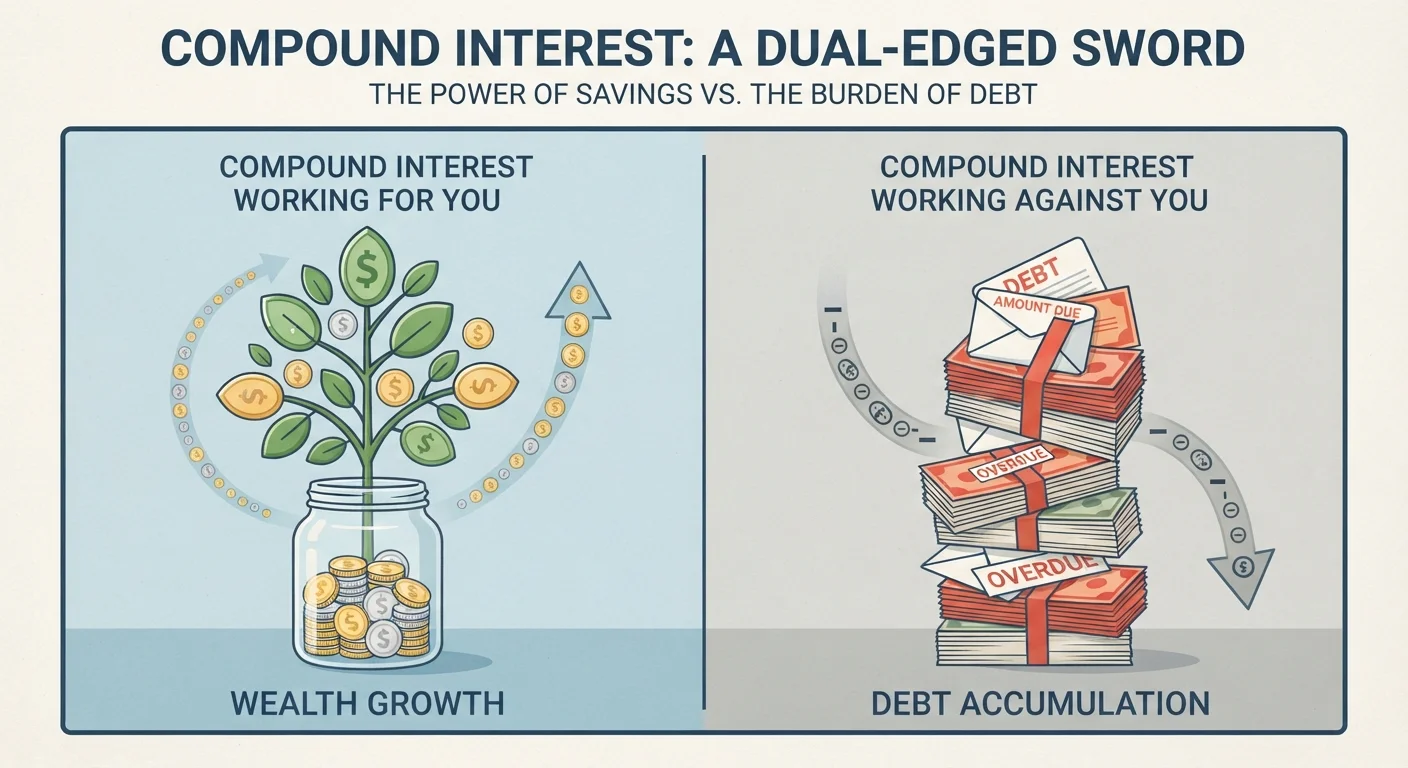
The Core Mechanic: Interest on Interest
Most people learn about interest as a flat percentage - borrow $1,000 at 10%, and you owe $100 in interest. That's simple interest. Compound interest works differently: once that $100 is added to the balance, next period's interest is calculated on $1,100, not just $1,000.
The gap between simple and compound interest seems small at first. But stretch it across years, and the difference becomes dramatic. This is why compound interest is often described as one of the most powerful forces in personal finance - and why it cuts both ways, depending on whether it's working on your savings or your debt.
For a deeper look at the underlying arithmetic, see how compound interest accumulates over time.
“Compound interest is the eighth wonder of the world. He who understands it, earns it; he who doesn't, pays it.”
— Widely attributed to Albert Einstein, Often cited in personal finance literature - note: origin of this attribution is disputed, but the underlying principle is well-established.
When Compound Interest Works For You
On the saving and investing side, compound interest is a genuine advantage. You deposit money, it earns interest, and then that combined total earns more interest - without you doing anything extra. The longer money stays invested, the more pronounced the effect becomes.
This is why financial educators consistently emphasize starting early. Someone who begins saving at 25 and stops at 35 can end up with more at retirement than someone who starts at 35 and saves continuously until 65 - purely because of the extra decade of compounding. Time is the key variable.
72
Rule of 72: Years to double money
Divide 72 by an annual interest rate to estimate how many years it takes a balance to double - a widely used mental math shortcut in personal finance education.
20%+
Average credit card APR in the US
According to Federal Reserve data, average credit card interest rates have exceeded 20% in recent years, making compounding on unpaid balances a significant financial risk.
The same principle applies to interest-bearing savings accounts, certificates of deposit, and similar instruments. Even modest rates compound into meaningful growth when given enough runway. For a broader framework on saving alongside debt, see the end-to-end personal finance guide on saving and debt management.
Start Small, Start Early
You don't need a large lump sum to benefit from compound interest. Even modest, regular contributions - say, $25 or $50 a month - begin compounding immediately. Starting 10 years earlier can matter far more than starting with a larger amount. Check whether your savings account or retirement plan compounds interest daily or monthly, since more frequent compounding yields slightly better results.
When Compound Interest Works Against You
The same mechanic that grows savings will inflate debt - and it does so aggressively when interest rates are high. Credit cards are the most common example. Many carry annual percentage rates (APRs) above 20%, and interest typically compounds daily. Carry a $3,000 balance on a card charging 24% APR, and you're adding roughly $60 in interest each month - on top of whatever you already owed.
The critical problem: if your minimum payment barely covers that interest charge, the principal barely shrinks. Meanwhile, next month's interest is calculated on a balance that hasn't meaningfully dropped. Balances can persist for years this way, costing far more than the original purchase.
Student loans, personal loans, and auto financing also use compound interest, though usually at lower rates than credit cards. The principle remains: every month a balance isn't reduced, it quietly grows. Understanding this makes it easier to see why paying high-interest debt first often saves the most money overall.
APR vs. APY: Know the Difference
When comparing financial products, you may see both APR (Annual Percentage Rate) and APY (Annual Percentage Yield). APY accounts for the effect of compounding within the year, making it a more accurate reflection of what you'll actually earn or owe annually. For savings accounts, look for APY; for loans and credit cards, APR is the standard disclosure - but remember that compounding still applies.
Balancing Both Sides in Real Life
Knowing how compound interest operates on both sides of the ledger helps explain a common personal finance tension: is it smarter to save money or pay down debt? The answer usually hinges on comparing interest rates.
If a savings account yields 4% annually and a credit card charges 22%, every dollar left on that card is costing more than the savings account is earning. Mathematically, paying off the card first is the higher-return move. That said, a small emergency fund is widely considered worth maintaining even while paying down debt - because without one, unexpected expenses often go right back on a credit card.
For a fuller look at navigating that trade-off, see where your extra money should go and understanding the emergency fund vs. debt repayment trade-off.
Compound interest is neither inherently good nor bad - it's a force that responds to direction. Point it at long-term savings, and it builds wealth gradually and quietly. Ignore it on a credit card balance, and it erodes financial stability just as steadily. Understanding which side of the equation you're on is the first step toward using it to your advantage.
This article is for general informational purposes only and does not constitute personalized financial, tax, or investment advice. Consult a qualified financial professional for guidance specific to your situation.
Frequently Asked Questions
Simple interest is calculated only on the original principal. Compound interest is calculated on the principal plus any previously earned interest. Over time, compound interest produces significantly larger totals - for better or worse.
Credit cards typically charge high interest rates that compound daily or monthly. If you carry a balance, interest gets added to your balance, and then future interest is calculated on that larger amount. This means unpaid balances grow quickly even if you stop using the card.
Yes, though the effect is modest at low interest rates. The real power emerges over long periods or at higher rates. Even small, consistent contributions to a savings or retirement account compound meaningfully over decades.
It depends on the account or loan. Savings accounts often compound daily or monthly. Many loans and credit cards also compound daily. More frequent compounding accelerates balance growth in either direction.
Yes - the Rule of 72. Divide 72 by the annual interest rate, and the result approximates how many years it takes to double your balance. At 6%, that's about 12 years; at 24% (a common credit card rate), a debt could double in just 3 years.
It often depends on the interest rates involved. High-interest debt typically costs more than low-risk savings earn, so eliminating it first is usually the more efficient financial move. For personalized guidance, consider speaking with a qualified financial adviser.
The content provided on our blog site traverses numerous categories, offering readers valuable and practical information. Readers can use the editorial team’s research and data to gain more insights into their topics of interest. However, they are requested not to treat the articles as conclusive. The website team cannot be held responsible for differences in data or inaccuracies found across other platforms. Please also note that the site might also miss out on various schemes and offers available that the readers may find more beneficial than the ones we cover.