

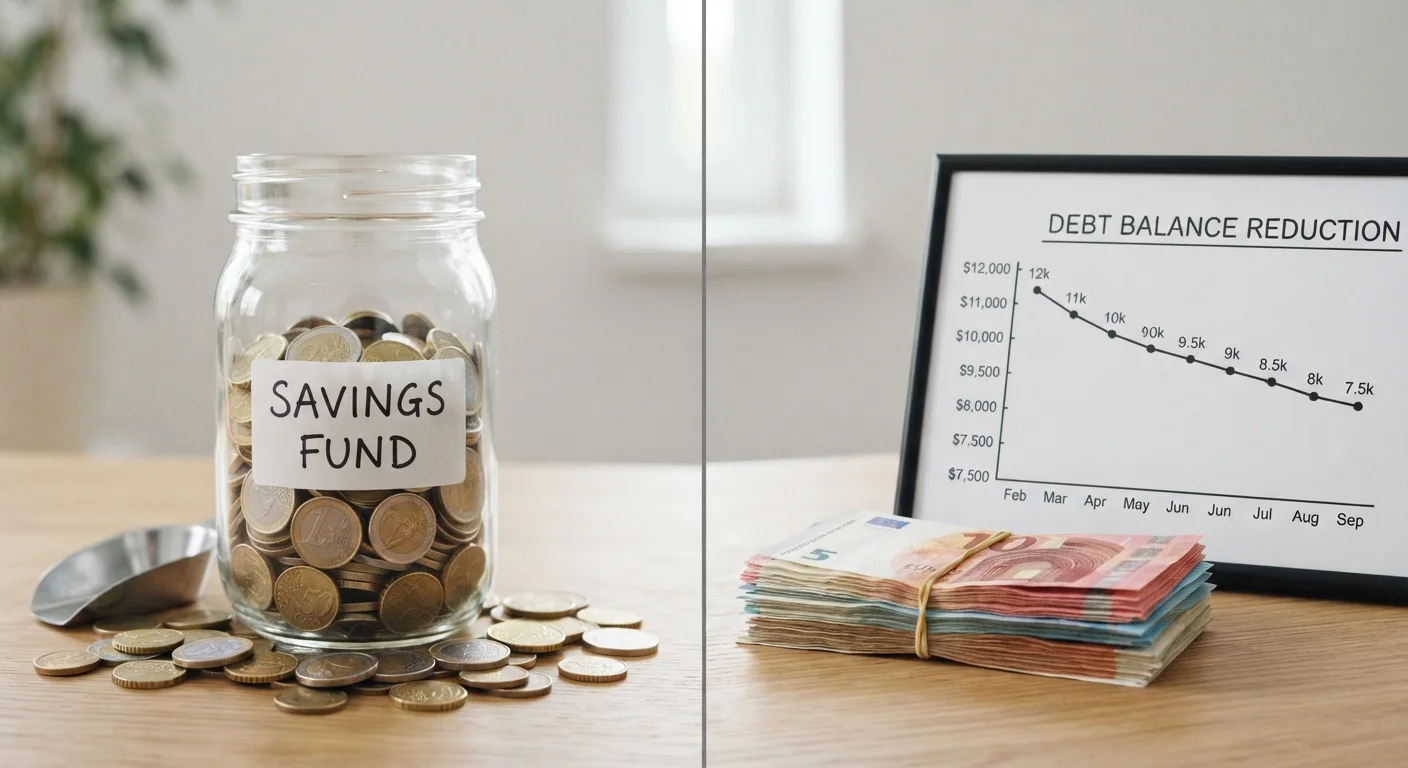
Option A
Building an Emergency Fund
The financial safety net that keeps one crisis from becoming a debt spiral.
Best for: Anyone without a cash cushion who risks going deeper into debt when unexpected expenses hit.
Option B
Paying Down Debt
The interest-eliminating strategy that frees up future cash flow.
Best for: People carrying high-interest balances where interest charges are eroding their monthly budget.
Why This Decision Is Harder Than It Looks
When you have a little breathing room in your budget - maybe from a raise, a tax refund, or trimming expenses - the next question is where that money does the most good. Should it shore up your savings or knock down what you owe?
The honest answer is: it depends. And that's not a dodge. The right move genuinely varies based on your interest rates, income stability, and how much you already have saved. Understanding how each option works makes the trade-off clearer. For a broader foundation on how these two goals fit into a complete plan, see the end-to-end personal finance guide.
| Criterion | Emergency Fund | Paying Down Debt |
|---|---|---|
| Primary benefit | Protection from unexpected expenses | Reduces interest charges over time |
| Financial return | Modest (savings rate, typically 4-5%) | Equals the debt's interest rate (often 15-25%) |
| Risk if ignored | One crisis forces new borrowing | Interest compounds, increasing total owed |
| Best when | No savings cushion exists | High-interest debt is active |
| Impact on cash flow | No immediate relief on monthly bills | Frees up cash as balances fall |
| Psychological effect | Reduces financial anxiety | Motivating as balances visibly decrease |
The Case for Building Your Emergency Fund First
An emergency fund is a reserve of cash set aside specifically for unplanned expenses - a medical bill, a broken appliance, or a gap between jobs. Most financial educators suggest working toward three to six months of essential expenses, though even a starter fund of $500 to $1,000 provides meaningful protection.
The core argument for saving first is about avoiding a debt spiral. If you direct every extra dollar at debt but have nothing saved, one emergency sends you straight back to borrowing - often at high interest. You end up taking two steps forward and one step back, repeatedly.
~40%
Americans who couldn't cover a $400 emergency
The Federal Reserve's Report on the Economic Well-Being of U.S. Households has consistently found that a significant share of adults would struggle to cover an unexpected $400 expense without borrowing or selling something.
20%+
Average APR on credit card accounts assessed interest
According to Federal Reserve data, the average interest rate charged on credit card accounts carrying a balance has exceeded 20% in recent reporting periods.
3-6 months
Recommended emergency fund target
Most personal finance educators and consumer agencies suggest saving enough to cover three to six months of essential living expenses, though even a smaller amount provides meaningful protection.
There's also a psychological dimension. Having money in a savings account reduces financial anxiety and creates a buffer that makes sticking to a budget easier. For people with variable income or jobs in less stable industries, that cushion carries extra weight.
If you're starting from zero, consider the concept of paying yourself first - treating a savings contribution like a non-negotiable bill, not an afterthought.
The Case for Paying Down Debt First
The financial argument for prioritizing debt repayment is primarily mathematical. If you're carrying a credit card balance at 20% APR, every dollar you don't pay down is effectively costing you 20 cents a year in interest. Few savings accounts come close to matching that rate of return.
Reducing debt also has a compounding benefit in reverse: as balances shrink, interest charges shrink, which frees up cash flow for other goals. This is why many people find that eliminating a high-interest balance changes their monthly budget noticeably.
Choosing which debts to target first is its own question. The avalanche vs. snowball comparison covers how interest-first and smallest-balance-first approaches differ in cost and motivation. And if you're weighing different loan structures, the guide to fixed vs. variable rate borrowing explains how rate type affects repayment risk.
Not All Debt Deserves Equal Urgency
Low-interest debt - such as a federal student loan at 4-5% - is very different from a credit card at 22%. When interest rates are low, the math for aggressive repayment is less compelling, and building savings may take reasonable priority. Always consider the actual interest rate on each debt before deciding how urgently to pay it down.
A Middle Path: Doing Both at Once
For many people, the most practical approach isn't a strict either/or. It's splitting extra money - some toward a starter emergency fund, some toward debt - until the fund reaches a basic threshold, then shifting more aggressively to debt repayment.
For example, you might contribute $100 a month to savings and put an additional $150 toward your highest-interest debt, rather than sending all $250 in one direction. Once your emergency fund hits $1,000, you redirect the $100 to debt too.
This kind of structured split reduces the risk of either extreme: being wiped out by one emergency or watching interest charges accumulate while you stockpile cash you don't urgently need. A monthly financial check-in can help you track whether your split is still working as your balances change.
Automating both contributions - savings transfers and extra debt payments - reduces the chance you'll spend the money before allocating it. The guide to automating your finances walks through how to set that up simply.
This article is for general informational purposes only and does not constitute personalized financial advice. Readers should consider consulting a qualified financial professional before making significant changes to their saving or debt repayment strategy.
The content provided on our blog site traverses numerous categories, offering readers valuable and practical information. Readers can use the editorial team’s research and data to gain more insights into their topics of interest. However, they are requested not to treat the articles as conclusive. The website team cannot be held responsible for differences in data or inaccuracies found across other platforms. Please also note that the site might also miss out on various schemes and offers available that the readers may find more beneficial than the ones we cover.