

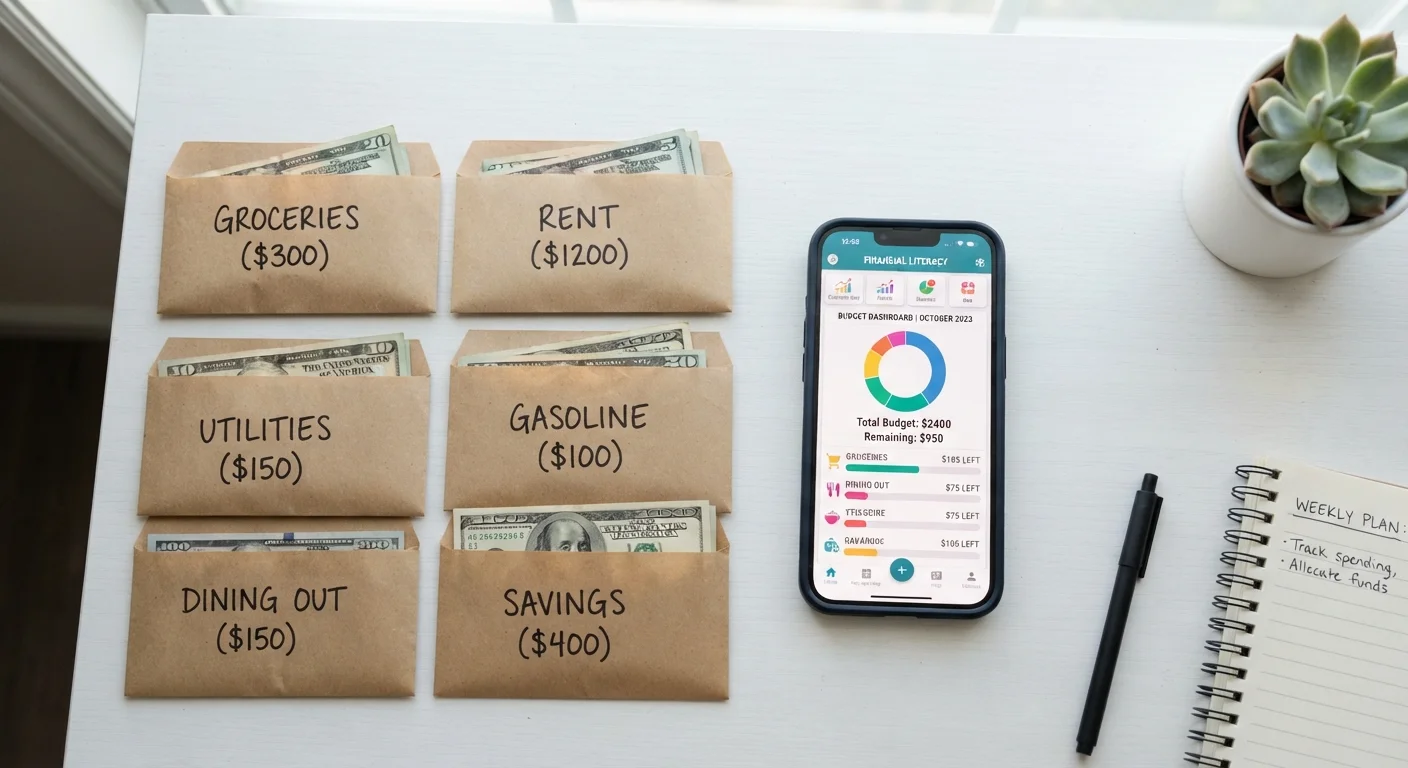
Option A
Envelope Budgeting
The tactile, cash-first method with built-in spending limits.
Best for: People who overspend when using cards and benefit from physically handling their money.
Option B
Digital Spending Categories
The flexible, screen-based approach to organizing your spending.
Best for: People who prefer cashless transactions and want real-time tracking across accounts.
What Each Method Actually Does
Both envelope budgeting and digital spending categories share the same core idea: divide your income into labeled buckets before you spend it. The difference is the material.
Envelope budgeting is as literal as it sounds. After each paycheck, you withdraw cash and distribute it into physical envelopes - one for groceries, one for gas, one for eating out, and so on. When an envelope is empty, that category is done for the month. No borrowing from next week, no exceptions unless you deliberately move cash from another envelope.
Digital spending categories do the same thing on a screen. You set a dollar limit for each category inside a budgeting app or spreadsheet, then log or sync every transaction against it. When a category hits its limit, you get a notification - or you simply see the number turn red. The spending boundary exists as data rather than paper.
Before committing to either, it's worth mapping your monthly cash flow so you know exactly how much belongs in each bucket. Guessing at category amounts is one of the most common reasons budgets fall apart in the first month.
| Criterion | Envelope Budgeting | Digital Spending Categories |
|---|---|---|
| Medium of exchange | Physical cash only | Cards, apps, any payment type |
| Spending enforcement | Hard stop - empty envelope | Soft alert - notification or visual cue |
| Setup effort | Low - envelopes and cash | Moderate - app setup or spreadsheet |
| Ongoing effort | Low once set up | Requires regular check-ins |
| Works for online spending | No - requires workarounds | Yes - syncs or logs digitally |
| Security risk | Cash loss is unrecoverable | Data privacy considerations |
| Spending history | None unless manually logged | Automatic with synced accounts |
| Flexibility mid-month | Requires physically moving cash | Easy category adjustments |
| Cost | Free | Free to paid (varies by tool) |
The Psychology Behind Each Approach
The envelope method has a well-documented psychological edge: paying with cash feels more real than swiping a card. Research in behavioral economics, including work by Drazen Prelec and Duncan Simester, has explored how the abstract nature of card payments tends to reduce the perceived cost of a purchase. Physical cash doesn't allow that same mental distance. When you hand over your last $40 in the grocery envelope, you feel it.
Digital categories, by contrast, rely on awareness rather than pain. The goal is to check your app often enough that you catch overspending before it compounds. This works well for disciplined trackers, but it requires consistent engagement. If you go two weeks without logging in, the guardrail disappears.
That said, digital tools have improved significantly in how they surface this information. Automatic bank syncing means transactions appear in your categories without manual entry, which makes it harder to fall out of the habit. The key is setting up alerts so the app prompts you - rather than waiting for you to remember to look.
~30%
More spent when paying by card vs. cash
Multiple consumer behavior studies suggest people tend to spend meaningfully more when using cards compared to cash, though exact figures vary by study design and population.
1 in 3
US adults with no working budget
A NFCC (National Foundation for Credit Counseling) survey found roughly a third of American adults do not track spending or maintain a budget.
74%
Budgeters who say tracking helps them save
According to NFCC consumer financial literacy survey data, a strong majority of adults who do budget report it helps them set aside more money.
Practical Trade-Offs Worth Knowing
Neither method is universally superior. The right fit depends on your daily habits, where you shop, and how honestly you'll engage with the system.
Envelope budgeting trade-offs:
- Works poorly when you shop online or pay recurring bills electronically.
- Carrying cash has security risks - a lost envelope means lost money with no recourse.
- Requires a trip to the bank or ATM on payday, which is an added friction point.
- Makes it harder to track spending history unless you log withdrawals separately.
Digital category trade-offs:
- Requires ongoing engagement - a set-and-forget approach usually fails.
- Some apps charge monthly fees, though free options exist (spreadsheets cost nothing).
- Connecting bank accounts raises data-sharing considerations that some people prefer to avoid.
- It's easier to rationalize overspending when there's no physical consequence.
If you want to compare how these fit alongside other budgeting frameworks, zero-based budgeting vs. the 50/30/20 rule walks through two other popular structures that often get paired with category-based approaches.
For a deeper look at how to actually log your spending - whether by app, spreadsheet, or paper - spending tracker methods compared breaks down the options clearly.
A Note on Hybrid and Partial-Cash Systems
You don't have to go all-in on either approach. Some budgeters use cash only for high-temptation categories - like dining out or impulse shopping - while managing fixed bills and subscriptions digitally. This hybrid approach captures some psychological benefit of cash without forcing you to withdraw your entire paycheck every month. Experiment to find what keeps you most honest.
Which One Should You Try First?
If you've never budgeted before, starting with the envelope method for a single month can be a revealing exercise even if you don't stick with it long-term. The tactile experience of dividing physical money forces you to make real decisions about priorities - decisions that are easier to defer when everything lives in an app. Personal budgeting from the ground up is a solid place to build that foundation before picking a method.
If you're already comfortable tracking your spending and most of your transactions are electronic, digital categories are likely the more practical long-term system. The flexibility to handle subscriptions, online purchases, and automatic payments without workarounds is genuinely useful in a modern spending environment.
Some people use a hybrid: cash envelopes for the two or three categories where they tend to overspend (restaurants, entertainment), and digital categories for everything else. There's no rule against mixing approaches - the goal is a system you'll actually use, month after month.
This article is for general informational purposes only and does not constitute personalized financial advice. For guidance specific to your situation, consider consulting a qualified financial professional.
The content provided on our blog site traverses numerous categories, offering readers valuable and practical information. Readers can use the editorial team’s research and data to gain more insights into their topics of interest. However, they are requested not to treat the articles as conclusive. The website team cannot be held responsible for differences in data or inaccuracies found across other platforms. Please also note that the site might also miss out on various schemes and offers available that the readers may find more beneficial than the ones we cover.