

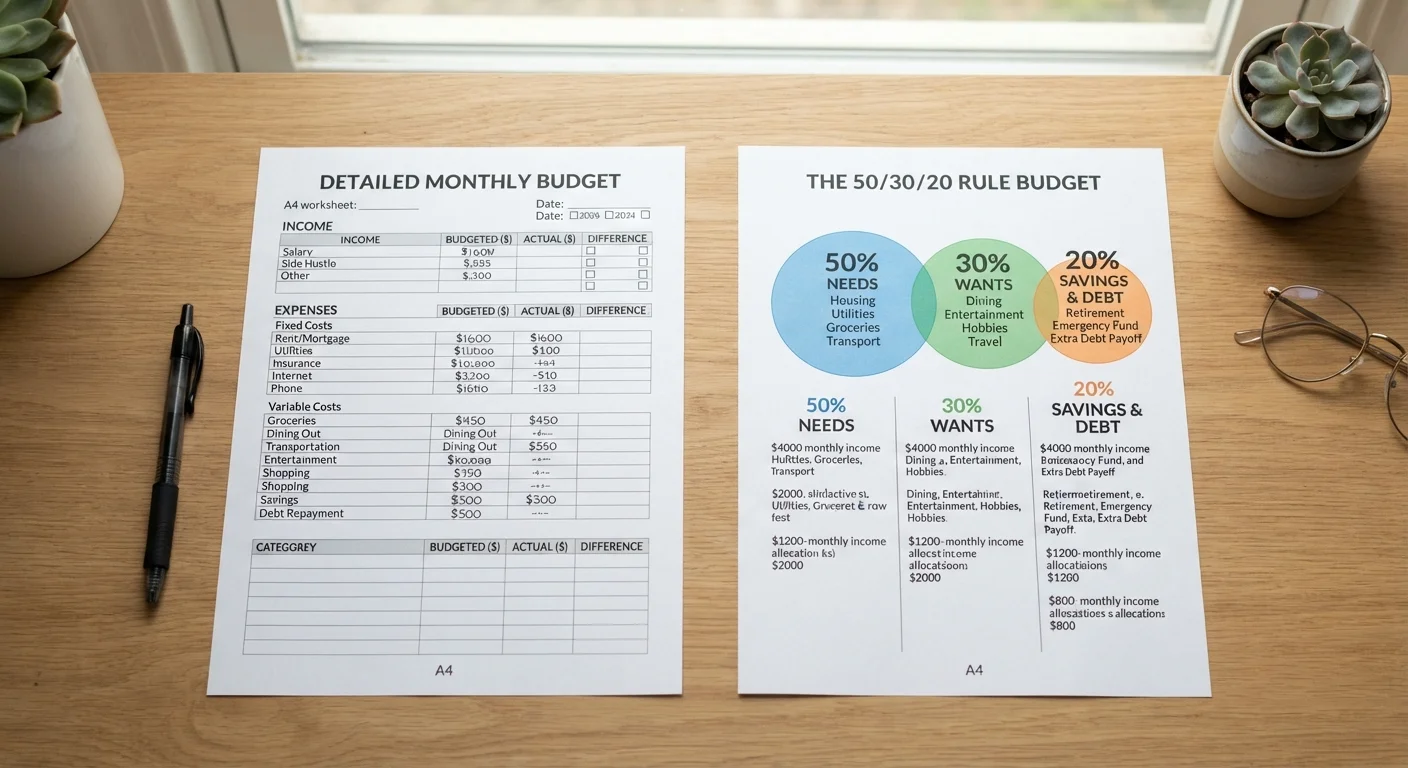
Option A
Zero-Based Budgeting
The detail-oriented method that accounts for every dollar.
Best for: People who want complete control over their spending and are willing to invest time tracking each expense category.
Option B
The 50/30/20 Rule
The simple percentage framework for hands-off budgeters.
Best for: People who want a low-maintenance structure without tracking every purchase individually.
How Each Method Works
Before comparing the two, it helps to understand exactly what each approach involves. If you're brand new to budgeting concepts, the Personal Budgeting from the Ground Up guide covers the foundational ideas worth knowing first.
Zero-Based Budgeting
With zero-based budgeting, you start from your total monthly income and assign every dollar to a specific category - rent, groceries, utilities, savings, entertainment, and so on - until you reach zero dollars remaining. The goal isn't to spend everything; it's to give every dollar an intentional destination. Unspent money gets assigned to savings or debt repayment rather than left to drift.
You rebuild this plan fresh each month, which means adjusting categories when life changes - a higher electric bill in winter, an irregular freelance payment, or an upcoming car repair.
The 50/30/20 Rule
The 50/30/20 rule divides your after-tax income into three buckets: 50% toward needs (housing, utilities, groceries, transportation), 30% toward wants (dining out, subscriptions, hobbies), and 20% toward savings and debt repayment. The percentages stay fixed, so once you've done the initial math, the framework mostly runs itself.
The method was popularized in part by Senator Elizabeth Warren and her daughter Amelia Warren Tyagi in their book All Your Worth, though the core concept of percentage-based budgeting has circulated in personal finance guidance for many years.
| Criterion | Zero-Based Budgeting | 50/30/20 Rule |
|---|---|---|
| Core concept | Every dollar gets a specific category | Income split across three broad buckets |
| Setup time | High - requires detailed category list | Low - three percentages, quick math |
| Monthly maintenance | Active - track and reassign each month | Minimal - percentages stay fixed |
| Best income type | Variable or irregular income | Stable, predictable paycheck |
| Granularity | High - every category tracked | Low - broad buckets only |
| Flexibility | Fully customizable each month | Fixed structure, less adaptable |
| Good for debt payoff | Yes - debt gets its own category | Partially - debt shares the 20% bucket |
| Beginner-friendly | Moderate - learning curve involved | Yes - simple to understand and start |
Where Each Method Falls Short
Both frameworks have real limitations worth knowing before you commit to one.
Zero-Based Budgeting: Time-Intensive by Design
The biggest drawback is the ongoing effort required. You need to track spending throughout the month and revisit your plan regularly. For people with busy schedules or inconsistent habits around record-keeping, the system can feel burdensome - and an abandoned budget helps no one. It can also feel overly restrictive to partners who want financial flexibility without itemizing every purchase.
The 50/30/20 Rule: Too Broad for Some Situations
The three-bucket structure glosses over details that matter. A household spending 60% on needs - not unusual in high-cost cities - has no clean way to apply the framework without distorting the percentages. The rule also doesn't distinguish between high-interest credit card debt and a low-rate mortgage, treating all debt repayment the same within that 20% bucket.
When Neither Framework Fits Perfectly
If your necessary expenses consistently exceed 50% of income, or if your spending doesn't fall neatly into "needs" and "wants," a rigid framework may cause more frustration than progress. In those cases, adapting the percentages to reflect your actual situation - or using zero-based budgeting with fewer, broader categories - can make either approach more practical. The goal is a plan that reflects real life, not one that forces real life to fit a template.
For a look at how other approaches handle similar trade-offs, see the comparison of envelope budgeting and digital spending categories.
Choosing the Right Fit for Your Life
The most effective budgeting method is one you'll actually use. Both zero-based budgeting and the 50/30/20 rule are tools - not mandates - and many people adapt or blend them over time.
~74%
Americans living paycheck to paycheck
A 2023 survey by PYMNTS and LendingClub found roughly 74% of U.S. consumers report living paycheck to paycheck, highlighting how common cash flow pressure is.
1 in 3
Adults with no written budget
Surveys from the National Foundation for Credit Counseling have consistently found that a significant share of U.S. adults do not maintain a formal household budget.
If you're motivated by granular control and are willing to invest 30-60 minutes per month reviewing line items, zero-based budgeting rewards that effort with a clearer picture of exactly where your money goes. If simplicity and sustainability matter more to you, the 50/30/20 rule offers a workable structure with minimal upkeep.
Some people start with the 50/30/20 rule to build the budgeting habit, then layer in zero-based thinking once they're comfortable with the basics. That hybrid approach is entirely reasonable - there's no rule that says you have to pick one and never adjust.
Whatever method you choose, a regular check-in is what keeps it working. The monthly budget review checklist can help you build that habit. And if you're still unsure where to start, common budgeting myths worth clearing up first.
This article is for general informational purposes only and does not constitute personalized financial advice. Consider consulting a qualified financial professional about budgeting strategies suited to your specific circumstances.
The content provided on our blog site traverses numerous categories, offering readers valuable and practical information. Readers can use the editorial team’s research and data to gain more insights into their topics of interest. However, they are requested not to treat the articles as conclusive. The website team cannot be held responsible for differences in data or inaccuracies found across other platforms. Please also note that the site might also miss out on various schemes and offers available that the readers may find more beneficial than the ones we cover.