

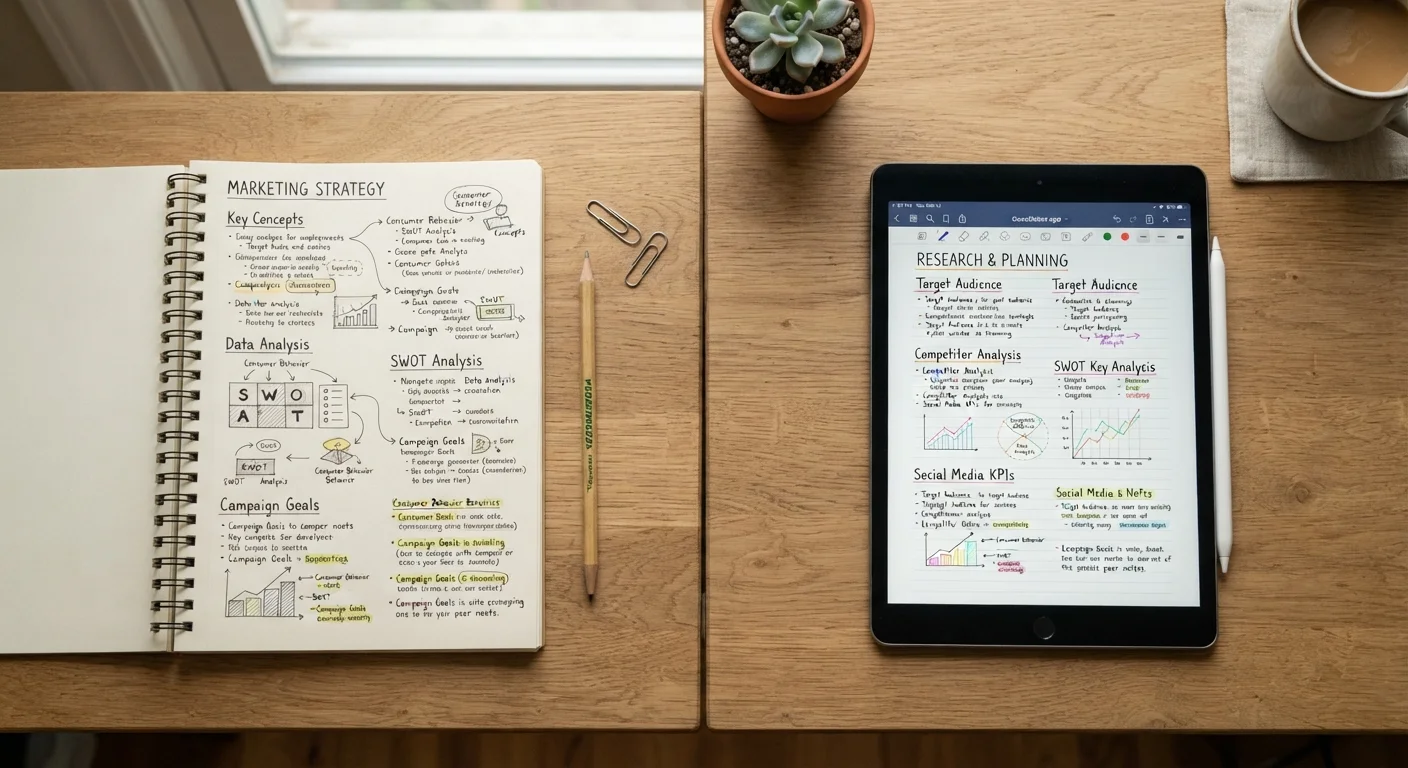
Our Verdict
Research consistently shows that handwriting supports deeper encoding for conceptual material, while digital tools offer practical advantages for organization, accessibility, and high-volume note-taking. Neither approach wins outright - the evidence points toward matching your medium to your specific task and learning objectives rather than committing to one format exclusively.
Learners who want to maximize comprehension of complex or conceptual material will benefit most from understanding when to reach for pen and paper versus a keyboard.
Why the Medium You Study With Actually Matters
When students switch from notebooks to laptops - or vice versa - they often focus on convenience. But cognitive science research suggests the medium itself shapes how information is processed, not just how quickly it's recorded. Understanding those differences can help you make a more deliberate choice.
The debate isn't simply about preference. Studies published in journals such as Psychological Science have examined whether typing and writing activate different cognitive processes. The short answer: they appear to. Typing often enables near-verbatim transcription, while handwriting's physical constraint tends to force paraphrasing and summarization - a process that supports deeper encoding. That said, the research picture is nuanced, and effect sizes vary across studies and learner populations.
For a structured look at how to build study sessions around these principles, see the practical framework for effective study sessions.
~25%
Recall advantage linked to handwritten notes
A frequently cited 2014 study by Mueller and Oppenheimer found handwriters outperformed typists on conceptual questions, though subsequent replication efforts have produced mixed results.
65%+
Students report distraction on devices during study
Multiple surveys of college students have found that a majority acknowledge off-task device use during study time, highlighting distraction as a real practical concern.
The Case for Digital Tools
Digital note-taking platforms offer genuine advantages that paper simply cannot match in certain contexts.
Fast input keeps pace with lectures
Typing speeds typically exceed handwriting speeds, allowing students to capture more raw information during fast-paced instruction or dense reading assignments.
Powerful search and organization features
Digital apps allow instant retrieval across thousands of pages of notes - a significant advantage when reviewing for exams or synthesizing material across multiple sources.
Easy editing, restructuring, and annotation
Unlike paper notes, digital text can be reorganized, color-coded, and annotated without creating visual clutter, making iterative review more practical.
Cloud sync supports studying anywhere
Notes stored in cloud platforms are accessible across devices, reducing the risk of losing material and enabling flexible study locations.
Accessibility tools benefit diverse learners
Screen readers, adjustable text size, voice input, and dyslexia-friendly fonts make digital environments more inclusive for students with learning differences.
For learners managing large volumes of material across multiple subjects - college students, working professionals, or anyone studying for professional certification - the organizational and retrieval benefits of digital tools are hard to dismiss. Searchable notes, synced cloud backups, and the ability to embed multimedia content represent real cognitive-load savings when content management itself becomes a task.
Digital tools also level the playing field for students with certain learning differences. Text-to-speech integration, adjustable font sizes, and assistive input methods make digital platforms significantly more accessible for many learners.
The Case for Pen and Paper
Despite the appeal of digital convenience, handwriting holds meaningful advantages backed by learning science.
Typing may encourage shallow transcription
Because typing is fast, students often record information verbatim without paraphrasing - a passive approach that research associates with weaker long-term retention of conceptual material.
Digital devices introduce significant distraction risk
Notifications, social media, and browsing can fragment study sessions. Research on multitasking consistently shows it impairs both comprehension and recall.
Screen fatigue can reduce sustained focus
Extended reading on backlit screens is associated with greater visual fatigue compared with reading on paper, which may affect study session duration and comfort.
Handwriting supports deeper encoding of complex ideas
The slower pace of handwriting appears to prompt more active summarization and conceptual processing, which may improve understanding and recall of analytical material.
The friction of writing by hand - slower, requiring more deliberate word choice - may be a feature rather than a bug. When you can't write everything verbatim, you are compelled to identify what matters most, a form of active processing that strengthens memory encoding. Research suggests this effect is especially pronounced for conceptual or analytical material, compared with straightforward factual lists.
Paper also eliminates a major pitfall of digital studying: the internet. Devices with connectivity introduce constant competition for attention, from notifications to browsing temptations. A notebook, by contrast, is a closed environment. For learners prone to digital distraction, this constraint alone can significantly improve study quality. You can explore note-taking structures that work particularly well on paper in our comparison of popular note-taking methods.
Replication and Ongoing Research
The widely cited Mueller and Oppenheimer findings on handwriting versus typing have faced mixed results in replication studies, meaning the effect may be smaller or more context-dependent than early headlines suggested. Learning science in this area is active and evolving. Treat general principles as guidance rather than absolute rules, and pay attention to what works in your own practice.
How to Choose - or Combine - Both Approaches
The strongest study practices often don't treat this as an either/or decision. Consider matching medium to task:
- Use handwriting for lectures, seminars, or reading sessions where understanding and synthesis are the goal.
- Use digital tools for organizing, reviewing, and annotating existing material, or for reference-heavy disciplines where search functionality saves significant time.
- Try hybrid workflows - for example, handwrite initial notes, then type a structured summary afterward as a retrieval practice exercise.
This combination approach aligns well with spaced repetition and interleaved practice strategies. If you're weighing broader study structure decisions, our article on interleaving vs. blocked practice offers a useful evidence-based complement to this discussion.
Ultimately, the best medium is one you will use consistently, intentionally, and with full attention. Self-awareness about your distraction patterns, the nature of your material, and your learning goals will guide you more reliably than any blanket recommendation.
The content provided on our blog site traverses numerous categories, offering readers valuable and practical information. Readers can use the editorial team’s research and data to gain more insights into their topics of interest. However, they are requested not to treat the articles as conclusive. The website team cannot be held responsible for differences in data or inaccuracies found across other platforms. Please also note that the site might also miss out on various schemes and offers available that the readers may find more beneficial than the ones we cover.