

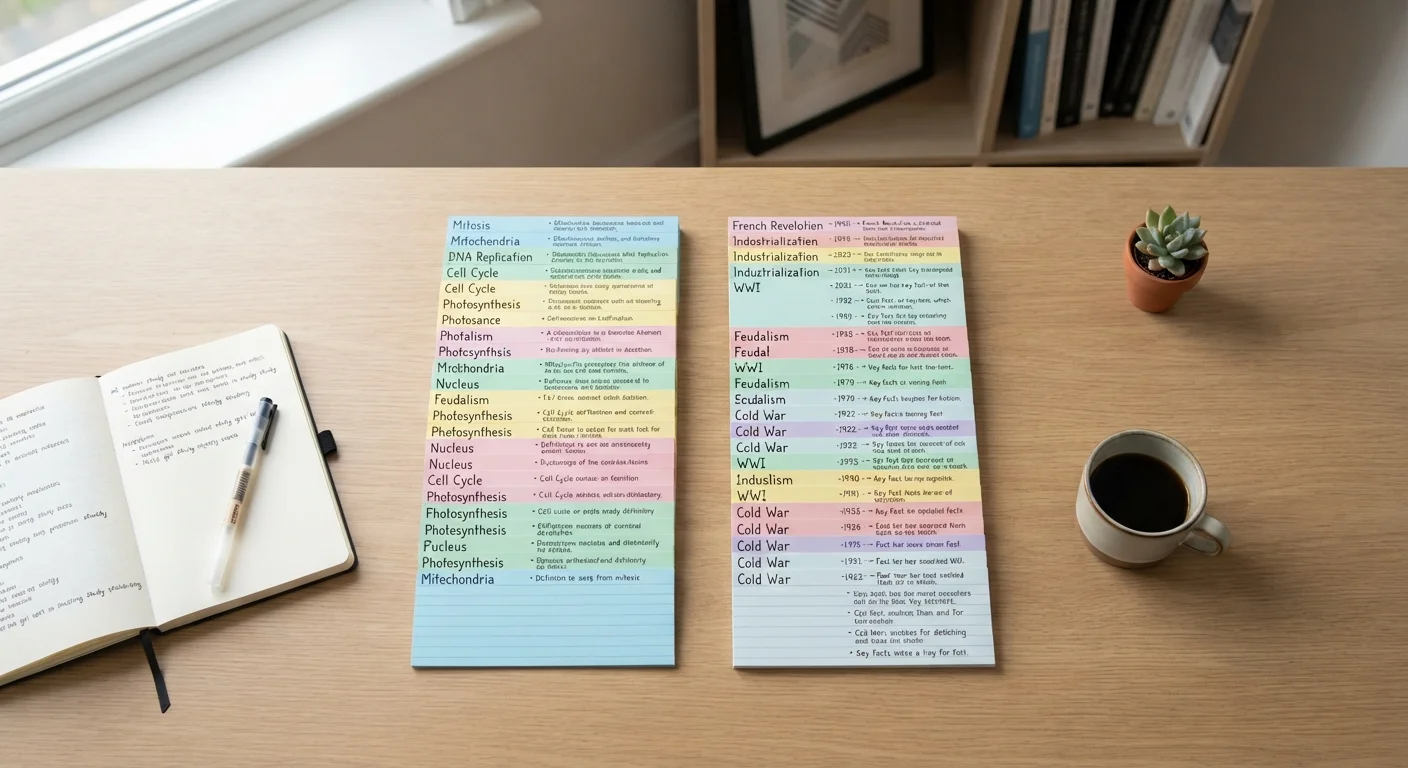
Option A
Blocked Practice
The familiar, topic-by-topic study method.
Best for: Best for initial skill acquisition and building basic familiarity with brand-new material.
Option B
Interleaved Practice
The research-backed, mixed-sequence study method.
Best for: Best for building durable, flexible knowledge that transfers to tests and real-world application.
What Blocked and Interleaved Practice Actually Mean
Most learners default to blocked practice without realizing it: study all of Chapter 3, then all of Chapter 4, then all of Chapter 5. Within a single session, one concept is drilled repeatedly before moving to the next. This approach feels productive - and for a very first introduction to material, it can be.
Interleaved practice works differently. Instead of clustering problems by type, a learner mixes questions or tasks from multiple topics within the same session - for example, rotating through algebra, geometry, and statistics problems rather than completing all of one kind before moving on.
The critical difference is not the total study time; it is the sequence in which material appears. That sequencing decision has a surprisingly large effect on what learners remember days and weeks later. For a deeper look at how session structure affects memory encoding, see building a study session that sticks.
| Criterion | Blocked Practice | Interleaved Practice |
|---|---|---|
| Session structure | One topic at a time | Multiple topics mixed together |
| Perceived difficulty | Feels easier, more fluent | Feels harder, more effortful |
| Short-term performance | Higher during practice | Lower during practice |
| Long-term retention | Weaker on delayed tests | Stronger on delayed tests |
| Transfer to new problems | Limited transfer | Stronger transfer |
| Best stage of learning | Initial introduction to topic | Review and consolidation |
| Strategy discrimination | Not practiced | Actively practiced each attempt |
Why Interleaving Outperforms Blocked Practice on Retention
Cognitive scientists use the term desirable difficulty to describe challenges that slow down the learning process in a way that ultimately strengthens memory. Interleaving is a textbook example. When problems are mixed, learners cannot rely on the previous problem to signal which formula or strategy to use - they must retrieve and discriminate on every single attempt.
This retrieval effort is precisely what makes interleaving powerful. It forces the brain to practice the selection of knowledge, not just its execution. That mirrors real-world conditions - and exam conditions - where no label tells you which concept applies.
~215%
Retention advantage for interleaved learners
A widely cited study by Rohrer and Taylor (2007) found interleaved mathematics practice produced roughly double the correct answers on a delayed test compared to blocked practice.
~60-70%
Drop in blocked-practice scores on delayed tests
Research on motor skill and mathematics learning consistently documents sharp declines in blocked-practice performance when tests occur days or weeks after the study session.
Blocked practice, by contrast, keeps the learner in a narrow groove. Because the context cues what strategy to apply, less effortful retrieval happens. Performance during the session looks better, which is why learners (and sometimes instructors) misjudge blocked practice as more effective. This gap between immediate performance and long-term retention is one of the most replicated findings in learning science. Understanding how the spacing effect compounds this further is worthwhile - read about the science behind spaced repetition for related context.
When to Use Each Approach - and How to Combine Them
Blocked practice is not without merit. Research suggests it is appropriate when a learner is completely new to a concept and needs extended exposure to build an initial schema. Jumping straight into interleaving before any foundation exists can cause unproductive confusion rather than desirable difficulty.
A practical approach many educators recommend is a phased structure:
- Phase 1 - Blocked: When first encountering a concept, work several blocked examples to build basic familiarity and procedural fluency.
- Phase 2 - Interleaved: Once the concept is recognizable, begin mixing it with previously studied material in subsequent sessions.
This mirrors how well-designed textbooks and curricula work at their best - introducing concepts sequentially but returning to them in mixed contexts over time. It also pairs naturally with spaced repetition: spacing determines when you revisit material; interleaving determines how you mix it when you do. For additional techniques that complement this structure, explore memory encoding strategies worth adding to your routine.
Interleaving Is Not the Same as Random Chaos
Effective interleaving involves mixing related but distinct concepts - not arbitrarily unrelated topics. For example, interleaving different equation types within algebra is productive; mixing algebra with unrelated history notes is not. The goal is to train discrimination among concepts that could be confused, not to create overwhelming disorder. Thoughtful sequencing within a subject area yields the strongest results.
The content provided on our blog site traverses numerous categories, offering readers valuable and practical information. Readers can use the editorial team’s research and data to gain more insights into their topics of interest. However, they are requested not to treat the articles as conclusive. The website team cannot be held responsible for differences in data or inaccuracies found across other platforms. Please also note that the site might also miss out on various schemes and offers available that the readers may find more beneficial than the ones we cover.