

Our Verdict
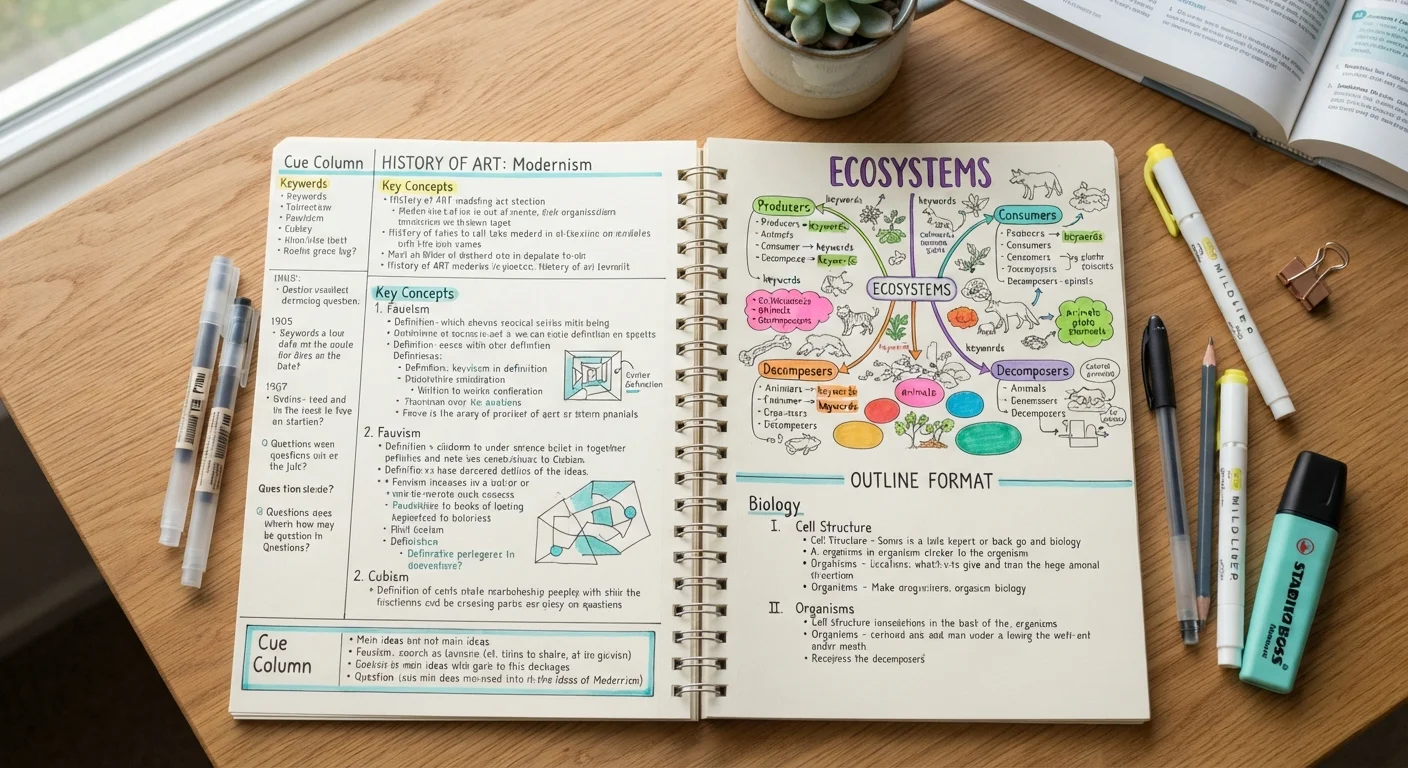
Each note-taking system offers distinct strengths depending on the subject, the learner's cognitive style, and how the notes will be used later. Cornell is a strong general-purpose choice for building retrieval habits, while mind maps suit creative or relational thinking. Outlines remain the most efficient option for linear, structured content.
| Best for | Recommended |
|---|---|
| Students wanting built-in self-testing and review | Cornell Method |
| Learners processing complex, interconnected concepts | Mind Mapping |
| Fast note capture during structured lectures or readings | Outline Method |
| Writers and thinkers working with free-form ideas | Sentence / Flow Method |
Why Your Note-Taking Method Matters
Note-taking is not simply transcription - it is an early act of learning. Research in cognitive science suggests that how you record information shapes how well you encode, organize, and later retrieve it. Yet many learners default to whatever system feels fastest in the moment, without considering whether it supports their actual goals.
Choosing a method intentionally can improve comprehension, reduce study time, and strengthen long-term recall. This comparison covers four widely used systems - Cornell, Mind Mapping, the Outline Method, and the Sentence/Flow Method - examining what each does well, where it falls short, and when to use it. For a broader look at how note-taking fits into a full study routine, see our practical study session framework.
The Cornell Method: Structure Built for Retrieval
Developed at Cornell University in the 1950s, the Cornell Method divides a page into three zones: a narrow cue column on the left, a wider note-taking column on the right, and a summary box at the bottom. During a lecture or reading, you capture ideas in the right column. Afterward, you write questions or keywords in the cue column - prompts that cover the notes - and write a brief summary at the bottom.
This built-in structure transforms passive notes into an active review tool. Covering the right column and answering the cue questions is a form of retrieval practice, one of the most well-supported strategies in memory research. The summary section also forces synthesis rather than mere copying.
Best suited for: Lectures, textbook chapters, and any content where understanding relationships between ideas matters. Less ideal for highly visual material or fast-paced brainstorming.
Upgrade Cornell Notes with Active Recall
After filling in your cue column, fold or cover the right-hand notes and try to answer each cue from memory before checking. This retrieval practice - even when you get answers wrong - strengthens long-term memory far more than re-reading. Aim to do this within 24 hours of taking the notes while memory is still fresh.
Mind Mapping: Thinking in Connections
A mind map starts with a central concept and branches outward into related ideas, sub-topics, and details, often using color and imagery. This radial format reflects associative thinking and can make relationships between concepts visible at a glance.
Mind maps are particularly useful for brainstorming, planning essays, reviewing before an exam, or working through subjects with many interconnected parts - such as biology, history, or project planning. However, they can become cluttered and are harder to create during fast-paced lectures. They also tend to sacrifice depth and detail in favor of breadth.
Best suited for: Conceptual overviews, creative planning, and synthesizing material after initial learning. Less suited to dense, sequential content.
| Cornell Method | Mind Mapping | Outline Method | Sentence/Flow Method | |
|---|---|---|---|---|
| Best for | Lectures, textbook reading | Visual/conceptual topics | Structured, linear content | Capturing nuance and context |
| Supports retrieval practice | Yes - cue column built in | Partial - visual recall | Only if reviewed actively | Rarely, without restructuring |
| Speed during class | Moderate | Slow | Fast | Fast |
| Ease of review | High - structured layout | High - visual overview | Moderate | Low - dense prose |
| Suits visual learners | Partially | Strongly | Minimally | Minimally |
| Works for dense material | Yes | Limited | Yes | Yes, but overwhelming |
The Outline Method and Sentence/Flow Notes
The Outline Method organizes information hierarchically using headings, subheadings, and indented bullet points. It mirrors the structure of most textbooks and many lectures, making it intuitive and fast to produce. The trade-off is that it works best when source material is already well-organized; it can produce fragmented, hard-to-use notes when a speaker or text is non-linear.
The Sentence Method (sometimes called Flow Notes) records each idea as a complete sentence or thought in sequence. It captures nuance and context that bullet-point outlines can miss, but it risks becoming a near-verbatim transcript - which research suggests may actually reduce deeper processing compared to selective, paraphrased notes. For more on this risk, see why rereading your notes can mislead you.
The question of whether to take notes digitally or by hand also affects which methods are practical. Our article on digital tools vs. paper for studying explores the evidence on both sides.
Choosing and Combining Methods
No single method is universally superior. The most effective approach depends on the subject, the format of instruction, and how you plan to review. A few practical principles can guide selection:
- Match method to material: Use outlines for structured lectures, mind maps for conceptual overview, and Cornell when review and self-testing are priorities.
- Combine strategically: Many learners take rough outline or sentence notes during class, then reorganize them into Cornell or mind map format afterward - reinforcing learning in the process.
- Review is non-negotiable: Any note system is only as valuable as the review habit attached to it. Notes that are never revisited contribute little to long-term retention.
For a broader survey of evidence-based study strategies, our study techniques reference overview provides a useful companion guide.
The content provided on our blog site traverses numerous categories, offering readers valuable and practical information. Readers can use the editorial team’s research and data to gain more insights into their topics of interest. However, they are requested not to treat the articles as conclusive. The website team cannot be held responsible for differences in data or inaccuracies found across other platforms. Please also note that the site might also miss out on various schemes and offers available that the readers may find more beneficial than the ones we cover.