

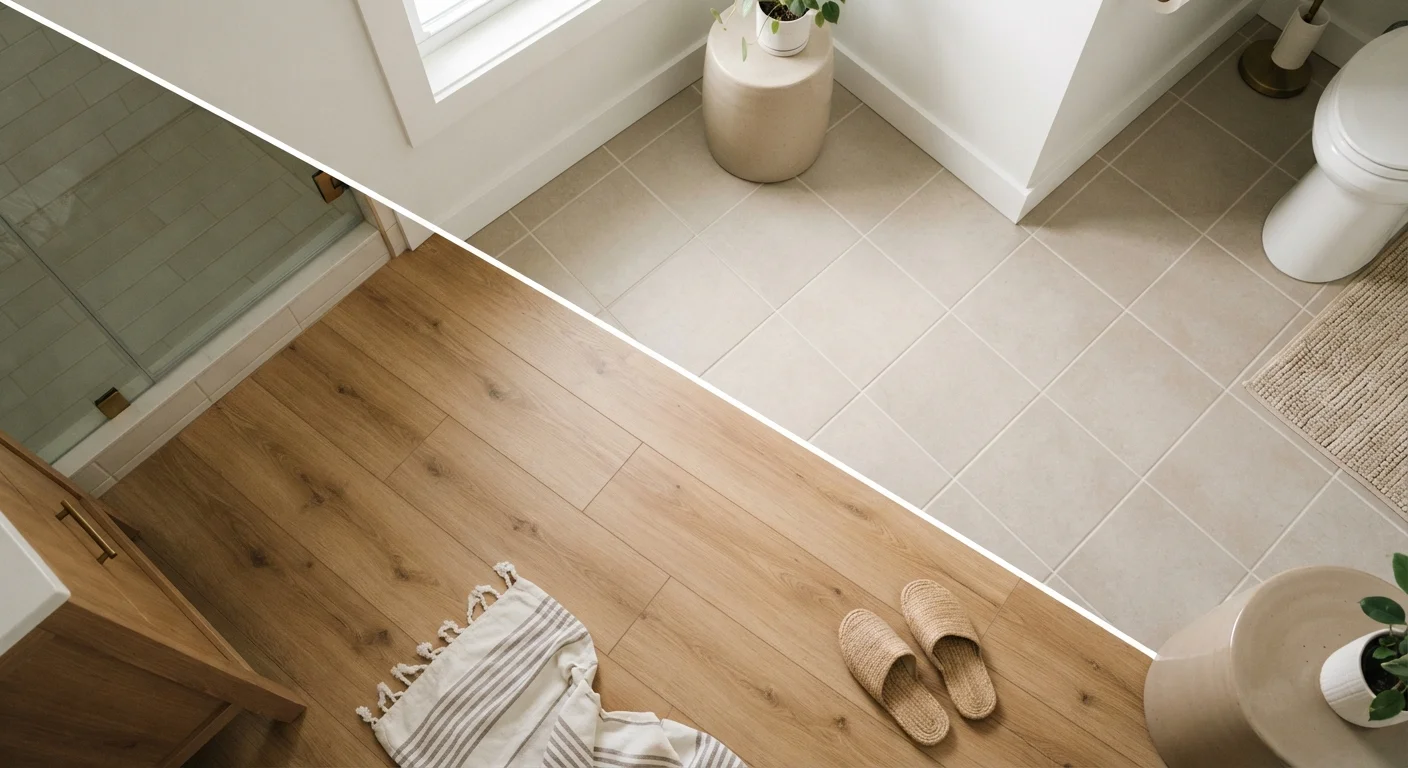
Option A
Ceramic or Porcelain Tile
The time-tested, fully waterproof standard.
Best for: Homeowners who want maximum longevity, easy cleaning, and don't mind a more involved installation process.
Option B
Luxury Vinyl Plank (LVP)
The resilient, DIY-friendly modern alternative.
Best for: Homeowners seeking a warmer underfoot feel, budget-conscious installation, and a faster project timeline.
How Each Material Handles Bathroom Conditions
Bathrooms are among the most demanding environments for flooring. Humidity cycles, standing water, temperature swings, and cleaning chemicals all take a toll. Understanding how tile and LVP behave under these conditions is the first step toward a floor that holds up.
Ceramic and porcelain tile are inherently impervious to water - the tile body itself won't absorb moisture. The weak point is the grout: standard unsanded or sanded grout is porous, and if left unsealed, it can absorb water and harbor mildew. Epoxy grout largely eliminates that vulnerability, though it's more expensive and harder to work with. For heavily used bathrooms or wet rooms, tile combined with a waterproof membrane underneath is the most reliable system available. See our guide on grout vs. caulk to understand where each material belongs at tile transitions and corners.
Luxury vinyl plank is water-resistant, not fully waterproof. The core of quality LVP - often made from a stone-plastic composite (SPC) or wood-plastic composite (WPC) - won't swell when exposed to moisture. However, water that seeps beneath the planks through seams, around toilet bases, or along wall edges can sit on the subfloor and cause damage over time. In standard bathrooms with normal splash and humidity, LVP performs reliably. In high-traffic bathrooms or rooms where water regularly pools, extra attention to sealing edges and perimeter transitions is essential.
| Criterion | Ceramic / Porcelain Tile | Luxury Vinyl Plank (LVP) |
|---|---|---|
| Waterproofing | Fully waterproof (tile body); grout needs sealing | Water-resistant; seams can be vulnerable |
| Typical lifespan | 30-50+ years | 15-25 years |
| Comfort underfoot | Hard, cold without radiant heat | Softer, warmer feel |
| DIY difficulty | Moderate to high | Low to moderate |
| Subfloor prep required | Rigid base, backer board often required | Flat, dry; minor imperfections tolerated |
| Scratch/dent resistance | Excellent | Good; can scratch with sharp objects |
| Maintenance | Grout cleaning and periodic sealing | Damp mop only; minimal upkeep |
| Suitable for wet rooms | Yes, with waterproof membrane | Not recommended |
Installation Complexity and Subfloor Requirements
Installation demands are where these two materials diverge most sharply - and the gap matters whether you're hiring a professional or tackling the work yourself.
Tile demands a stiff, level subfloor. Flex causes grout and tile to crack over time. In most bathrooms, that means installing cement backer board (such as cement board or fiber-cement panels) over the subfloor before any tile goes down. The subfloor also needs to meet deflection standards - industry guidelines generally recommend no more than L/360 deflection under load. If your subfloor bounces or has soft spots, those issues must be addressed before tiling. The tile-setting process itself involves thinset mortar, proper tile layout planning, and grouting - a multi-day project that requires drying time between stages. For a broader look at sequencing these steps in a full renovation, our bathroom renovation planning guide covers layout decisions through finish selection.
LVP is comparatively forgiving. Many products can float - meaning they click together and rest on the subfloor without adhesive - and they tolerate minor height variations better than tile. The subfloor still needs to be clean, dry, and reasonably flat (typically within 3/16 inch over 10 feet), but the tolerance for imperfection is wider. Confident DIYers can often complete a bathroom LVP install in a single day.
L/360
Minimum subfloor stiffness for tile
The Tile Council of North America recommends subfloor deflection no greater than L/360 under load to prevent tile and grout cracking.
3/16"
LVP flatness tolerance over 10 feet
Most LVP manufacturers specify the subfloor must be flat within 3/16 inch over a 10-foot span for a proper floating installation.
15-25 yrs
Typical LVP residential lifespan
Quality stone-plastic composite LVP products carry residential wear warranties generally ranging from 15 to 25 years under normal use conditions.
Cost, Lifespan, and Long-Term Value
Material and labor costs vary significantly by region, but tile consistently carries a higher professional installation cost due to the preparation and skill involved. LVP material costs have dropped as the category matured, and DIY installation can eliminate most labor cost entirely.
On lifespan, tile wins decisively in raw longevity. Porcelain tile in a well-maintained bathroom can last several decades without needing replacement - the limiting factor is usually grout condition or style obsolescence, not the tile itself. Quality LVP is typically rated for 15-25 years under normal residential use, though heavy foot traffic and moisture exposure can shorten that window.
When evaluating long-term value, factor in the cost of eventual replacement. A tile floor that lasts 40 years may represent better value per year than an LVP floor replaced twice in the same span - but that calculation shifts if installation cost differences are large or if you plan to sell the home in the nearer term.
A note on resale: Both materials are broadly accepted by buyers in the current housing market. Tile tends to signal durability and quality in bathrooms; LVP reads as updated and practical. Neither is a liability if installed well.
Radiant Heat Compatibility
Electric radiant heat systems are compatible with both tile and select LVP products, but the rules differ. Tile conducts and retains heat efficiently and is an ideal partner for in-floor heating. LVP can work with low-temperature radiant systems, but always verify the manufacturer's maximum temperature rating - typically 85°F surface temperature - before installing LVP over any heated subfloor. Exceeding that threshold can cause the planks to warp or delaminate.
The content provided on our blog site traverses numerous categories, offering readers valuable and practical information. Readers can use the editorial team’s research and data to gain more insights into their topics of interest. However, they are requested not to treat the articles as conclusive. The website team cannot be held responsible for differences in data or inaccuracies found across other platforms. Please also note that the site might also miss out on various schemes and offers available that the readers may find more beneficial than the ones we cover.