

Why Basement Waterproofing Is So Widely Misunderstood
Basement moisture problems are among the most common - and most mishandled - issues US homeowners face. The waterproofing product market is crowded with solutions that promise to stop leaks permanently, and it's easy to mistake a temporary fix for a lasting one. Understanding what actually causes water intrusion is the foundation of solving it correctly.
Water enters basements through three main pathways: hydrostatic pressure pushing through walls or floors, capillary action wicking moisture through porous concrete, and direct leakage through cracks or gaps. Each mechanism requires a different response - and confusing them leads to wasted money and recurring damage. See how hidden project costs can compound these problems in our guide to renovation budget pitfalls.
Myth
Painting the interior walls with waterproofing sealant will stop water from coming in.
Fact
Interior masonry sealants can slow vapor transmission but cannot withstand sustained hydrostatic pressure - the force of water-saturated soil pushing against the foundation.
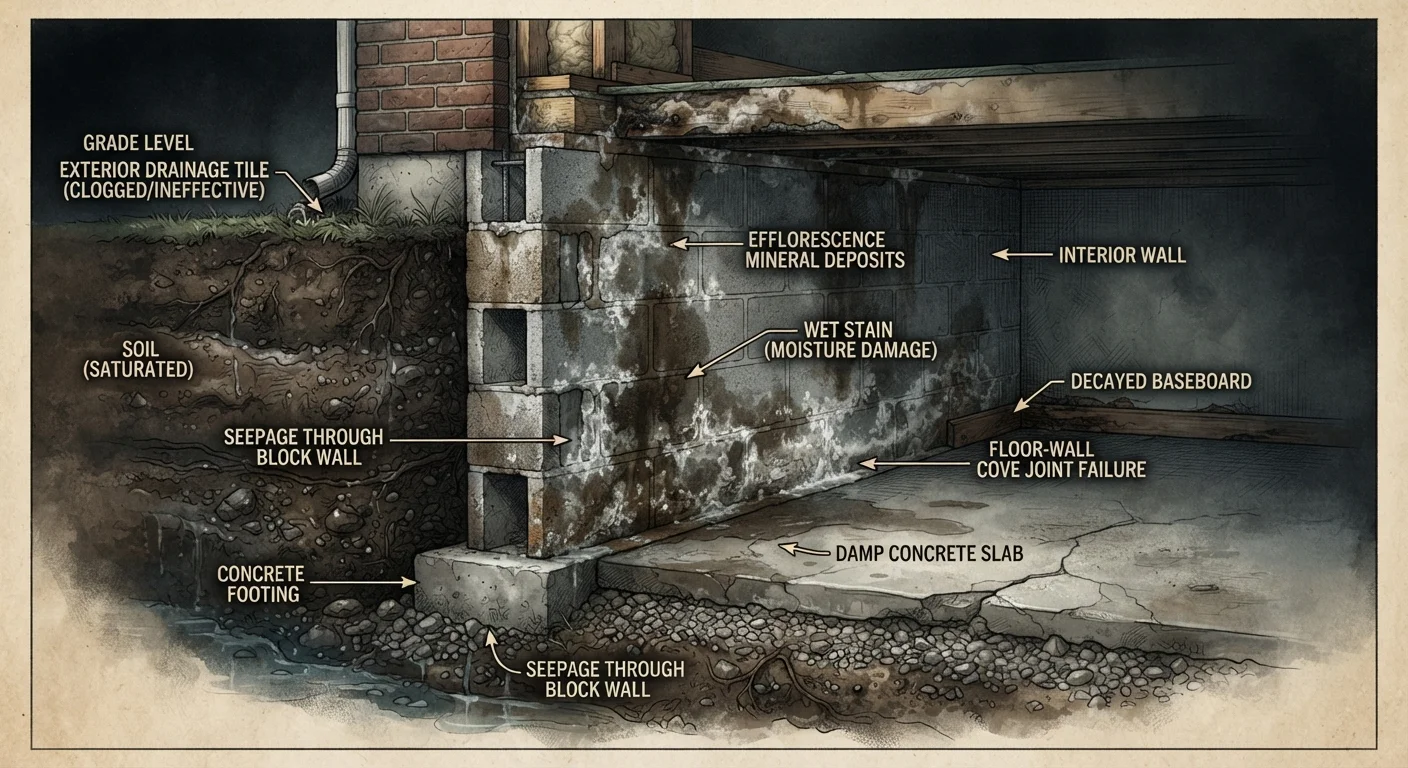
Products marketed as "waterproofing paint" are more accurately vapor barriers or dampproofing coatings. When groundwater builds up against a foundation wall and hydrostatic pressure increases - particularly after heavy rain - these coatings peel, bubble, and fail. The water finds any path through, often appearing as efflorescence (white mineral deposits) or active seepage at the base of the wall. Addressing the pressure source - typically exterior drainage - is the necessary first step.
Myth
If water is getting in through the walls, the wall itself needs to be sealed from the inside.
Fact
In most cases, water entering through basement walls originates from poor drainage, improper grading, or failed exterior waterproofing - not a wall defect that an interior coating can fix.
The wall is the last line of defense, not the first. Water that pools against the foundation eventually finds microscopic voids in concrete or mortar joints and migrates inward. Treating the wall surface without correcting the exterior conditions is like mopping without turning off the tap. Regrading soil, extending downspouts, and ensuring gutters are functioning properly often dramatically reduces or eliminates interior moisture without any wall treatment at all.
Myth
A sump pump is the complete solution to a wet basement.
Fact
A sump pump removes water that has already entered the basement. It is one component of a water management system, not a standalone waterproofing solution.
Sump pumps are essential and effective - but only when paired with a drainage system that collects and channels water to the sump pit. Without a perimeter drain or drain tile, water can still pool on the floor or seep into framing and finishes before reaching the sump. Additionally, sump pumps require a reliable power source; battery backup systems are worth considering in areas prone to storm-related outages, since pumps are most needed precisely when power is at risk.
Myth
Any crack in the foundation wall can be fixed with hydraulic cement or caulk.
Fact
Not all cracks are equal. Hairline cracks from normal curing differ fundamentally from cracks caused by settlement or lateral soil pressure, which may indicate structural movement requiring professional evaluation.
Hydraulic cement expands as it sets and can temporarily plug active water leaks in non-structural cracks - a legitimate short-term use. But applying it to a crack caused by shifting soil or differential settlement without addressing the underlying movement means the crack will reopen, often wider. Horizontal cracks in block walls, in particular, can signal inward bowing from soil pressure - a structural issue that no sealant can address. Similarly, the principle of using the right material in the right location applies broadly to home repairs; our guide on where grout and caulk each belong illustrates this well for tiled surfaces.
Myth
Once a basement is waterproofed professionally, it's a permanent fix with no maintenance needed.
Fact
Even professionally installed waterproofing systems require periodic maintenance - sump pumps need testing, drain lines can clog, and exterior membranes can degrade over time.
Interior drainage systems should have their sump pit and pump inspected at least annually. Test the pump by pouring water into the pit and confirming it activates and discharges correctly. Drain tile can collect silt or mineral buildup over years and may need flushing. Exterior waterproofing membranes, typically applied to the foundation exterior during excavation, can be damaged by root intrusion or soil movement. No waterproofing system is indefinitely passive - treating it as part of routine home maintenance protects the investment.
What Actually Works - and Where to Start
Before any interior treatment, homeowners should inspect and address exterior conditions. Gutters clogged with debris can dump hundreds of gallons of water against a foundation during a single rainstorm. Downspouts should discharge at least six feet away from the house. The soil grade around the foundation should slope away - roughly one inch of drop per foot for the first six feet - to prevent pooling.
Don't Finish Basement Walls Over an Unresolved Moisture Problem
Installing drywall, insulation, or wood framing over a damp or leaking basement wall traps moisture and creates ideal conditions for mold growth and wood rot - often invisible until significant damage has occurred. Resolve water intrusion fully before any finishing work begins. If you're planning a basement renovation, factor waterproofing into the early planning stages, not as an afterthought.
If exterior corrections don't resolve the issue, interior drainage systems - perforated drain tile installed at the footing level, directing water to a sump pit - are the most reliable interior solution. These systems manage water that enters rather than blocking it at the source, which is a realistic and proven approach for many foundation types. A sump pump is a component of this system, not a substitute for it.
Structural cracks - those wider than a hairline, horizontal, or stair-stepping through block walls - warrant evaluation by a licensed structural engineer or foundation specialist before any waterproofing work begins. Sealing over a structural problem does not resolve it. Given the complexity and the safety implications of foundation work, consulting a qualified professional is strongly recommended before committing to any major approach. Permits may be required for drainage system installation; verify requirements with your local building department.
Mold Risk Makes Delay Costly
Persistent basement moisture creates conditions where mold can begin growing within 24 to 48 hours on organic materials like wood framing and drywall. Beyond structural damage, mold remediation adds significant cost and complexity to any repair project. If you observe visible mold, musty odors, or signs of prolonged moisture, consult a qualified remediation professional in addition to addressing the water source. Do not attempt to seal over mold-affected surfaces.
Surface preparation matters enormously for any treatment you do apply. Much like how wall prep determines paint durability, cleaning, etching, and repairing concrete before applying any coating or sealant is what determines whether it holds at all.
The content provided on our blog site traverses numerous categories, offering readers valuable and practical information. Readers can use the editorial team’s research and data to gain more insights into their topics of interest. However, they are requested not to treat the articles as conclusive. The website team cannot be held responsible for differences in data or inaccuracies found across other platforms. Please also note that the site might also miss out on various schemes and offers available that the readers may find more beneficial than the ones we cover.