

Start here
What Is an Electrical Circuit?
Build on it
How Your Home's Electrical Panel Works
Go deeper
Types of Circuits in a Typical Home
Apply it
What Homeowners Can Safely Do - and What They Can't
Know your limits
When to Call a Licensed Electrician
What Is an Electrical Circuit?
A circuit is a continuous loop that allows electrical current to travel from your utility supply, through your home's wiring, power a device or fixture, and return safely back. If that loop is broken anywhere - by a switch, a tripped breaker, or damaged wiring - the current stops and the device goes dark.
Every outlet, light fixture, and hardwired appliance in your home sits on at least one circuit. Understanding this loop concept is the foundation for making sense of everything else in your electrical system.
Circuit
A closed loop through which electrical current flows from a power source, through wiring and devices, and back again. Breaking the loop at any point stops the flow.
Circuit Breaker
A resettable safety switch inside your electrical panel that automatically cuts power to a circuit when current exceeds a safe level, preventing overheating and fire.
Ampere (Amp)
The unit used to measure the amount of electrical current flowing through a circuit. Breakers and wires are rated by amps, and they must be matched to each other.
Dedicated Circuit
A circuit wired solely to serve one specific appliance or outlet, ensuring it always has adequate power without competing with other devices.
GFCI
Ground Fault Circuit Interrupter - a type of outlet or breaker that shuts off power in milliseconds when it detects an unintended path for current, reducing shock risk in wet areas.
240-Volt Circuit
A higher-voltage circuit used for large appliances like electric dryers and ranges. It uses a double-pole breaker and requires two hot wires rather than one.
How Your Home's Electrical Panel Works
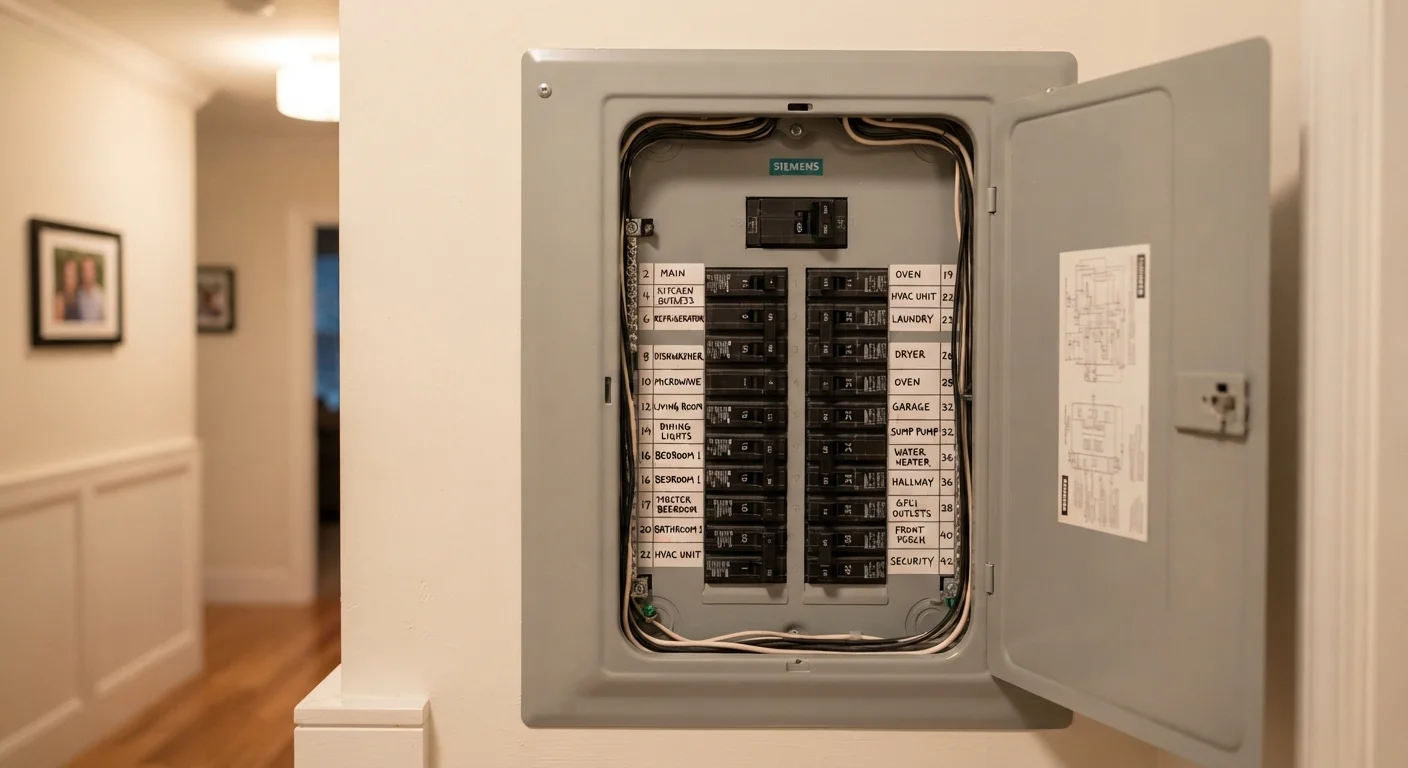
Your electrical panel - sometimes called a breaker box or load center - is the hub where utility power enters your home and divides into individual circuits. Inside, each circuit connects to its own circuit breaker, a spring-loaded switch that automatically cuts power if current exceeds a safe level.
Older homes may use fuse boxes instead, where a metal strip inside a screw-in fuse melts to break the circuit under overload. Both systems serve the same protective purpose, but modern panels with breakers are easier to reset and generally safer to work around.
The panel's main breaker controls power to all circuits simultaneously. Each branch breaker is rated in amperes (amps) - commonly 15A or 20A for general circuits, and 30A to 50A for large appliances. The breaker rating must match the wire gauge on that circuit; mismatches create fire hazards.
Panel Access Is Not DIY Territory
While it can be useful to visually familiarise yourself with your panel layout, opening the panel cover and touching internal wiring or terminals is dangerous even with the main breaker off - the utility service wires remain live. Leave any internal panel work to a licensed electrician.
Types of Circuits in a Typical Home
Not all circuits are equal. Your home likely contains several distinct types:
- General lighting circuits: Typically 15-amp circuits serving overhead lights and standard outlets across rooms.
- General-purpose outlet circuits: Usually 20-amp circuits powering multiple outlets in living spaces and bedrooms.
- Dedicated appliance circuits: Single circuits wired exclusively to one high-demand appliance - refrigerators, dishwashers, washing machines, and microwave ovens commonly have their own dedicated circuits.
- Large-appliance circuits: 240-volt circuits for electric dryers, ranges, central air conditioners, and electric water heaters. These use a double-pole breaker occupying two slots in the panel.
- GFCI-protected circuits: Required by code in bathrooms, kitchens, garages, outdoor areas, and other damp locations to protect against electric shock.
Mapping your circuits - noting which breaker controls which area - is one of the most useful projects a homeowner can complete.
What Homeowners Can Safely Do - and What They Can't
Electrical work spans a wide range of complexity, and knowing where the safe boundary lies protects both you and your home. Just as some car maintenance tasks are straightforward while others demand a qualified mechanic, the same principle applies to home electrical work.
Generally safe for informed homeowners
- Resetting a tripped circuit breaker (once only - investigate if it trips again immediately)
- Replacing outlet or switch cover plates
- Replacing a light bulb or fixture shade
- Testing outlets with a plug-in circuit tester
- Labeling your electrical panel
Requires a licensed electrician
- Adding, moving, or extending any wiring
- Installing new outlets, switches, or fixtures that require new wiring
- Upgrading or replacing the electrical panel
- Installing dedicated circuits for appliances
- Any work on 240-volt circuits
- Work that requires an electrical permit
Never Ignore a Repeatedly Tripping Breaker
Continuously resetting a breaker that keeps tripping is not a fix - it is a warning sign. Repeated tripping can indicate an overloaded circuit, a failing breaker, or a wiring fault, all of which can pose fire or shock risks. Have a licensed electrician diagnose the cause before resetting it again.
When to Call a Licensed Electrician
Some warning signs should prompt an immediate call to a licensed electrician rather than a DIY attempt:
- Breakers that trip repeatedly without an obvious overload cause
- Outlets or switches that are warm to the touch, discolored, or produce sparks
- A burning smell from any outlet, fixture, or the panel
- Lights that flicker or dim unexpectedly
- Any exposed or damaged wiring
In the US, electrical work in occupied dwellings is regulated by the NEC and enforced through local building codes. Most new circuits, panel changes, and significant repairs require a permit and inspection. A licensed electrician knows these requirements, carries the appropriate insurance, and can ensure the work passes inspection - protecting your home's safety and resale value.
Investing in a professional for complex electrical work is not a sign of defeat - it is the standard that keeps homes safe. For other areas of your home where design and function intersect, resources like understanding core interior design concepts can help you plan renovations holistically before any licensed trade work begins.
Label Your Panel Before You Need It
Take an hour to systematically map and label every breaker in your panel, noting the room or appliance each one controls. Store a copy of the map on your phone as well. During an emergency or a renovation project, accurate labeling can save time and prevent accidental exposure to live circuits.
This article is for general informational purposes only. Electrical work involves serious safety risks. Always consult a licensed electrician for any wiring, panel, or circuit installation work, and verify permit requirements with your local authority having jurisdiction (AHJ).
Frequently Asked Questions
A breaker trips when a circuit draws more current than it is rated for. Repeated tripping usually means the circuit is overloaded with too many devices, there is a faulty appliance drawing excess current, or there is a wiring fault. Do not simply keep resetting a repeatedly tripping breaker - have a licensed electrician investigate the cause.
Most single-family homes have between 20 and 30 circuits, though larger homes can have more. The number depends on square footage, the age of the home, how many dedicated appliance circuits were installed, and whether any upgrades have been made over time.
Adding an outlet involves tapping into existing wiring and may require a permit, depending on your local building code. This type of work should be performed by a licensed electrician to ensure it is done safely and meets code requirements in your area.
A GFCI (Ground Fault Circuit Interrupter) outlet monitors current flow and shuts off power within milliseconds if it detects a ground fault, reducing the risk of electric shock. US electrical codes generally require GFCI outlets in wet or damp areas such as bathrooms, kitchens, garages, and outdoor spaces.
Turn on lights or plug a lamp into outlets throughout the home, then switch off breakers one at a time in the panel while noting what goes dark. Many panels have a labeling card inside the door - filling this out accurately is a worthwhile project and helps future troubleshooting.
No. Installing a breaker with a higher amperage rating than the circuit's wiring is designed for is dangerous and a fire hazard. The breaker exists to protect the wire; replacing it with a larger one removes that protection. Always match breaker ratings to the wire gauge on that circuit.
The content provided on our blog site traverses numerous categories, offering readers valuable and practical information. Readers can use the editorial team’s research and data to gain more insights into their topics of interest. However, they are requested not to treat the articles as conclusive. The website team cannot be held responsible for differences in data or inaccuracies found across other platforms. Please also note that the site might also miss out on various schemes and offers available that the readers may find more beneficial than the ones we cover.