

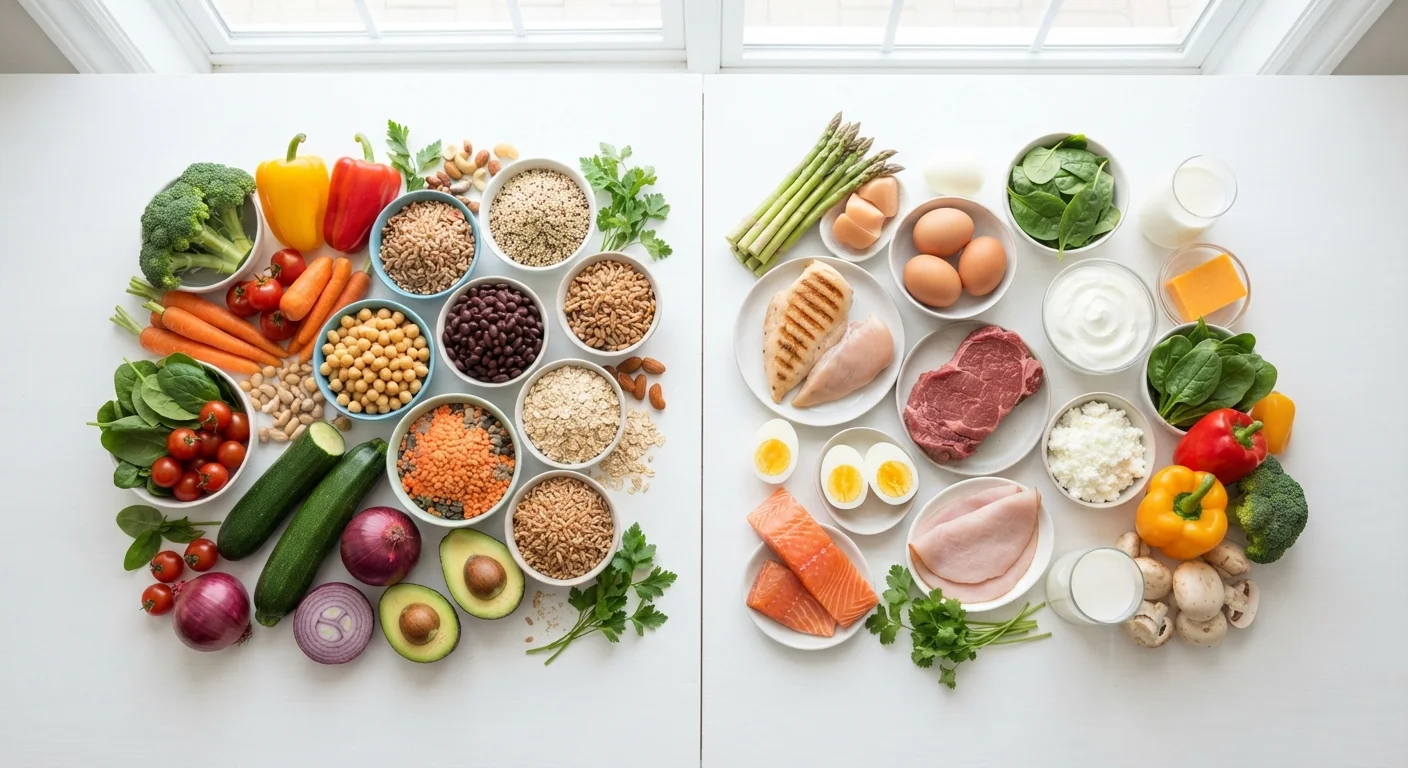
Option A
Plant-Based Diet
The whole-food, animal-free (or animal-minimal) approach.
Best for: People seeking to reduce animal product consumption for health, environmental, or ethical reasons.
Option B
Omnivorous Diet
The traditional mixed eating pattern including both plant and animal foods.
Best for: People who want dietary flexibility and find it easier to meet certain nutrient needs through animal sources.
Defining the Two Approaches
The term plant-based diet covers a spectrum - from fully vegan (no animal products) to predominantly plant-forward patterns that occasionally include fish, eggs, or dairy. What unites them is an emphasis on vegetables, fruits, legumes, whole grains, nuts, and seeds as the foundation of eating.
An omnivorous diet includes both plant and animal foods - meat, poultry, fish, dairy, and eggs alongside plant foods. In practice, this describes the eating pattern of most Americans. Critically, both categories contain enormous variation in quality: a plant-based diet heavy in refined carbohydrates and processed meat alternatives is nutritionally very different from one built on whole foods, just as an omnivorous diet rich in vegetables and lean proteins differs greatly from one dominated by ultra-processed options.
As our guide on whole foods vs. ultra-processed foods explains, food processing level often predicts health outcomes more reliably than whether a food is animal- or plant-derived.
What the Research Actually Shows
Large observational studies - including analyses of Adventist Health cohorts and the EPIC-Oxford study - find that people following plant-based diets tend to have lower rates of heart disease, type 2 diabetes, certain cancers, and obesity. However, these associations come with important caveats: plant-based eaters in study populations often share other health-conscious behaviors, making it difficult to isolate the effect of diet alone.
Randomized controlled trials, which are better at establishing causation, show that plant-based diets can improve blood lipid profiles, reduce blood pressure, and lower blood glucose - but so can high-quality omnivorous diets like the Mediterranean pattern, which consistently ranks among the most evidence-supported eating frameworks.
~20%
Reduced cardiovascular disease risk in plant-based eaters
A 2019 meta-analysis in the Journal of the American Heart Association found approximately 20% lower cardiovascular disease risk among those following plant-based dietary patterns.
~5%
US adults identifying as vegan or vegetarian
Gallup polling has consistently found that roughly 5% of US adults describe themselves as vegetarian, with a smaller subset identifying as vegan.
17g
Average daily fiber intake for US adults
The USDA reports average US fiber consumption sits around 17g per day - well below the recommended 25-38g - regardless of dietary pattern.
The honest scientific summary is that diet quality matters more than dietary category. Both patterns, when built around whole foods and adequate variety, are associated with positive health outcomes. Both, when dominated by processed foods and low nutrient diversity, are not.
Key Nutritional Differences
Where the two patterns diverge most meaningfully is in nutrient availability and bioavailability - how well the body absorbs and uses specific nutrients.
| Criterion | Plant-Based Diet | Omnivorous Diet |
|---|---|---|
| Vitamin B12 | Requires supplementation | Readily available from animal foods |
| Iron | Non-heme (lower bioavailability) | Heme iron (higher bioavailability) |
| Omega-3s (EPA/DHA) | Limited; algae supplements needed | Available from oily fish |
| Dietary fiber | Typically high | Variable; often lower |
| Protein completeness | Requires food combining knowledge | Complete proteins widely available |
| Saturated fat intake | Generally lower | Can be higher depending on choices |
| Phytonutrient intake | Typically high | Depends on plant food variety |
Nutrients that require attention on plant-based diets include vitamin B12 (found almost exclusively in animal products), heme iron (more readily absorbed than plant-based non-heme iron), zinc, long-chain omega-3 fatty acids (EPA and DHA), calcium, vitamin D, and iodine. These are not impossible to obtain from plants, but they require deliberate planning - and often supplementation for B12 in particular. Our article on nutrients vegetarians and vegans are most likely to miss covers this in detail.
Omnivorous diets, meanwhile, can fall short in fiber, phytonutrients, and certain antioxidants if plant food intake is low - a common pattern in the standard American diet. Meeting the recommendation of five or more servings of fruits and vegetables daily is achievable on both patterns, but requires active effort in either case.
For a broader look at common misconceptions about both eating styles, see our piece on separating nutrition fact from fiction.
Making a Decision That Fits Your Life
The evidence does not point to one universal diet as superior for all people in all contexts. Individual factors - genetics, health conditions, medications, cultural food traditions, budget, and personal values - all shape which pattern is sustainable and healthful for a given person. Sustainability of a dietary pattern is itself a health factor: a diet that cannot be maintained long-term provides few lasting benefits.
It is also worth recognizing, as explored in our piece on why your relationship with food shapes what you actually eat, that emotional, social, and psychological dimensions of eating matter alongside nutritional composition.
Special Populations Need Extra Guidance
Children, pregnant individuals, older adults, and people managing chronic conditions have distinct nutritional needs that can make either dietary pattern riskier without professional oversight. The American Academy of Nutrition and Dietetics states that well-planned plant-based diets can be appropriate at all life stages - but the emphasis is on 'well-planned.' If you belong to any of these groups, consult a registered dietitian before adopting significant dietary changes.
This article is for general informational purposes only and does not constitute medical or dietary advice. Speak with a registered dietitian or qualified healthcare professional before making significant changes to your eating pattern, especially if you have a pre-existing health condition or are pregnant, nursing, or caring for young children.
The content provided on our blog site traverses numerous categories, offering readers valuable and practical information. Readers can use the editorial team’s research and data to gain more insights into their topics of interest. However, they are requested not to treat the articles as conclusive. The website team cannot be held responsible for differences in data or inaccuracies found across other platforms. Please also note that the site might also miss out on various schemes and offers available that the readers may find more beneficial than the ones we cover.