

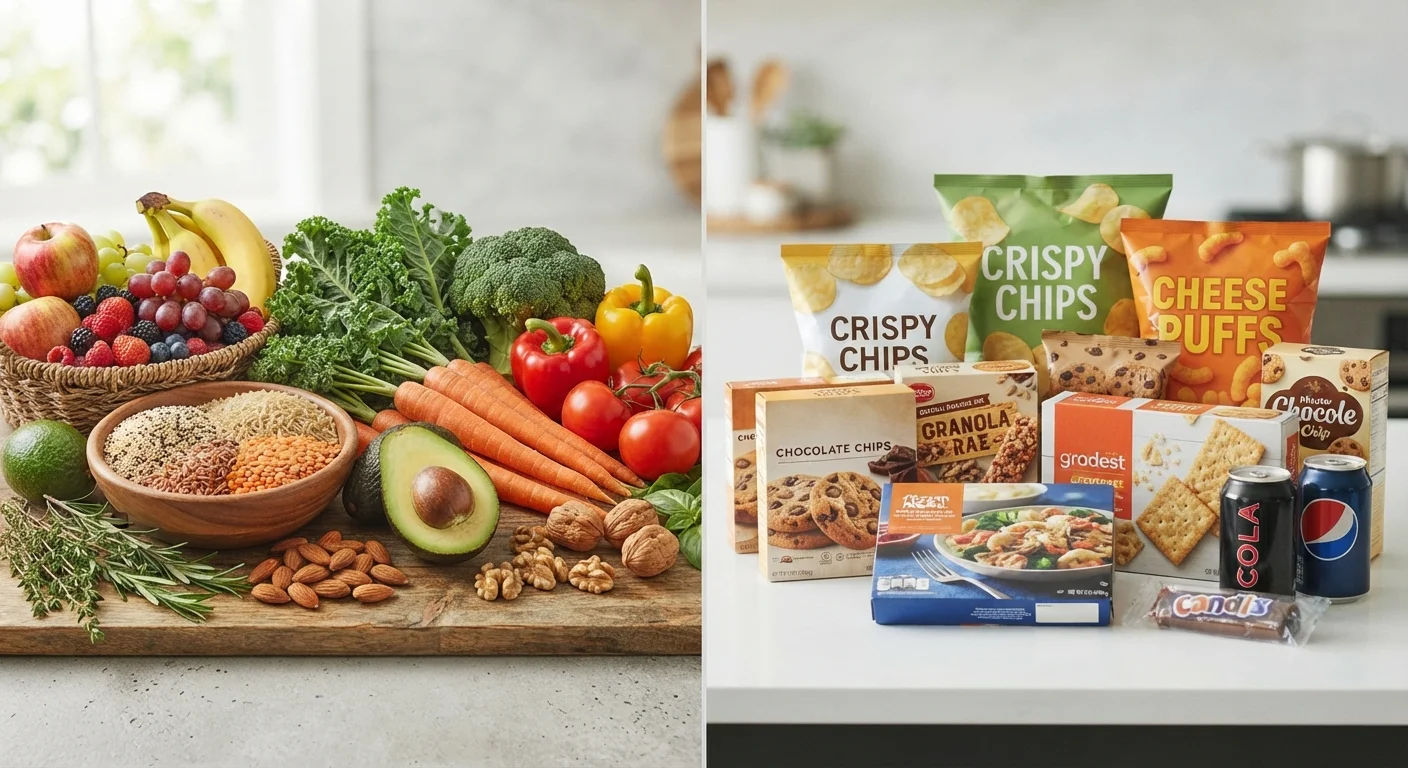
Option A
Whole Foods
Foods in or close to their natural, unaltered state.
Best for: People seeking nutrient-dense dietary patterns with minimal industrial modification.
Option B
Ultra-Processed Foods
Industrially manufactured products designed for convenience and palatability.
Best for: Understanding what to moderate - and why the category matters for long-term health research.
How Foods Are Classified: The NOVA Framework
When nutrition researchers talk about food processing, they're not referring to a simple binary. The NOVA classification system, developed by researchers at the University of São Paulo, organizes foods into four groups based on the nature and extent of industrial processing - not nutrient content alone.
Group 1 includes unprocessed or minimally processed foods: fresh fruits, vegetables, plain meats, eggs, and legumes. Group 2 covers processed culinary ingredients - oils, butter, flour, salt - used to prepare Group 1 foods. Group 3 is processed foods: items like canned fish, cheese, or cured meats that use preservation techniques. Group 4 is ultra-processed foods (UPFs): industrial formulations typically containing additives, preservatives, emulsifiers, artificial flavors, or colorings not used in ordinary home cooking.
This distinction matters because it shifts focus from individual nutrients to the overall nature of what we eat - a more holistic lens that has proven useful in large-scale population research. To understand what to look for on product packaging, see our guide on reading a nutrition label without getting lost in the numbers.
| Criterion | Whole Foods | Ultra-Processed Foods |
|---|---|---|
| NOVA Classification | Group 1 (unprocessed/minimally processed) | Group 4 (industrial formulations) |
| Typical Ingredients | Single or few natural ingredients | Long list including additives, emulsifiers, flavorings |
| Nutrient Density | Generally high in fiber, vitamins, minerals | Often low fiber, high sodium, added sugar |
| Research Association | Linked to healthier long-term outcomes | Associated with higher chronic disease risk |
| Examples | Apples, oats, eggs, lentils, plain yogurt | Flavored chips, reconstituted meats, sugary cereals |
| Shelf Life | Shorter; requires refrigeration or fresh storage | Extended; engineered for stability |
| Cost & Accessibility | Variable; some items affordable, others less so | Often lower cost; widely available |
What the Research Suggests
A growing body of observational research has associated high ultra-processed food consumption with increased risks of cardiovascular disease, type 2 diabetes, certain cancers, and depression. A large 2019 cohort study published in The BMJ found that each 10% increase in the proportion of ultra-processed foods in the diet was linked to significantly higher all-cause mortality risk.
Importantly, these are associations, not proven causal relationships. People who eat more ultra-processed foods may also have other lifestyle factors - lower income, less sleep, higher stress - that independently affect health. Researchers continue to investigate whether the harm comes from specific additives, the displacement of nutritious foods, or both.
57%
Share of US calories from ultra-processed foods
A study published in BMJ Open estimated that ultra-processed foods account for approximately 57% of energy intake in the average American diet.
+10%
UPF intake linked to higher mortality risk
A 2019 cohort study in The BMJ found each 10-percentage-point increase in ultra-processed food consumption was associated with a statistically significant rise in all-cause mortality.
4 groups
NOVA food classification tiers
The NOVA framework, developed at the University of São Paulo, categorizes all foods into four groups based on the extent and purpose of industrial processing.
Whole foods, by contrast, appear in dietary patterns - Mediterranean, DASH, and traditional plant-based diets - consistently linked to better long-term health markers. These patterns emphasize variety and minimally altered ingredients rather than any single superfood. For a broader comparison of dietary approaches, see plant-based eating vs. omnivorous diets.
The Middle Ground: Not All Processing Is Equal
One of the most important nuances in this conversation is that processed does not automatically mean harmful. Frozen vegetables, canned tomatoes, plain rolled oats, and pasteurized milk all undergo some degree of processing - yet they retain substantial nutritional value and contain none of the additives that characterize ultra-processed products.
The concern is specific to Group 4: products engineered for hyper-palatability, extended shelf life, and low cost, often at the expense of fiber, protein quality, and micronutrient density. Breakfast cereals loaded with added sugar, flavored chips, and reconstituted meat products fall into this tier - not plain frozen peas.
Processing Isn't a Single Category
It's easy to conflate 'processed' with 'unhealthy,' but the distinction lies in how and why processing occurs. Pasteurization, freezing, and canning preserve nutritional value with minimal additives. Ultra-processing, by contrast, typically reconstructs ingredients and adds substances purely for texture, flavor, or shelf stability - a meaningfully different category. When in doubt, a short, recognizable ingredient list is a useful rule of thumb.
Recognizing where added sugars hide is part of navigating this spectrum effectively. Our article on hidden sources of sugar in everyday foods offers a practical guide to spotting them on ingredient lists.
Practical Steps Toward a Whole-Food-Leaning Diet
Shifting dietary patterns doesn't require overhauling every meal at once. Research on behavior change suggests incremental substitutions - replacing a processed snack with fruit and nuts, or choosing plain canned beans over a flavored convenience pack - can contribute meaningfully to overall diet quality over time.
A useful starting point is auditing what's actually in your regular grocery basket. Our nutritional audit for your weekly shop provides a structured checklist for assessing whether everyday choices cover the nutritional bases most adults need.
Context matters too: cost, time, cultural food practices, and food access all shape what's realistic for any given household. The goal isn't dietary perfection - it's building an awareness of the food spectrum that makes each choice more informed.
This article is for general informational and educational purposes only and does not constitute medical or nutritional advice. Consult a qualified healthcare professional or registered dietitian before making significant changes to your diet.
The content provided on our blog site traverses numerous categories, offering readers valuable and practical information. Readers can use the editorial team’s research and data to gain more insights into their topics of interest. However, they are requested not to treat the articles as conclusive. The website team cannot be held responsible for differences in data or inaccuracies found across other platforms. Please also note that the site might also miss out on various schemes and offers available that the readers may find more beneficial than the ones we cover.