

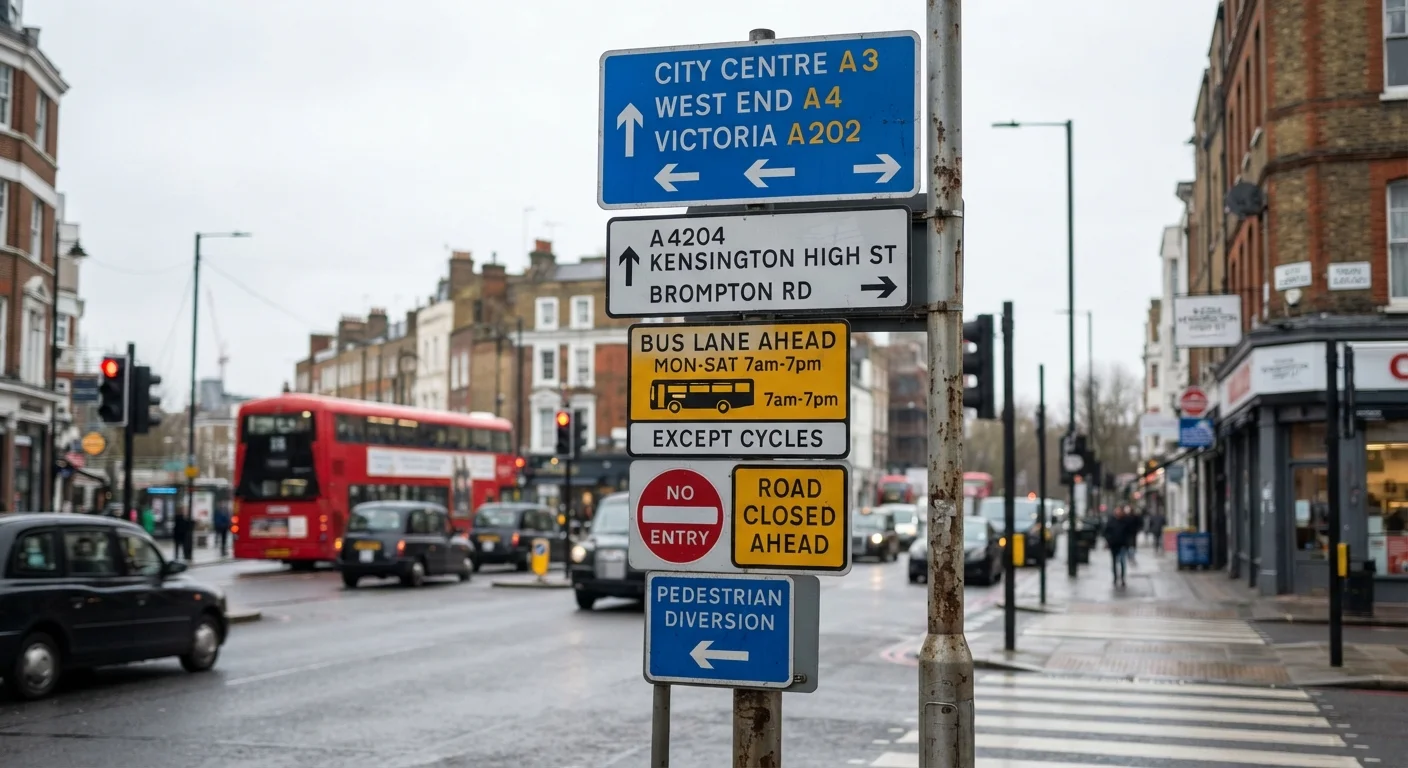
Why Sign Misreading Is More Common Than You Think
Most drivers passed a written knowledge test years - sometimes decades - ago. Since then, signage has evolved, local rules have changed, and the sheer volume of information on modern roads has grown. The result: a surprising number of experienced drivers routinely misinterpret signs they see every day.
This isn't only a new-driver problem. New car owners often get things wrong in their first year, but seasoned drivers carry their own blind spots - often false confidence in what a sign means based on a half-remembered rule. Understanding which signs trip people up most is the first step toward reading the road more accurately.
| Most misunderstood signal type | Flashing yellow arrow (permissive left turn) (Commonly cited in driver education research) |
| Legal status of pavement markings | Legally enforceable, same as posted signs (Uniform Traffic Control Devices (MUTCD) standards) |
| School zone speed applicability | Only when children are present or during posted hours (Varies by state; verify local rules) |
| Advisory speed sign color | Yellow (not white - white = regulatory limit) (MUTCD sign color standards) |
| Recommended forward scanning distance | 12-15 seconds ahead for effective sign reading (General driver training guidance) |
The Signs Drivers Most Commonly Get Wrong
The following markings generate the most confusion among U.S. drivers, based on driver education research and traffic safety data.
Flashing Yellow Arrow
This relatively newer signal allows a left turn while oncoming traffic still has a green light - meaning you must yield before turning. Many drivers treat it like a protected green arrow and proceed without checking for oncoming vehicles. It is a permissive signal, not a protected one.
"Do Not Pass" vs. Double Yellow Lines
A Do Not Pass sign prohibits overtaking even if the road ahead looks clear. Double yellow center lines carry the same prohibition on most roads, yet drivers frequently treat them as a suggestion rather than a rule. Passing in these zones is both illegal and statistically dangerous.
Speed Limit vs. Advisory Speed Signs
Regulatory speed limit signs (white, rectangular) set a legal maximum. Yellow advisory speed signs - often posted before curves or ramps - indicate a recommended safe speed for that specific geometry, not a legal limit. Treating a 35 mph advisory curve sign as the posted limit can lead to either over-caution or dangerous overconfidence.
Yield vs. Stop
A Yield sign requires you to slow and give way to traffic that has the right of way - but you do not legally need to come to a complete stop unless traffic requires it. Many drivers either roll through without genuinely yielding, or stop unnecessarily and confuse following drivers. Neither extreme is correct.
"No Turn on Red" Exceptions
A blank "No Turn on Red" sign prohibits the turn at all times. But when it includes a time-restriction panel (e.g., 7 AM - 6 PM), the restriction only applies during those hours. Drivers frequently miss the restriction panel entirely - or ignore the time and turn illegally outside posted hours.
School Zone Speed Limits
The reduced speed in a school zone typically applies only when children are present or during posted hours. Drivers often either maintain highway speed assuming the zone is inactive, or slow unnecessarily at 10 PM on a weekend. Check the posted conditions panel carefully.
Permissive Signal
A traffic signal that allows a maneuver - such as a left turn - but requires the driver to yield to oncoming traffic first. It does not guarantee a clear path the way a protected signal does.
Advisory Speed Sign
A yellow sign recommending a safe travel speed for a specific road feature, such as a curve or ramp. It is not a legally enforceable speed limit, but deviating from it significantly increases crash risk.
Gore Area
The triangular striped zone at the junction of a highway exit or entrance ramp. It is off-limits to all vehicles and must not be driven through or used to gain road position.
HOV Lane
A High-Occupancy Vehicle lane restricted to cars carrying a minimum number of passengers, typically two or three. Marked with diamond symbols on the pavement, HOV lanes are a moving-violation zone for solo drivers who enter them without qualification.
Supplemental Panel
A secondary sign mounted below a primary road sign that modifies its message - for example, specifying the hours during which a restriction applies. Missing the supplemental panel is a frequent cause of sign misinterpretation.
Pavement Markings That Are Frequently Overlooked
Road markings are legally binding in the same way posted signs are - but they're easier to miss, especially in rain or at night.
- Solid white edge lines: Mark the right boundary of the travel lane. Crossing them to pull over is generally permitted, but they signal that shoulders may be narrow or absent.
- White stop lines: Vehicles must stop before the line, not on it. Stopping past the line at a crosswalk is both illegal and a pedestrian hazard.
- Diamond symbols in lanes: These designate HOV or bus lanes. Entering without meeting the occupancy requirement is a moving violation in most states.
- Diagonal yellow lines (Gore areas): The triangular striped area at highway on- and off-ramps is off-limits to all traffic. Cutting through these areas to gain position is illegal and contributes to merge-zone crashes.
Understanding pavement markings becomes especially important when navigating complex intersections - a challenge covered in detail in our guide on roundabout errors and how to read them correctly.
1 in 3
Drivers who misidentify a flashing yellow arrow's meaning
Driver knowledge surveys conducted by traffic safety researchers have found a significant proportion of licensed drivers treat permissive signals as protected ones.
~50%
Of intersection crashes involve failure to obey traffic controls
According to the Federal Highway Administration, a large share of intersection collisions are linked to sign or signal compliance failures.
Building Better Sign-Reading Habits
Staying accurate on the road isn't just about memorizing symbols - it's about developing the attention habits that let you process signs in time to act on them. Hazard perception - the ability to anticipate rather than react - is closely tied to how well drivers read environmental cues, including signage.
A few practical habits help:
- Scan ahead, not just immediately in front. Most drivers look 3-4 seconds ahead; effective sign-reading requires scanning 12-15 seconds down the road, especially in unfamiliar areas.
- Read the full sign assembly. Many signs have supplemental panels below the main message that modify the rule. Ignoring these is one of the most common misreading errors.
- Refresh your knowledge periodically. State DMV handbooks are publicly available and are updated when signage standards change. Reading the relevant chapter once every few years costs little time and can correct long-held misunderstandings.
- Be especially alert in unfamiliar regions or countries. Sign conventions vary significantly - see our guide on adapting to driving in an unfamiliar country for what to expect.
When in Doubt, Default to Caution
If you're uncertain what a sign means in the moment, the safest response is to slow down and give way rather than proceed on a guess. You can look up the correct meaning after the fact using your state's DMV handbook, which is freely available online. Refreshing your knowledge occasionally is a straightforward way to close gaps that can develop over years of driving.
The content provided on our blog site traverses numerous categories, offering readers valuable and practical information. Readers can use the editorial team’s research and data to gain more insights into their topics of interest. However, they are requested not to treat the articles as conclusive. The website team cannot be held responsible for differences in data or inaccuracies found across other platforms. Please also note that the site might also miss out on various schemes and offers available that the readers may find more beneficial than the ones we cover.