

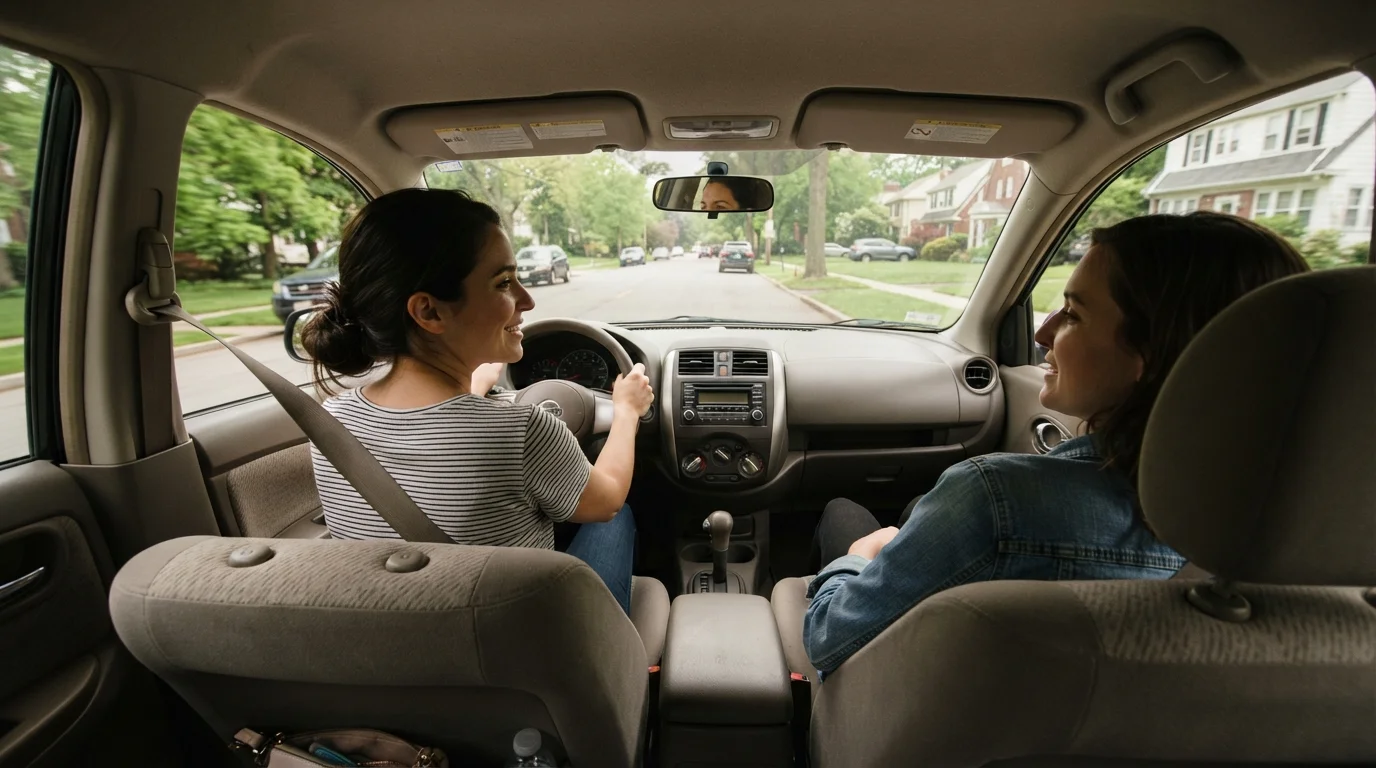
The Social Car: Why Who's With You Changes How You Drive
Most drivers think of safety as a personal discipline - eyes on the road, hands on the wheel, phone in the glovebox. What's often underestimated is how powerfully the people around us shape the decisions we make behind the wheel.
Traffic psychology research has documented a consistent pattern: the mere presence of passengers alters driver behaviour, sometimes in protective ways, but more often - particularly for newer drivers - in ways that increase crash risk. A driver alone tends to self-regulate more carefully. Add passengers and social dynamics enter the equation.
This isn't a character flaw. It's a normal human response to being observed and evaluated by others. Understanding it is the first step to managing it.
“Young drivers are not simply inexperienced versions of adult drivers - they are still developing the risk-assessment systems that adults take for granted, and the presence of peers accelerates that vulnerability in measurable ways.”
— Dr. Bruce Simons-Morton, Senior investigator, Eunice Kennedy Shriver National Institute of Child Health and Human Development
Peer Passengers and Risk-Taking: What the Evidence Shows
The relationship between peer passengers and elevated risk is one of the more robustly documented findings in driver behaviour research. Studies using naturalistic driving data - cameras and sensors installed in real vehicles over extended periods - have found that crash and near-crash rates among teenage drivers rise substantially when other teenagers are in the car.
~3x
Crash risk increase with multiple teen passengers
Research published in peer-reviewed traffic safety literature has found teenage driver crash risk rises significantly with each additional teenage passenger, with some estimates suggesting a roughly threefold increase with two or more peers present.
16-17
Age group with highest passenger-related risk
The Insurance Institute for Highway Safety (IIHS) identifies 16- and 17-year-old drivers as the group most affected by peer passenger presence in terms of elevated crash involvement rates.
~50%
Of US states with passenger restrictions for new drivers
Approximately half of US states include passenger restrictions as part of their Graduated Driver Licensing programs, limiting the number of young passengers a newly licensed driver may carry.
The mechanisms appear to include distraction, social performance (driving in a way that signals confidence or status), and a diffusion of perceived responsibility - the feeling that risk is somehow shared across more people. Notably, when an adult passenger is present, the risk-elevation effect largely disappears, and in some studies reverses.
It's worth pairing this with the broader reality that cognitive load at the wheel is already high. Adding an animated social conversation pushes the mental workload further.
When Passengers Help: The Case for the Calm Co-Pilot
Passenger influence cuts both ways. Experienced, attentive passengers - a veteran driver in the front seat, or a passenger who actively calls out hazards - can meaningfully support safer driving. They reduce navigational load, provide a second perspective, and may moderate a driver's pace naturally.
The key variable is the passenger's own attitude toward safety. A passenger who normalises speeding, mocks cautious behaviour, or repeatedly distracts the driver amplifies risk. A passenger who respects the driver's need to focus actively reduces it.
How to Be a Safer Passenger
Passengers share responsibility for journey safety too. Avoid sudden loud noises, don't distract the driver during merges or intersections, and feel confident saying something if you're genuinely concerned about the driver's speed or attention. A good passenger is situationally aware, not just along for the ride.
For less experienced drivers, having a trusted, experienced adult passenger during challenging conditions - heavy traffic, unfamiliar roads, night driving - can serve as a useful developmental tool. Think of it as a graduated support structure rather than a crutch.
Practical Strategies for Staying in Control
Awareness of occupant dynamics is useful only if it translates into action. A few straightforward approaches make a real difference:
- Set expectations before you leave. A quick word - "I'll need to focus in heavy traffic, so let's pause conversation there" - costs nothing and frames the journey as a shared responsibility.
- Manage the environment. Keep music at a level that doesn't compete with sirens or horn signals. Ask passengers to avoid handing objects to the driver while moving.
- Know your limits. If a route feels challenging, that's the wrong time for a full group conversation. Night driving and unfamiliar roads compound cognitive demand.
- Don't mistake confidence for competence. Feeling relaxed with friends in the car can mask the fact that your attention has divided. Comfort and safety are not the same thing.
If you're returning to driving after time away, the added layer of managing passengers may feel overwhelming. Building back to that gradually is reasonable - rebuilding confidence solo first before adding social complexity makes sound sense.
Frequently Asked Questions
Research suggests they can, depending on who the passenger is and the driver's experience level. Peer passengers are most strongly associated with increased risk-taking in younger and newer drivers. However, experienced, calm passengers can sometimes have a stabilising effect.
Studies point to social pressure, a desire to appear confident, and a reduced sense of personal accountability when peers are present. Adolescent brain development also means the reward signals linked to peer approval are particularly strong in this age group.
Both are cognitive distractions, but research generally shows in-car conversation carries somewhat lower risk than phone calls. A passenger can pause conversation during a hazard and may even provide a second pair of eyes. A phone caller has no awareness of road conditions.
Setting clear expectations before departure helps - letting passengers know you'll need quiet in complex traffic, for example. Keeping music at a moderate level, limiting backseat disruptions, and asking passengers not to hand things to the driver are all practical steps.
Several US states have graduated driver licensing (GDL) laws that restrict the number of passengers a newly licensed driver may carry, particularly at night. Specifics vary by state, so check your state's DMV or motor vehicle authority for current rules.
The content provided on our blog site traverses numerous categories, offering readers valuable and practical information. Readers can use the editorial team’s research and data to gain more insights into their topics of interest. However, they are requested not to treat the articles as conclusive. The website team cannot be held responsible for differences in data or inaccuracies found across other platforms. Please also note that the site might also miss out on various schemes and offers available that the readers may find more beneficial than the ones we cover.