

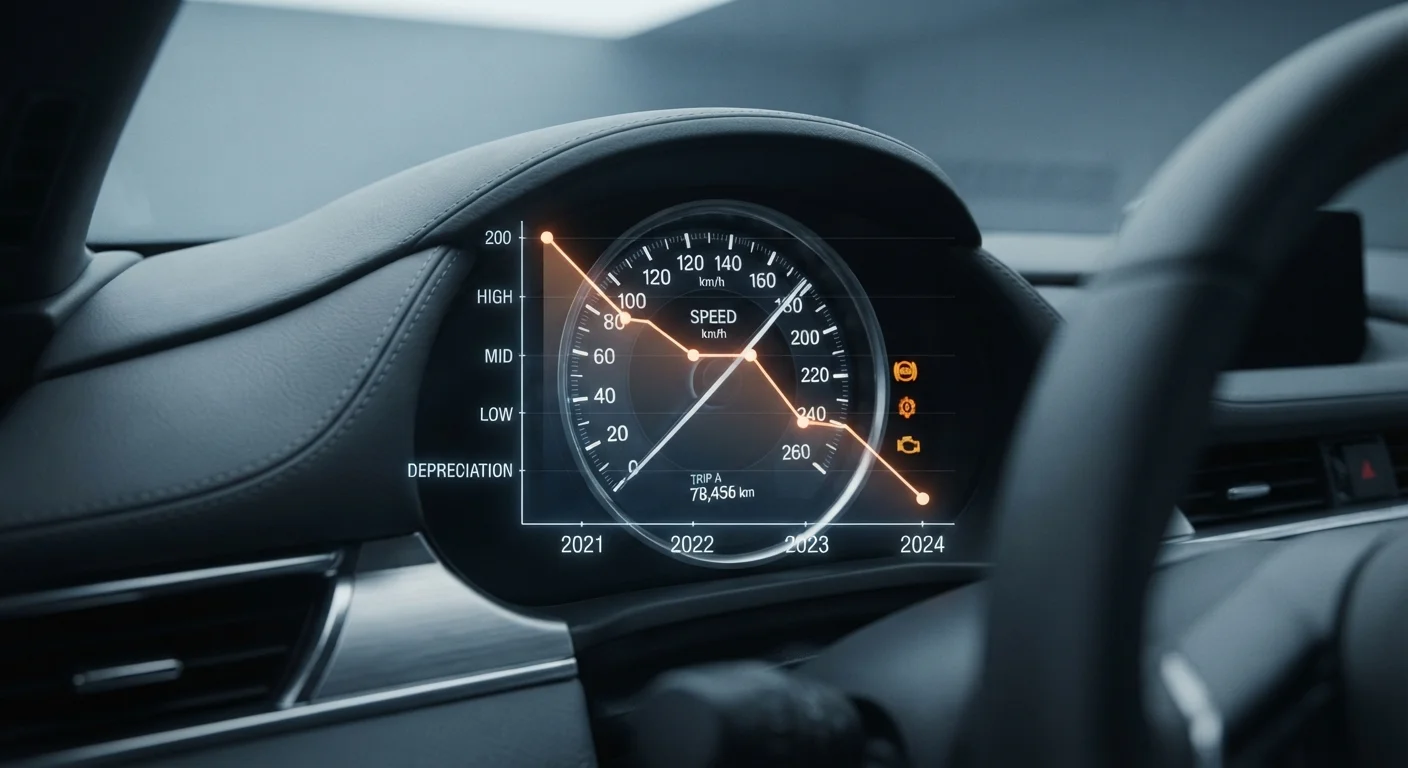
What Depreciation Actually Means for Drivers
Depreciation isn't an abstract accounting term - it's money leaving your pocket every year you own a vehicle. The moment a new car is driven off the lot, it is no longer worth what you paid for it. Dealers can't sell it as new, and the market adjusts its value accordingly.
For most new vehicles, that first-year drop is the sharpest. After that, the curve flattens gradually, though value continues to erode. By the time a car is five years old, it has often lost 40%-60% of its original purchase price, depending on the make, model, and how it was maintained.
Depreciation is a central part of the true cost of owning a car - one that's easy to ignore because it doesn't show up as a monthly bill, but it accumulates silently throughout ownership.
15%-25%
Value lost by new cars in year one
Industry estimates consistently place first-year depreciation for new vehicles in this range, with some segments dropping even further.
~50%
Average value remaining after five years
General automotive industry data suggests many new vehicles retain roughly half their value after five years of average use, though this varies widely by make and model.
#1
Depreciation's rank among ownership costs
For many new-car buyers, depreciation exceeds fuel, insurance, and maintenance as the single largest annual ownership expense, particularly in the first three years.
Key Factors That Influence How Fast a Car Loses Value
Not all vehicles depreciate at the same rate. Several variables play a significant role in how quickly - or slowly - a car sheds market value.
- Mileage: Higher annual mileage is one of the biggest drivers of faster depreciation. Vehicles with lower odometer readings consistently command higher resale prices.
- Condition and maintenance history: A car with complete service records and no accident history retains more value. Lapsed maintenance and prior damage raise red flags for buyers and appraisers alike. Good ownership habits directly support resale value.
- Make and model reputation: Vehicles known for reliability and low ownership costs tend to depreciate more slowly. Conversely, some luxury models can lose value sharply once their warranty period ends.
- Market demand and segment trends: Consumer preferences shift over time. A vehicle category that falls out of favour - like certain large sedans - can see accelerated depreciation regardless of its mechanical condition.
- Colour and trim: Neutral colours (white, black, silver, grey) generally appeal to more buyers, supporting stronger resale values. Unusual colours or stripped-down trim levels can limit your pool of interested buyers.
Protect Your Vehicle's Resale Value
Keep a dedicated folder - physical or digital - for every service receipt, inspection report, and repair invoice from day one. When it comes time to sell or trade in, a complete paper trail can meaningfully increase buyer confidence and your final offer. Don't underestimate the value of documentation.
Depreciation and the Long-Term Cost of Ownership
When drivers calculate the cost of owning a vehicle, they often focus on fuel, insurance, and repairs. Depreciation rarely gets the same scrutiny - yet for many owners it represents the single largest annual expense, particularly in the first few years.
This is why keeping a car long-term can make strong financial sense. Once you've held a vehicle past its steepest depreciation years, the rate of value loss slows considerably. At that point, your primary costs shift to maintenance and repairs - which, for a well-kept vehicle, are often more predictable and manageable than a new car payment combined with rapid depreciation.
For drivers who do trade in or sell frequently, understanding depreciation helps set realistic expectations. A car purchased for $35,000 that's worth $20,000 three years later has cost roughly $5,000 per year in depreciation alone - before a single tank of gas or oil change.
“The biggest cost of owning a car isn't the payment - it's the gap between what you paid and what you'll get back. Most drivers never add that up until they're sitting across from a dealer.”
— Cars & Driving Editorial Team, Automotive ownership analysts
If you're a first-time owner trying to get your footing, our guide to car ownership from day one covers the broader responsibilities and costs that come with the territory.
What You Can - and Can't - Control
Depreciation is inevitable, but its pace is partly within your influence. Staying on top of scheduled servicing, keeping the vehicle clean and undamaged, and retaining all maintenance documentation can meaningfully strengthen your position at resale time. Buyers and appraisers treat a documented service history as evidence of a cared-for car.
What you can't control: broader market forces, fuel price trends that shift demand away from certain vehicle types, or new model releases that make your existing car feel dated. These external factors are real, and no amount of careful maintenance will fully offset a significant market shift against your vehicle's segment.
It's also worth separating fact from fiction when it comes to ownership costs. Some drivers believe certain choices - like skipping a service - have little impact on long-term value, when the opposite is often true. Our piece on common car ownership myths addresses several of these misconceptions directly.
Understanding depreciation won't eliminate it, but it gives you clearer expectations and better tools for planning - whether you're buying, selling, or simply holding on for the long haul. For ongoing maintenance guidance that supports both reliability and resale value, the car maintenance hub is a practical starting point.
Frequently Asked Questions
Most new vehicles lose somewhere between 15% and 25% of their purchase price within the first 12 months. Some models depreciate even faster, particularly those in oversupplied segments or with weaker brand reputation. This first-year drop is typically the steepest in a car's entire lifespan.
No. Used vehicles have already absorbed the steepest part of the depreciation curve, so their ongoing rate of value loss is generally slower. Buying used means someone else has taken the biggest hit, which is one financial argument in favour of pre-owned vehicles.
High mileage, poor maintenance history, lack of service records, unpopular colours, and low market demand all accelerate depreciation. Certain vehicle categories - such as large sedans and some luxury models - can also lose value faster due to shifting consumer preferences.
You cannot stop depreciation, but consistent maintenance, keeping mileage reasonable, avoiding damage, and retaining all service records can help your vehicle hold its value better at resale. Appearance also matters - minor cosmetic issues can disproportionately drag down perceived value.
Even if you never sell, depreciation reflects the opportunity cost of your investment. It also affects insurance valuations and, in some cases, loan-to-value ratios if you refinance. Understanding it gives you a fuller picture of what your vehicle truly costs you over time.
The content provided on our blog site traverses numerous categories, offering readers valuable and practical information. Readers can use the editorial team’s research and data to gain more insights into their topics of interest. However, they are requested not to treat the articles as conclusive. The website team cannot be held responsible for differences in data or inaccuracies found across other platforms. Please also note that the site might also miss out on various schemes and offers available that the readers may find more beneficial than the ones we cover.