

Why Medication Documentation Matters More Than You Might Expect
Carrying medications across international borders is, for most travelers, an uneventful part of the journey - but the consequences of being underprepared can range from a frustrating delay to confiscation or, in rare cases involving controlled substances, serious legal trouble. The gap between a smooth crossing and a complicated one often comes down to documentation and advance research, not the medications themselves.
Rules are not uniform. What counts as a controlled substance varies by country - and even by region within a country. A medication your doctor prescribes freely in the United States may require advance permits in Japan, may be capped in quantity in France, or may be outright prohibited in the UAE or certain Southeast Asian nations. These aren't hypothetical edge cases; they affect everyday travelers carrying common prescriptions for anxiety, pain, or attention disorders.
The good news is that nearly all of these complications are avoidable with the right preparation. As part of your broader trip planning - which our pre-trip planning checklist covers in detail - medications deserve their own dedicated checklist.
What you will need
What to Gather Before You Pack
Before anything goes into a bag, make sure you have the right tools and documentation assembled. The items below reflect what international customs authorities and airline security officers most commonly expect from travelers carrying prescription medications.
Physician's Travel Letter
A signed letter on official letterhead from your doctor explaining your diagnosis, each medication prescribed, dosage, and medical necessity for the journey.
Original Prescription Bottles
Pharmacy-labeled bottles confirm the medication is legally prescribed and match your physician's letter at customs.
Translated Medication Summary
A written summary of your medications translated into the destination country's language, helping officials identify what you are carrying.
Travel Insurance Policy Documents
Documents confirming coverage for medical emergencies abroad, including potential medication replacement or hospitalization.
Insulated Medication Pouch or Case
Maintains appropriate temperature for medications that require refrigeration, such as insulin, during transit.
Controlled Substances Can Be Prohibited Abroad
Medications that are legally prescribed in the United States - including certain opioid pain relievers, benzodiazepines, ADHD medications, and some sleep aids - may be classified as controlled or outright banned substances in other countries. Carrying them across certain borders without proper permits can result in serious legal consequences. Research your specific medications before every international trip, not just the first.
Once you have your documents in order, the actual packing and customs process becomes far more manageable. Our guide to packing efficiently without forgetting essentials covers how to organize these items within a smart overall packing strategy.
Step-by-Step: Preparing to Travel With Medications
Follow these steps in the weeks before your trip to ensure you arrive at every border checkpoint with the right documentation, correctly packed medications, and a contingency plan in place.
List Every Medication You Plan to Carry
Start by writing out every prescription and over-the-counter medication you intend to travel with. For each item, note the generic name (not just the brand name), the dosage, the prescribing condition, and the quantity you plan to bring. Generic names are universally recognized and are critical when communicating with foreign customs officers or pharmacists.
Include vitamins and supplements that could be mistaken for controlled substances in some jurisdictions - melatonin, for example, is regulated in certain countries.
Research Each Destination Country's Import Rules
For every country on your itinerary, research whether each of your medications is legally permitted for import. The destination country's embassy website and your own government's travel advisory pages (such as travel.state.gov for US travelers) are the most reliable starting points.
Pay close attention to quantity limits - many countries allow only a 30-day supply of a controlled substance, regardless of your trip length - and whether advance permits or declarations are required. Transit countries also count: if your layover involves clearing customs in a third country, their rules apply too.
Obtain a Physician's Letter and Updated Prescriptions
Request a letter from your prescribing doctor on official practice letterhead. The letter should clearly state:
- Your full name and date of birth
- Each medication's generic and brand name
- Dosage and frequency of use
- The medical condition being treated
- A statement confirming the medication is medically necessary for travel
Ask your doctor to date and sign the letter. Some countries may request this be notarized or apostilled - confirm requirements through the embassy before your trip. Also ensure your prescriptions themselves are current; expired prescriptions can raise red flags at customs.
Pack Medications Correctly for Travel
Always pack your medications in your carry-on bag, never in checked luggage. Checked baggage can be lost, stolen, or exposed to temperature extremes in cargo holds that may degrade medication efficacy - this is especially critical for insulin and other temperature-sensitive treatments.
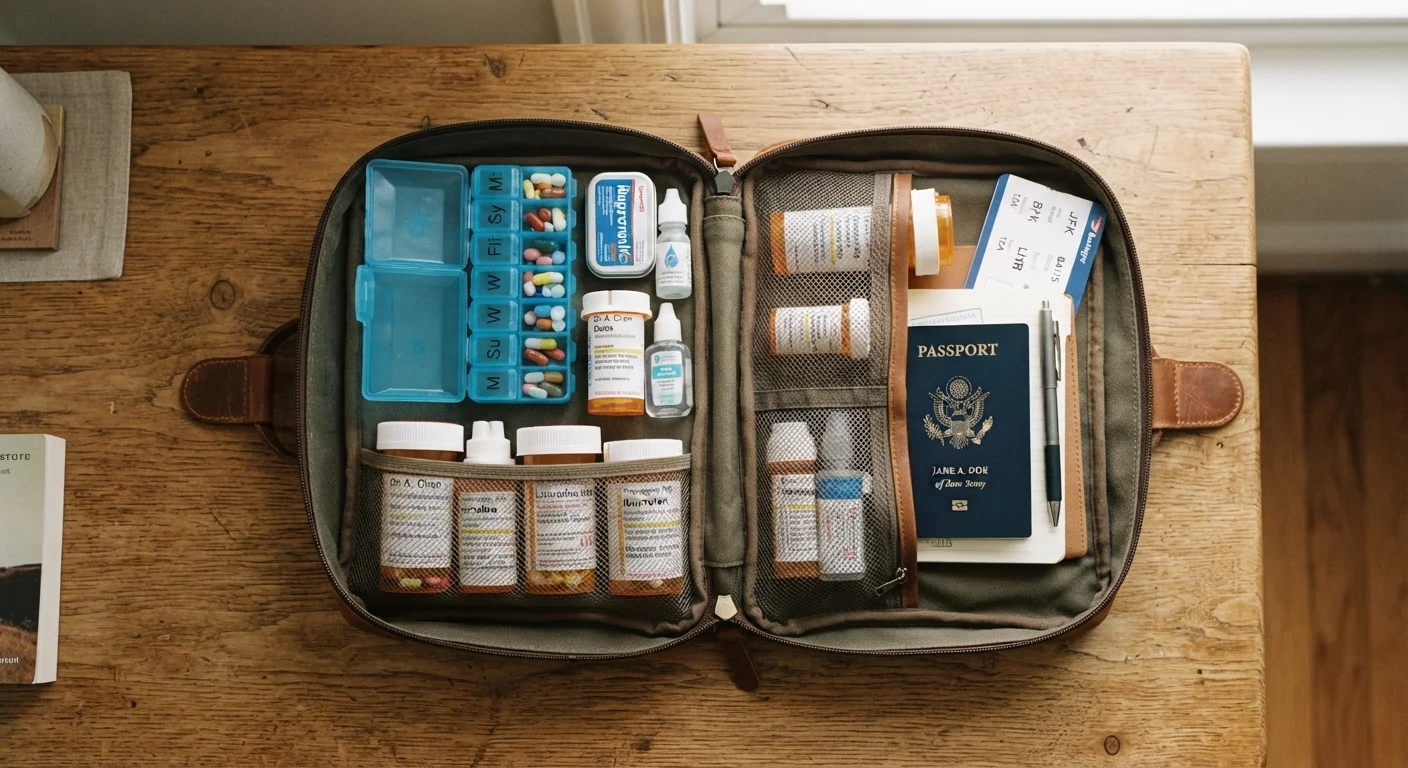
Keep medications in their original pharmacy-labeled bottles whenever possible. If you use a pill organizer for daily convenience, retain the original bottles in your bag alongside it. Liquids and gels, including liquid medications, may be subject to airline security liquid restrictions; however, medically necessary liquids are typically exempt when declared at the security checkpoint.
Prepare Documentation for Security and Customs
Organize all medication-related documents together in a dedicated folder or zippered pouch: your physician's letter, prescription copies, and a printed medication list. Having these immediately accessible - rather than buried in your luggage - prevents delays and demonstrates transparency to screening officers.
At US Transportation Security Administration (TSA) checkpoints, you are not required to remove medications from your bag, but declaring them separately can speed the process. At international customs, declare medications proactively if the country's entry form asks or if you carry controlled substances. Failing to declare when required is treated far more seriously than declaring something that turns out to be unrestricted.
Plan for Emergencies and Replacement Scenarios
Consider what happens if a medication is lost, confiscated, or runs out unexpectedly. Steps worth taking in advance include:
- Researching whether your medication is available in your destination country and under what name
- Confirming whether your travel insurance includes emergency medication coverage
- Noting the contact details for the nearest US embassy or consulate, which can sometimes assist with medical emergencies abroad
- Asking your doctor whether a small backup supply is clinically appropriate
For ongoing trips or extended travel, also look into whether your destination has international pharmacies or telemedicine services that could assist if your situation changes.
Use a Pill Organizer Thoughtfully
Pill organizers are convenient for daily use but can create confusion at security checkpoints if medications are removed from their original labeled bottles. Consider keeping a small supply in an organizer for convenience while retaining the original labeled bottles as your official documentation. This approach balances practicality with compliance.
Always Verify Rules With Official Sources
Medication import rules change frequently and vary dramatically between countries. The information in this article is general and educational - it is not legal or medical advice. Before you travel, confirm current requirements directly with the destination country's embassy or consulate and your own government's travel advisory service. Regulations that applied last year may no longer be accurate.
For a broader view of everything that could require your attention before a major international journey, see our pre-departure checklist for long-haul international travel. And if you want to think through a wider range of travel disruptions - from lost luggage to medical emergencies - this guide to anticipating trip problems is worth reading before you board.
This article provides general travel information and education only. It is not medical or legal advice. Medication import rules change frequently - always verify current requirements with your destination country's embassy or consulate and your own government's official travel advisory resources before travelling. Consult a qualified healthcare professional regarding any decisions about your medications.
The content provided on our blog site traverses numerous categories, offering readers valuable and practical information. Readers can use the editorial team’s research and data to gain more insights into their topics of interest. However, they are requested not to treat the articles as conclusive. The website team cannot be held responsible for differences in data or inaccuracies found across other platforms. Please also note that the site might also miss out on various schemes and offers available that the readers may find more beneficial than the ones we cover.