

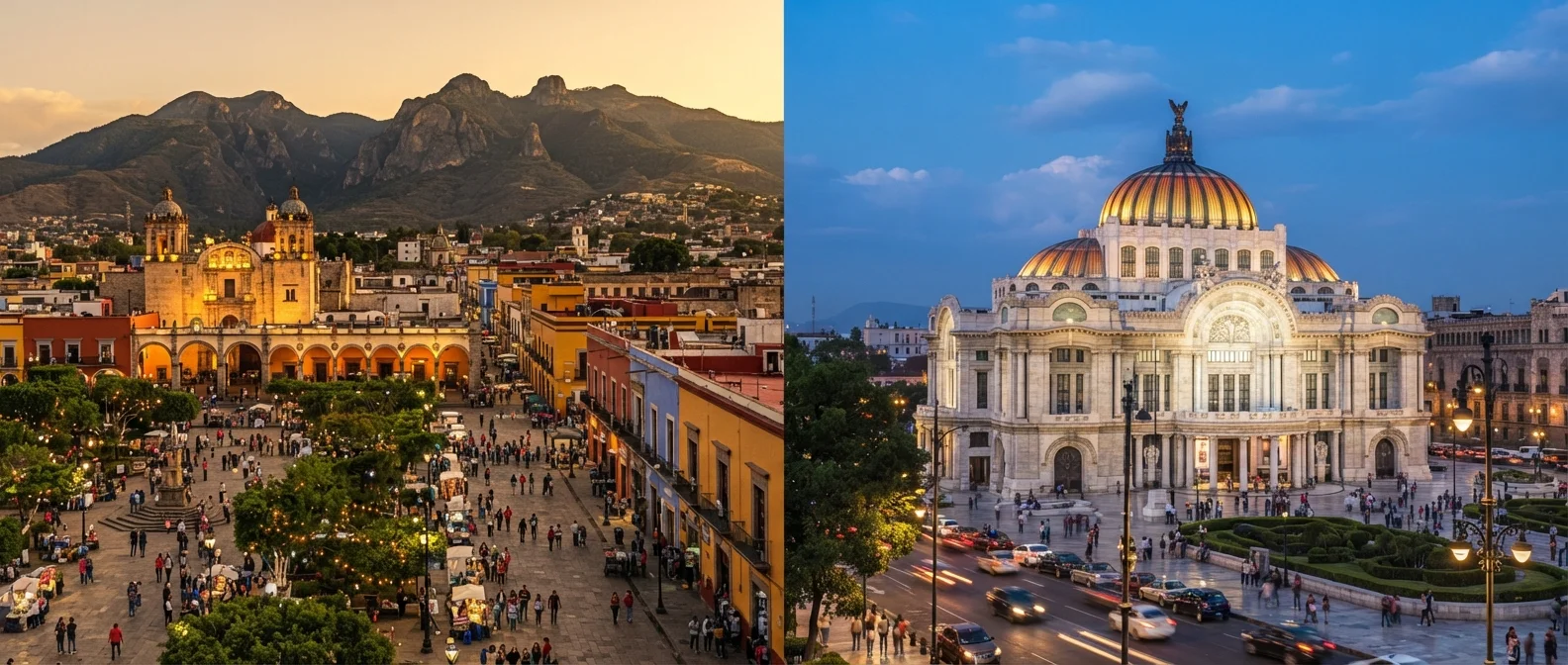
Option A
Oaxaca
The artisan soul of southern Mexico.
Best for: Travelers who want deep cultural immersion, indigenous heritage, mezcal traditions, and a slower, more intimate pace.
Option B
Mexico City
A vast, electric cosmopolitan capital.
Best for: Travelers who want world-class museums, diverse neighborhoods, cutting-edge cuisine, and the full energy of a global megacity.
What Each City Actually Feels Like
Oaxaca is a city that settles into you slowly. Walking the terracotta-and-green streets of its historic center - a UNESCO World Heritage site - you encounter hand-painted alebrijes (fantastical carved wooden figures), the smoke of copal incense drifting from doorways, and markets piled high with chapulines (toasted grasshoppers) and fresh-pressed tlayudas. The city sits at roughly 5,000 feet in a mountain valley in southern Mexico, giving it a mild, dry climate and a landscape unlike anywhere else in the country. Indigenous Zapotec and Mixtec culture is not a background note here - it is the main event.
Mexico City, by contrast, hits you all at once. With more than 20 million people in its greater metropolitan area, it is one of the most populous cities on Earth. Yet it is also remarkably navigable: its neighborhoods each have a distinct personality, from the leafy, café-lined streets of Colonia Roma to the ancient ruins of Teotihuacán sitting just outside the city limits. The capital draws from every corner of Mexican culture and blends it with cosmopolitan energy that can genuinely surprise first-time visitors.
| Criterion | Oaxaca | Mexico City |
|---|---|---|
| City size | ~300,000 (city proper) | ~9M city / 20M+ metro |
| Pace | Relaxed, walkable | Fast-paced, sprawling |
| Signature experience | Mezcal & Zapotec heritage | World-class museums & cuisine |
| Top archaeological site | Monte Albán | Teotihuacán / Templo Mayor |
| UNESCO status | Historic center listed | Historic center listed |
| Food scene focus | Regional depth (mole, mezcal) | National breadth & global range |
| International flights | Limited direct US routes | Extensive direct US routes |
| Best for | Immersive, intimate travel | First-timers, urban explorers |
Food, Drink, and Market Culture
Oaxacan cuisine is considered one of Mexico's most celebrated regional traditions. The city is home to seven distinct mole sauces, rich tasajo (dried beef), and some of the country's most respected mezcal producers. The Mercado Benito Juárez and Mercado 20 de Noviembre are essential stops - expect a sensory overload of fresh produce, handmade chocolate, and grilled meats served on long communal tables. Mezcal here is not a cocktail ingredient; it is a cultural institution with deep ties to Zapotec agricultural practices and local agave ecology.
Mexico City's food landscape is staggering in its breadth. Street taco stands operate around the clock, Michelin-recognized restaurants share blocks with generations-old fondas (small family diners), and the historic Mercado de la Merced is one of the largest traditional markets in the Americas. The capital is also where you can explore cuisines from every Mexican state - Oaxacan, Yucatecan, Poblano - under one metropolitan roof. Both cities reward curious eaters, but in different registers: Oaxaca offers depth and regional specificity; Mexico City offers range and relentless discovery.
7
Distinct mole sauces native to Oaxacan cuisine
Oaxaca is often called 'the land of seven moles,' each made with a unique combination of chiles, spices, and local ingredients.
~400
Museums in Mexico City
Mexico City is frequently cited as having one of the highest concentrations of museums of any city in the world.
~2,500 years
Age of Monte Albán archaeological site
Monte Albán, outside Oaxaca city, is considered one of the earliest urban centers in Mesoamerica, founded around 500 BCE.
History, Heritage, and Day Trips
Oaxaca's crown jewel is Monte Albán, a Zapotec city built around 500 BCE that sits on a flattened mountaintop overlooking the valley. It is one of the earliest cities in Mesoamerica and remains one of the most atmospheric archaeological sites in Mexico. The nearby villages of Teotitlán del Valle (famous for handwoven rugs) and San Bartolo Coyotepec (black pottery) are accessible within an hour and give travelers direct contact with living craft traditions that predate the Spanish colonial period.
Mexico City's historical depth is equally extraordinary, anchored by the Zócalo - one of the largest public plazas in the world - and the adjacent Templo Mayor, the excavated ruins of the Aztec capital Tenochtitlán. The Museo Nacional de Antropología alone could occupy an entire day. Day trips fan out to Teotihuacán's towering pyramids to the northeast and the canals of Xochimilco to the south, each offering a different chapter of Mexican civilization. For travelers who enjoy comparing cities with deep, layered histories, this kind of experience resonates across continents - much like planning a visit to Morocco's imperial cities, where each stop reveals a distinct cultural era.
A Note on Safety and Travel Planning
Both Oaxaca and Mexico City are popular destinations for international travelers, but conditions vary by neighborhood and can change over time. The US Department of State publishes travel advisories for Mexican states - checking these before you travel is strongly recommended. As with any major city, standard urban awareness (keeping valuables secure, using reputable transportation) goes a long way toward a safe and enjoyable trip.
Logistics: Getting There, Getting Around
Mexico City's Benito Juárez International Airport (AICM) and the newer Felipe Ángeles International Airport (AIFA) handle an enormous volume of direct international flights from US cities. Once in the city, the Metro system is extensive, and rideshare apps are widely available. Oaxaca's Xoxocotlán International Airport receives direct flights from select US cities and frequent connections from Mexico City - the flight takes about an hour. Within Oaxaca's compact historic center, most sights are walkable, with colectivos (shared minivans) serving outlying villages affordably.
Combining both cities on a single trip is entirely realistic for travelers with a week or more. A common approach is to fly into Mexico City, spend three to four days exploring the capital, then take a short flight south to Oaxaca for the remainder of the trip. Travelers should always verify current entry requirements, transportation options, and travel advisories through official government sources before departing, as conditions can change.
The content provided on our blog site traverses numerous categories, offering readers valuable and practical information. Readers can use the editorial team’s research and data to gain more insights into their topics of interest. However, they are requested not to treat the articles as conclusive. The website team cannot be held responsible for differences in data or inaccuracies found across other platforms. Please also note that the site might also miss out on various schemes and offers available that the readers may find more beneficial than the ones we cover.