

Why Mental Stimulation Matters as Much as the Walk
Many dog owners measure a good day by how far they walked or how much their dog ran. Physical activity is genuinely important - but it only addresses part of what a dog needs to feel settled and content. Dogs are problem-solving, scent-driven animals whose brains are wired to work. When that cognitive capacity goes unused, restlessness, anxiety, and destructive behavior often follow.
Think of it this way: a dog that spends two hours running but never uses its nose, engages a new skill, or solves a simple challenge is like a person who exercises every day but never reads, socializes, or pursues a hobby. The body is tired; the mind is not. If you're preparing for a new dog, building mental enrichment into the daily routine from the start is one of the most valuable habits you can form.
Below are seven practical, vet-informed approaches to keeping your dog's mind genuinely engaged.
Nose work and scent games
A dog's sense of smell is estimated to be tens of thousands of times more sensitive than a human's. Giving dogs structured opportunities to use their nose - hiding treats around a room, introducing scent discrimination games, or enrolling in a formal nose work class - taps directly into instinctive behavior. Even 10-15 minutes of sniff-focused activity can leave a dog noticeably calmer than a longer physical workout. On walks, allowing your dog to stop and sniff freely (rather than maintaining a steady pace) is itself a form of mental enrichment.
Scent work taps directly into instinct and can calm a dog more effectively than extra physical exercise.
Food puzzles and slow feeders
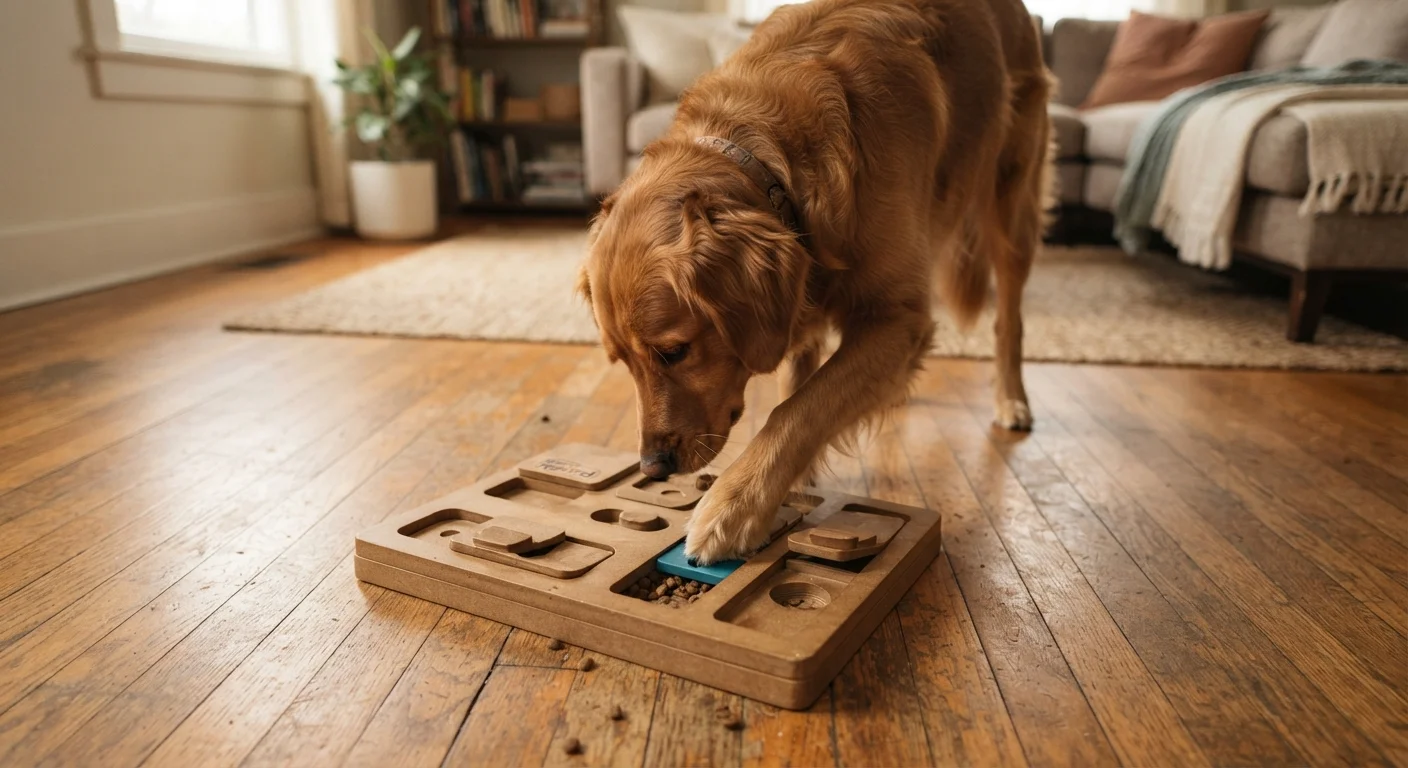
Replacing a standard bowl with a puzzle feeder, lick mat, or stuffed food toy turns mealtime into a problem-solving session. Dogs are foragers by nature, and working for food engages that drive in a healthy, controlled way. The difficulty level matters: a puzzle that's too easy provides no real challenge, while one that's too hard can cause frustration. Start simple and gradually increase complexity as your dog gains confidence. This approach is particularly useful for high-energy dogs and those prone to gulping their food.
Turning mealtime into a puzzle engages a dog's natural foraging instinct and provides genuine cognitive work.
Short training sessions with new skills
Learning a new cue requires concentration, pattern recognition, and memory - all cognitively demanding tasks. Regular, brief training sessions (five to ten minutes, several times a week) provide structured mental engagement and reinforce the human-dog bond. You don't need to work toward competition-level obedience. Teaching a dog to identify named toys, perform a sequence of behaviors, or navigate a simple home agility course all count. Positive reinforcement methods - rewarding desired behavior rather than correcting unwanted behavior - are consistently supported by animal behavior research as both effective and welfare-positive.
Learning new skills is cognitively demanding for dogs - short, consistent training sessions deliver outsized mental benefit.
Socialization and novel experiences
Exposure to new environments, people, smells, and situations exercises a dog's ability to assess, adapt, and respond - all forms of active cognitive processing. This doesn't mean overwhelming a dog with chaotic environments. Calm, positive exposure to a new park, a pet-friendly store, or a different walking route provides meaningful novelty. For dogs that are well-socialized, structured playdates with familiar dogs also provide social and cognitive stimulation. Always gauge your individual dog's comfort level; forced exposure to stressful situations has the opposite effect.
Novel environments and positive social experiences actively engage a dog's brain in ways a familiar routine cannot.
Chewing and foraging activities
Chewing is a natural, self-soothing behavior for dogs that also requires sustained focus. Appropriate chew items - selected based on your dog's size, chewing style, and any dental considerations your vet has noted - give dogs an outlet that is both mentally engaging and physically satisfying. Scatter feeding (spreading kibble across a sniff mat or in grass) mimics foraging and encourages slow, deliberate searching. These lower-key activities are especially well-suited to older dogs or those recovering from injury, for whom vigorous exercise may be limited. If you've adopted an older dog, chew and foraging activities are often an ideal starting point.
Chewing and scatter feeding are low-impact enrichment tools that suit dogs of any age or fitness level.
Interactive play that requires thinking
Not all play is equally stimulating. Fetch is great exercise, but it's largely repetitive. Games that require dogs to make decisions - such as hide-and-seek with their owner, learning which hand holds a treat, or searching for a hidden toy - engage working memory and attention more actively. Rotating which games you play prevents habituation and maintains novelty. Play also builds confidence, particularly in dogs that are shy or under-socialized, making it a welfare tool as well as an enrichment one.
Decision-based play engages working memory and attention in ways that repetitive fetch alone does not.
Structured "job" activities suited to breed traits
Many dogs were selectively bred for specific tasks - herding, retrieving, tracking, or guarding. When those drives go unaddressed, the energy often redirects into undesirable behavior. Providing breed-appropriate outlets doesn't require professional-level training. A retriever that practices carrying objects, a herding breed that works through agility exercises, or a terrier that gets to dig in a designated spot is engaging instincts in a constructive way. Understanding your dog's background helps you design enrichment that fits how they're actually built to think and move. For dogs that also struggle with leash manners, channeling breed energy through structured activities often makes training easier overall.
Breed-appropriate "job" activities channel instinctive drives constructively and reduce behavior problems linked to unmet needs.
Building Enrichment Into Everyday Life
Mental enrichment doesn't require expensive equipment or elaborate setups. Most of the strategies above can be woven into existing routines with minimal preparation. A training session during a commercial break, a sniff walk instead of a brisk one, or a stuffed food toy at mealtimes all count.
Start Small and Build Gradually
If your dog isn't used to enrichment activities, introduce one at a time and keep sessions short - five to ten minutes is plenty to start. Dogs new to puzzle feeders or nose work may need initial guidance to understand what's being asked of them. Progress at the dog's pace rather than pushing for quick results; confidence built slowly tends to last.
Dogs showing signs of persistent boredom - excessive barking, chewing, or restlessness - may also be experiencing underlying anxiety. If enrichment strategies don't ease those behaviors over time, consult your veterinarian or a certified applied animal behaviorist. This is especially relevant for dogs with separation anxiety, where enrichment alone is rarely sufficient.
This article is for general informational purposes only and does not constitute veterinary or behavioral advice. Always consult a qualified professional for concerns about your dog's health or behavior.
The content provided on our blog site traverses numerous categories, offering readers valuable and practical information. Readers can use the editorial team’s research and data to gain more insights into their topics of interest. However, they are requested not to treat the articles as conclusive. The website team cannot be held responsible for differences in data or inaccuracies found across other platforms. Please also note that the site might also miss out on various schemes and offers available that the readers may find more beneficial than the ones we cover.