

Our Verdict
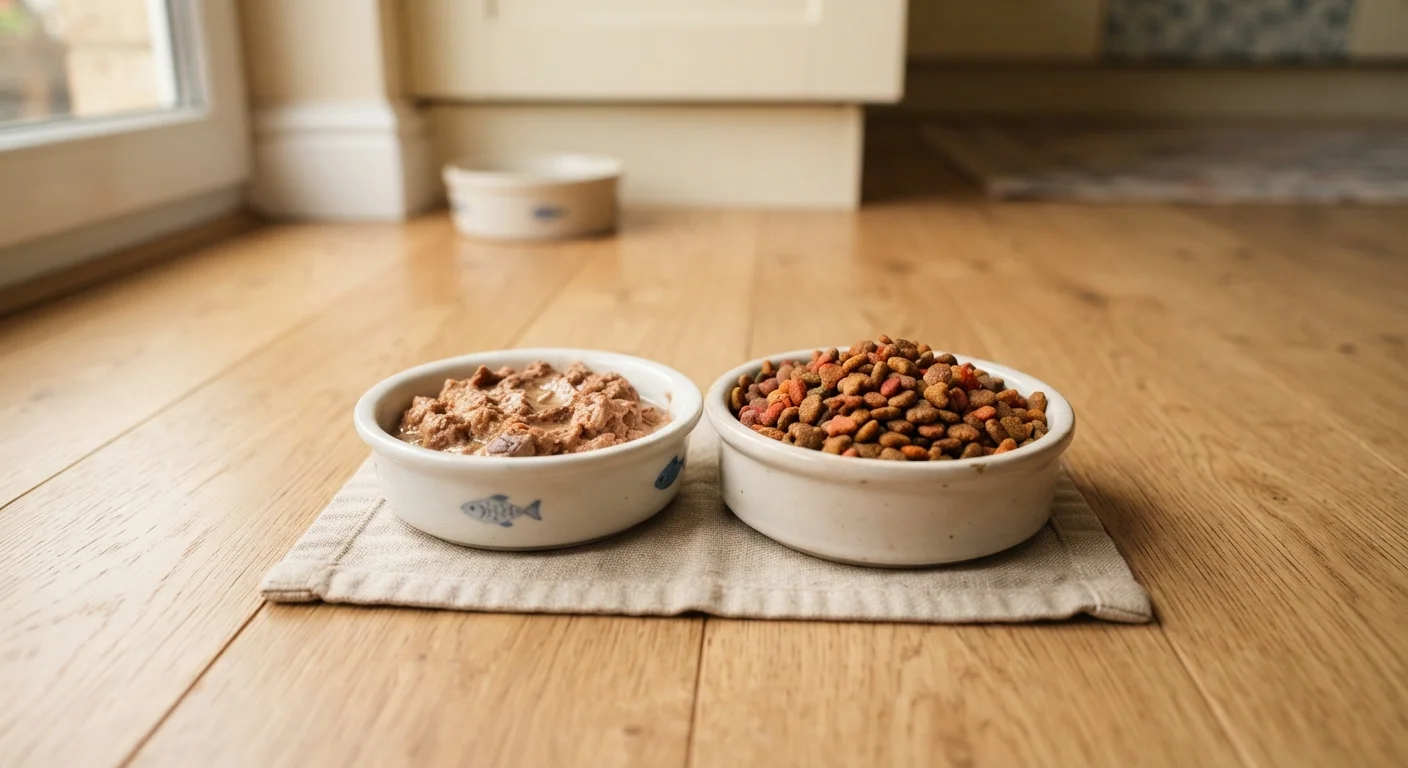
Wet food offers clear hydration advantages and tends to better align with a cat's carnivore biology, while dry food wins on convenience, shelf life, and cost per calorie. Neither format is nutritionally complete over the other by default - quality and balance matter more than format alone. For most cats, a thoughtful combination or a format chosen around individual health needs will serve better than a rigid either/or approach.
Cat owners managing a specific health condition like urinary issues or kidney disease will generally benefit most from prioritizing wet food, while busy households seeking a practical daily routine may find dry food or a mixed feeding strategy more sustainable.
Why the Wet vs. Dry Debate Matters for Cat Health
Cats are obligate carnivores - their bodies are built to derive nutrition from animal tissue, which naturally contains significant moisture. In the wild, prey animals provide roughly 70% water content. Commercial cat food formats vary dramatically from that baseline, which is why the wet-versus-dry question carries real health implications rather than being purely a matter of preference.
Dry food (kibble) typically contains 6-10% moisture, while wet food generally ranges from 70-82%. That gap has downstream effects on hydration, kidney function, urinary health, and caloric intake. Understanding these differences helps owners make choices that fit their cat's physiology, not just their own convenience. For a broader look at feline nutrition misconceptions, see Cat Nutrition Myths That Persist Despite the Evidence.
Advantages of Wet Food
High moisture content supports kidney and urinary health
At 70-82% water, wet food helps cats meet their daily fluid needs passively - important for a species with a low thirst drive and susceptibility to urinary and kidney disease.
Lower in carbohydrates, closer to natural prey diet
Most wet foods contain fewer carbohydrates than dry kibble, aligning more closely with the low-carb, high-protein diet cats evolved to eat as obligate carnivores.
More palatable for many cats, including picky eaters
The texture, aroma, and moisture content of wet food tend to make it more appealing, which is especially valuable for cats recovering from illness or with reduced appetite.
May support healthy weight through greater satiety
Higher protein and water content can promote feelings of fullness with fewer calories, potentially reducing overeating in cats prone to weight gain.
Wet food's high moisture content is its most clinically significant advantage. Cats have a naturally low thirst drive - an evolutionary trait from desert-dwelling ancestors who obtained most fluid from prey. This means cats fed exclusively dry food often exist in a mild, chronic state of underhydration, which over time can stress the kidneys and predispose them to urinary tract disease.
Wet food also tends to be lower in carbohydrates, more closely mimicking a prey-based diet. For cats managing weight or blood sugar regulation, that macronutrient profile can be meaningful. Many cats also find wet food more palatable, which matters for picky eaters or cats recovering from illness.
Disadvantages of Wet Food
Higher cost per serving than dry food
Wet food generally delivers fewer calories per dollar spent, which can make it expensive as a sole diet - particularly in households with multiple cats.
Shorter shelf life once opened
Opened cans or pouches must be refrigerated and used within 24-48 hours, requiring more careful meal planning and reducing the convenience of free-feeding.
Strong odor and messier to handle
Many owners find wet food less pleasant to store and serve, and leftover food in the bowl can spoil quickly, requiring prompt cleanup, especially in warmer environments.
Wet food's practical downsides are real and worth weighing honestly. Open cans must be refrigerated and used within 24-48 hours, making portion control and meal scheduling more demanding. It is generally more expensive per calorie than dry food, which adds up quickly in multi-cat households.
Some owners also find the smell and texture off-putting, and wet food left in the bowl for extended periods can spoil, attracting bacteria. Unlike some dry food marketing implies, wet food does not inherently cause more dental problems - but it also does not contribute to dental cleaning in the way some kibble is formulated to do.
~70-82%
Moisture content in typical wet cat food
Compared to roughly 6-10% in dry kibble, wet food far more closely mirrors the water content of a cat's natural prey.
~3x
More fluid intake in wet-food-fed cats
Studies have found that cats fed wet food consume significantly more total daily water than those fed dry food alone, even when accounting for water bowl intake.
Advantages of Dry Food
Dry kibble offers genuine practical benefits. It is shelf-stable, easy to portion, and typically costs less per serving - factors that matter for owners on a budget or managing multiple cats. It also suits free-feeding arrangements, where a measured portion is left available throughout the day, which can work well for cats that self-regulate their intake.
Certain dental-health kibble formulas are designed with larger kibble size or specific fiber structures intended to create mild mechanical abrasion on the tooth surface. The American Veterinary Dental College notes that while few diets have strong evidence for significant dental benefit, some specially formulated options carry the Veterinary Oral Health Council (VOHC) seal, indicating tested efficacy. Standard kibble, however, should not be assumed to prevent dental disease.
When One Format May Serve Your Cat Better
Certain health conditions shift the balance decisively. Cats with chronic kidney disease (CKD), idiopathic cystitis, urolithiasis (bladder stones), or diabetes are frequently advised by veterinarians to consume more wet food to increase fluid intake and better regulate blood glucose. In these cases, the format becomes part of the medical management plan, not just a feeding preference.
Conversely, cats with a history of obesity who are prone to overeating may need more structured portion control, which some owners find easier to manage with dry food measured by weight. Kittens and senior cats may have differing palatability and texture needs as well.
Reading the AAFCO Statement on Cat Food Labels
Every commercially sold cat food should include an AAFCO nutritional adequacy statement on the label, indicating whether it meets standards for a specific life stage (kitten, adult, or all life stages). 'Complementary' or 'supplemental' foods do not meet these standards and should not serve as a sole diet. When evaluating any wet or dry food, checking for this statement is a reliable first step in assessing nutritional completeness.
Whatever format you choose, the nutritional profile of the food matters as much as the moisture content. Look for products that meet AAFCO (Association of American Feed Control Officials) nutritional adequacy standards for your cat's life stage. This information is printed on the packaging label. For a comprehensive overview of cat ownership responsibilities including feeding decisions, see Everything Cat Ownership Involves That Nobody Warns You About.
The Case for Combining Both Formats
Many veterinarians suggest a mixed feeding approach - wet food once or twice daily with dry food available or used to complete the caloric balance - as a practical middle ground. This strategy captures the hydration benefits of wet food while preserving the convenience and cost efficiency of kibble.
There is no one-size-fits-all ratio. A cat owner's schedule, the cat's individual health status, and budget will all shape what's workable. Tracking your cat's weight, coat condition, litter box output, and energy level over time gives you meaningful feedback on whether a feeding approach is working. Your veterinarian is the right resource for guidance tailored to your individual cat - especially if a health condition is involved. You can also incorporate food-format review into your routine using a tool like the Monthly Cat Care Checklist.
This article is for general informational purposes only and is not a substitute for personalized veterinary advice. Consult your veterinarian for guidance on your cat's specific nutritional needs.
The content provided on our blog site traverses numerous categories, offering readers valuable and practical information. Readers can use the editorial team’s research and data to gain more insights into their topics of interest. However, they are requested not to treat the articles as conclusive. The website team cannot be held responsible for differences in data or inaccuracies found across other platforms. Please also note that the site might also miss out on various schemes and offers available that the readers may find more beneficial than the ones we cover.