

Why Indoor Cats Need Active Enrichment
An indoor lifestyle offers cats real safety advantages - shorter exposure to traffic, predators, and infectious disease. But safety without stimulation creates its own risks. Cats are natural hunters, and without outlets for that drive, boredom can emerge quickly. It often shows up as excessive grooming, furniture scratching, aggression, or withdrawn behaviour.
Enrichment isn't a luxury - it's a core part of responsible cat care. The goal is to recreate the cognitive and physical challenges cats would naturally encounter, within the structure of a home. For a broader look at the tradeoffs of keeping cats indoors, see our article on indoor versus outdoor cat health.
Below are eight practical enrichment strategies that work across different cat personalities, home sizes, and budgets.
Use Puzzle Feeders Instead of a Standard Bowl
Replacing your cat's food dish with a puzzle feeder - a device that requires pawing, rolling, or nudging to release kibble - taps directly into the natural foraging instinct. It slows eating, reduces boredom-related overeating, and gives the brain a genuine workout at mealtime. Start with easier puzzles and gradually introduce more complex designs as your cat gains confidence.
Feeding puzzles turn mealtime into a mentally engaging hunt rather than a passive routine.
Create Vertical Space with Cat Trees and Shelves
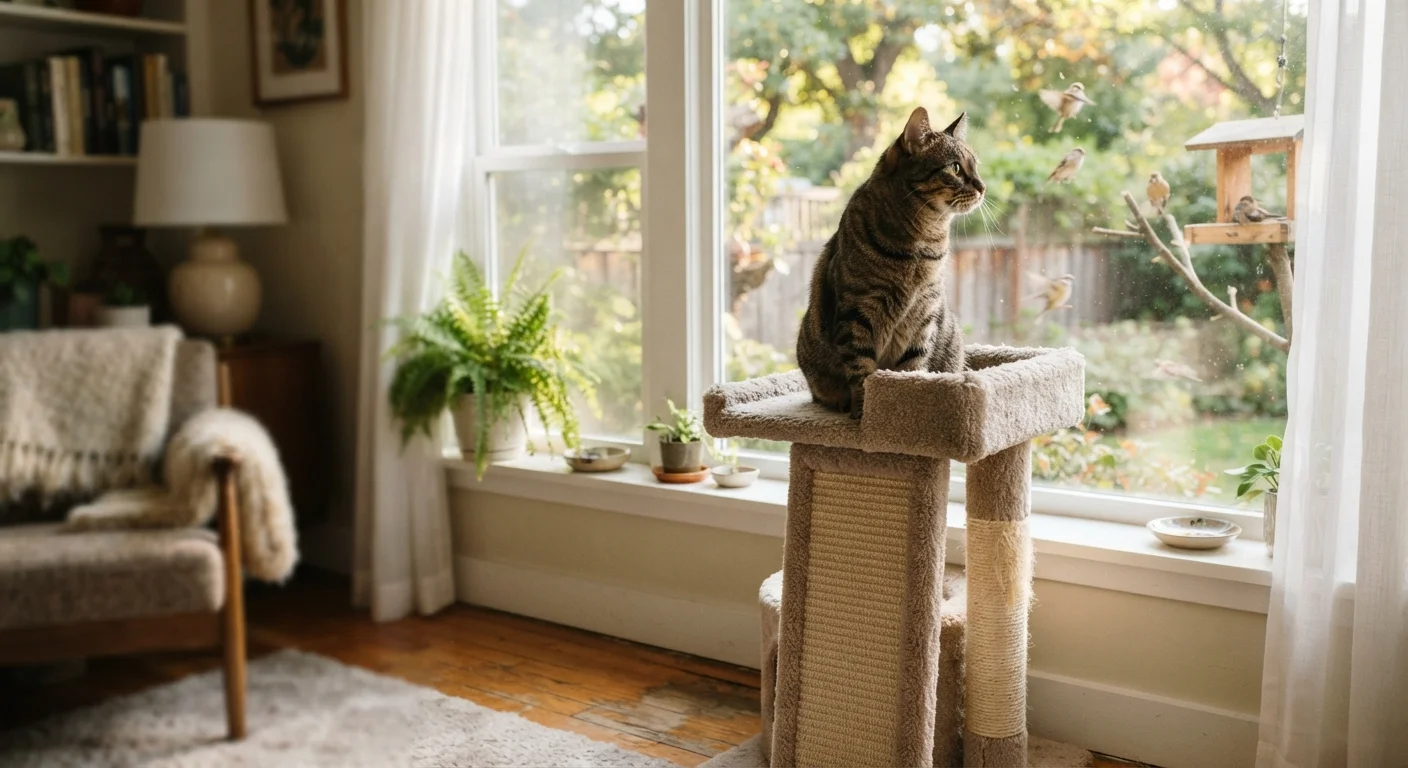
Cats instinctively seek high vantage points - it's both a safety behaviour and a way to survey their territory. A tall cat tree, wall-mounted shelves, or a cleared-off bookshelf top gives cats a legitimate outlet for climbing and perching. Multiple levels in different rooms expand your cat's perceived territory without expanding your floor space.
Vertical space dramatically expands a cat's sense of territory within the same square footage.
Set Up Window Access and Bird Feeders Outside
A window perch with an outdoor view is one of the simplest and most effective enrichment tools available. Place a bird feeder or squirrel-friendly area within sightline, and your cat gains a live, unpredictable visual stimulus that no manufactured toy can fully replicate. Rotate which windows are accessible to keep the view feeling fresh.
A well-placed bird feeder outside a window gives indoor cats hours of natural visual stimulation.
Rotate Toys on a Weekly Cycle
Cats habituate quickly to objects that don't change. A toy that's fascinating on Monday may be ignored by Thursday. Instead of leaving all toys out permanently, divide them into two or three groups and rotate which set is accessible each week. When a previously stored toy reappears, it often registers as novel - triggering renewed interest without any additional cost.
Rotating toy sets every week can make existing toys feel new again to your cat.
Incorporate Interactive Play Sessions Daily
Wand toys, laser pointers with a physical target at the end, and crinkle tunnels all invite active participation from you - and that social element matters. Aim for two short sessions per day (around 10-15 minutes), ideally one in the morning and one in the evening when cats are naturally more active. Always let your cat 'catch' something tangible at the end of a play session to avoid frustration.
Ending every play session with a physical 'catch' satisfies the predatory sequence and prevents frustration.
Introduce Safe Scent Enrichment
Cats experience the world largely through smell. Offering safe, novel scents - dried catnip, silver vine, valerian root, or even a paper bag that's been outside - engages olfactory processing that indoor cats rarely get to use. Rotate scent-based enrichment weekly. Not all cats respond to catnip (sensitivity is genetic), so experiment to find what your cat finds engaging.
Safe scent enrichment engages a part of a cat's brain that visual or physical toys cannot reach.
Try Clicker Training for Mental Engagement
Training isn't just for dogs. Many cats can learn to sit, high-five, or navigate obstacle courses using positive reinforcement and a clicker. The process demands concentration and problem-solving, making it one of the most cognitively demanding enrichment activities available. Short sessions of three to five minutes are enough - cats lose interest quickly, so keep training concise and always end on a success.
Short clicker training sessions are among the most cognitively demanding enrichment activities for cats.
Offer Foraging Opportunities Beyond the Food Bowl
In addition to puzzle feeders, you can hide small portions of dry food or treats around the home - under a paper cup, inside a crinkled piece of paper, or tucked in a cardboard box. This scatter feeding approach encourages your cat to use nose and memory to locate food, replicating a hunting-and-searching pattern. Start with obvious hiding spots and increase difficulty as your cat gets the idea.
Scatter feeding at varying locations encourages cats to use memory and scent to navigate their home.
Building a Stimulating Routine
The most effective enrichment isn't one-off - it's woven into your cat's daily structure. Cats are creatures of habit, so predictable windows for play, feeding puzzles, and exploration help regulate their mood and reduce anxiety. Even 10-15 minutes of intentional interaction twice a day can make a meaningful difference.
Match Enrichment to Your Cat's Personality
Some cats are bold explorers who relish novelty, while others are cautious and need gradual introduction to new objects or activities. Observe your cat's response to each enrichment type and lean into what genuinely engages them. A shy cat may find scatter feeding less stressful than interactive wand play, at least initially. There's no single formula - the best enrichment is whatever your individual cat actually uses.
If you want to track how your enrichment efforts are fitting into broader cat care, our monthly cat care checklist covers behavioural observation alongside grooming and health monitoring.
This article is for general informational purposes only and is not a substitute for advice from a qualified veterinarian. If your cat shows sudden changes in behaviour or signs of distress, consult your vet.
The content provided on our blog site traverses numerous categories, offering readers valuable and practical information. Readers can use the editorial team’s research and data to gain more insights into their topics of interest. However, they are requested not to treat the articles as conclusive. The website team cannot be held responsible for differences in data or inaccuracies found across other platforms. Please also note that the site might also miss out on various schemes and offers available that the readers may find more beneficial than the ones we cover.