

How Minimum Payments Are Calculated
Every month, your credit card statement shows two numbers: the full balance and the minimum payment due. The minimum is calculated one of two ways - a flat dollar amount (often around $25-$35) or a percentage of your balance (typically 1-3%) plus accrued interest, whichever is higher.
Here's the catch: as you pay down your balance, your minimum payment shrinks too. That might sound like good news, but it means you're automatically paying less and less toward the debt each month. Lenders refer to this as a "declining minimum" structure, and it's one reason balances can feel almost permanent.
Check Your Statement's Required Disclosure
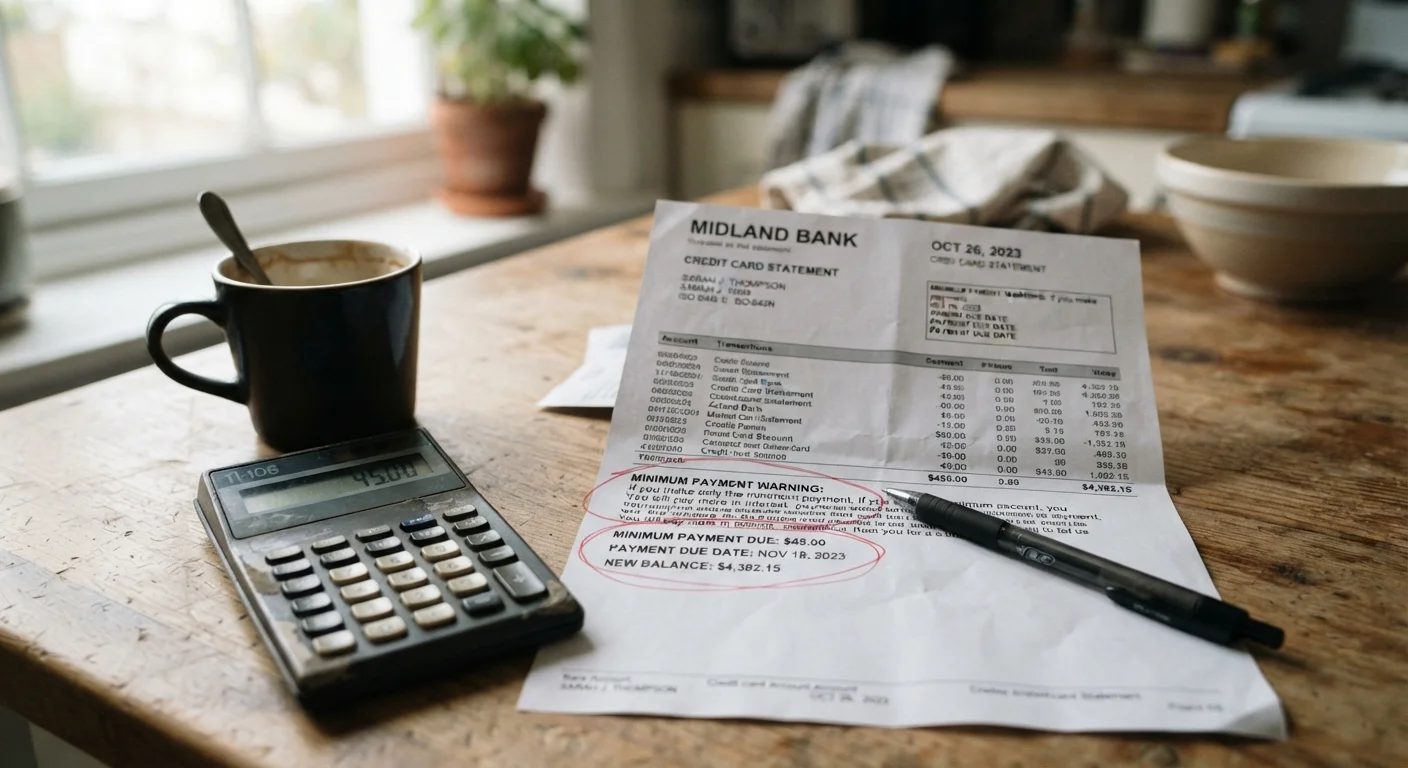
Under the Credit CARD Act of 2009, US credit card issuers must include a minimum payment warning on every statement. This box shows you exactly how long payoff will take - and the total interest cost - if you only ever pay the minimum. It's worth reading every month as a reality check.
The Real Cost of Paying the Minimum
Let's put some numbers to this. Suppose you carry a $3,000 balance on a credit card with a 20% annual percentage rate (APR). If you pay only the minimum each month and add no new charges, you could spend more than 14 years paying it off - and pay well over $3,000 in interest alone on top of the original balance.
Your credit card statement is actually required to show you this calculation. Look for the disclosure box labeled something like "Minimum Payment Warning." It will show you both the total time and the total interest if you only ever pay the minimum - numbers that many people find eye-opening.
14+ years
Time to repay $3,000 at 20% APR on minimums
Calculated using standard amortization for a declining minimum payment structure at a 20% annual interest rate.
~$3,300+
Total interest paid on that same $3,000 balance
Based on declining minimum payment calculations; actual amounts vary by card terms and issuer methodology.
1-3%
Typical minimum payment as a share of balance
Most major US credit card issuers set minimums within this range, per standard industry disclosures.
Why Lenders Set Minimums So Low
Minimum payments aren't set with your financial health as the priority. They're structured so that accounts stay active and in good standing - meaning lenders continue collecting interest for as long as possible. A low minimum reduces the chance you'll miss a payment and default, which protects the lender's income stream. That's a reasonable business model, but it runs counter to your goal of getting out of debt.
Understanding this dynamic is important. There's nothing wrong with the minimum payment as a safety net in a tough month, but treating it as your regular strategy is one of the financial habits that quietly extend debt for years.
Set a Fixed Payment, Not the Minimum
Rather than paying whatever the minimum is each month, choose a fixed dollar amount you can reliably afford - and stick with it. A consistent payment prevents your payoff timeline from stretching as your balance slowly declines, and it keeps you in control of when you'll actually be debt-free.
What Paying More Actually Does
The math shifts dramatically when you pay above the minimum. Using the same $3,000 balance at 20% APR, increasing your monthly payment by just $50 above the minimum could cut your repayment time roughly in half and save hundreds in interest charges.
The reason is straightforward: when you pay more than the interest charge, the extra goes directly toward reducing the principal. A smaller principal generates less interest next month, which means more of your next payment reduces the principal - and the cycle accelerates in your favor.
Once you've decided to pay more, choosing where to focus matters. Our guide on high-interest debt first versus smallest balance first walks through both approaches so you can pick the one that fits your situation.
Making Consistent Progress Without Willpower
One of the simplest ways to pay more than the minimum is to automate a fixed payment amount rather than letting the lender set it for you. If you schedule a consistent payment - say $150 a month - you avoid the trap of the shrinking minimum dragging your payoff date further away.
Automating your debt payments removes the monthly decision and reduces the chance of accidentally paying less during a busy period. You can often set this up directly through your card issuer's online account.
If you're also wondering whether to prioritize debt repayment or build a savings cushion first, that's a genuinely useful question to work through. See our overview on emergency fund versus debt repayment trade-offs for a grounded look at both sides.
This article is for general informational purposes only and does not constitute personalized financial advice. Consult a qualified financial professional for guidance tailored to your circumstances.
Frequently Asked Questions
When you pay only the minimum, the bulk of that payment goes toward interest charges rather than reducing your principal. As the balance drops slowly, so does your minimum payment - which further slows progress. The result is a repayment timeline that can stretch into decades.
Paying the minimum on time keeps your account current and avoids late payment penalties, so it won't directly harm your score. However, carrying a high balance relative to your credit limit - known as credit utilization - can drag your score down over time.
Even adding $25-$50 above the minimum each month can meaningfully shorten your repayment period and reduce total interest paid. The more you can add consistently, the bigger the impact. Use the payoff calculator on your card issuer's website to see the numbers for your specific balance.
There are times - like a financial emergency - when paying the minimum is the responsible short-term choice to stay current and avoid penalties. The risk comes from making it a habit rather than a temporary measure. As soon as your situation stabilizes, paying more than the minimum is strongly advisable.
Most credit card issuers set the minimum as either a flat fee (often around $25-$35) or a percentage of your outstanding balance (typically 1-3%), plus any accrued interest and fees - whichever is greater. The exact method varies by lender and is spelled out in your card agreement.
The content provided on our blog site traverses numerous categories, offering readers valuable and practical information. Readers can use the editorial team’s research and data to gain more insights into their topics of interest. However, they are requested not to treat the articles as conclusive. The website team cannot be held responsible for differences in data or inaccuracies found across other platforms. Please also note that the site might also miss out on various schemes and offers available that the readers may find more beneficial than the ones we cover.