

The Five Factors That Shape Your Score
Credit scoring models - FICO being the most widely used - calculate your score by analyzing the data in your credit reports across five categories. Understanding these gives you a clear picture of where to focus your energy.
- Payment history (~35%): Whether you've paid past bills on time is the single largest factor. Even one missed payment can have a meaningful negative impact.
- Amounts owed / credit utilization (~30%): This measures how much of your available revolving credit you're using. Keeping balances well below your credit limits - generally under 30% - tends to help your score.
- Length of credit history (~15%): Older accounts generally help. This includes how long your oldest and newest accounts have been open, and the average age of all accounts.
- Credit mix (~10%): Having experience with different types of credit - such as installment loans and revolving accounts - can positively influence your score.
- New credit / recent inquiries (~10%): Applying for several new credit accounts in a short window can signal financial stress and temporarily lower your score.
Review Your Credit Reports Regularly
You're entitled to free credit reports from each of the three major bureaus - Equifax, Experian, and TransUnion - through AnnualCreditReport.com. Reviewing them lets you catch errors or fraudulent accounts that could be silently lowering your score. Disputing inaccuracies is free and can sometimes produce a meaningful improvement.
Understanding how credit cards affect your utilization and payment history can sharpen your approach. See how credit and debit cards differ beyond payment method for more context on how each type affects your financial profile.
What Credit Scores Deliberately Ignore
Many people assume their credit score is a comprehensive measure of financial health. It isn't - and by law, certain types of information are excluded.
Thin Credit Files Are a Real Problem
An estimated 45 million U.S. adults are 'credit invisible' or have too little credit history to generate a score, according to the Consumer Financial Protection Bureau. This doesn't mean they're poor money managers - it often means they've simply avoided debt. Some newer scoring approaches are beginning to incorporate rent and utility payment data to address this gap, but traditional scores remain narrow.
- Income and employment: Earning $30,000 or $300,000 a year has no direct effect on your score. Neither does being employed or unemployed at any given moment.
- Savings and assets: Money in your checking, savings, or retirement accounts is invisible to credit scoring models.
- Net worth: Someone who is wealthy but avoids credit entirely can have a thin or nonexistent credit file.
- Race, religion, gender, and national origin: The Equal Credit Opportunity Act prohibits the use of these characteristics in credit scoring.
- Where you live: Your zip code or neighborhood is not a factor in your score.
This matters because a strong score doesn't mean someone is financially secure overall - and a lower score doesn't mean someone is irresponsible with money. Scores measure one narrow slice: how you've managed credit obligations.
~28%
Americans with subprime credit scores
According to FICO data, roughly 28% of U.S. consumers have a FICO Score below 670, which most lenders classify as subprime or fair.
5-10 pts
Typical drop from a single hard inquiry
FICO research indicates a single hard inquiry usually lowers a score by fewer than five points, though the exact impact varies by credit profile.
Why Your Score Actually Matters in Daily Life
Credit scores have real consequences beyond getting a mortgage. Here's where your number shows up in practical, everyday situations:
- Loan interest rates: Borrowers with higher scores typically qualify for lower rates. On a car loan or mortgage, that difference can add up to thousands of dollars over the life of the loan.
- Credit card approvals and terms: Card issuers use your score to determine whether to approve your application and what credit limit to offer.
- Apartment rentals: Most landlords pull credit reports - and sometimes scores - as part of the application process.
- Auto insurance premiums: In most U.S. states, insurers use credit-based insurance scores (related to, but distinct from, regular credit scores) when setting premiums.
- Utility deposits: Some utility providers check credit and may waive security deposits for applicants with strong scores.
“A credit score is not a measure of your worth or your financial wisdom. It's a very specific tool that measures one thing: how you've used credit in the past.”
— Consumer Financial Protection Bureau, U.S. federal consumer finance regulatory agency
If you're carrying high-interest debt across multiple accounts, it's worth understanding how debt consolidation works and what it doesn't fix - because the process can temporarily affect your credit score.
This article is for general informational purposes only and does not constitute personalized financial or legal advice. Consult a qualified financial professional for guidance specific to your situation.
Frequently Asked Questions
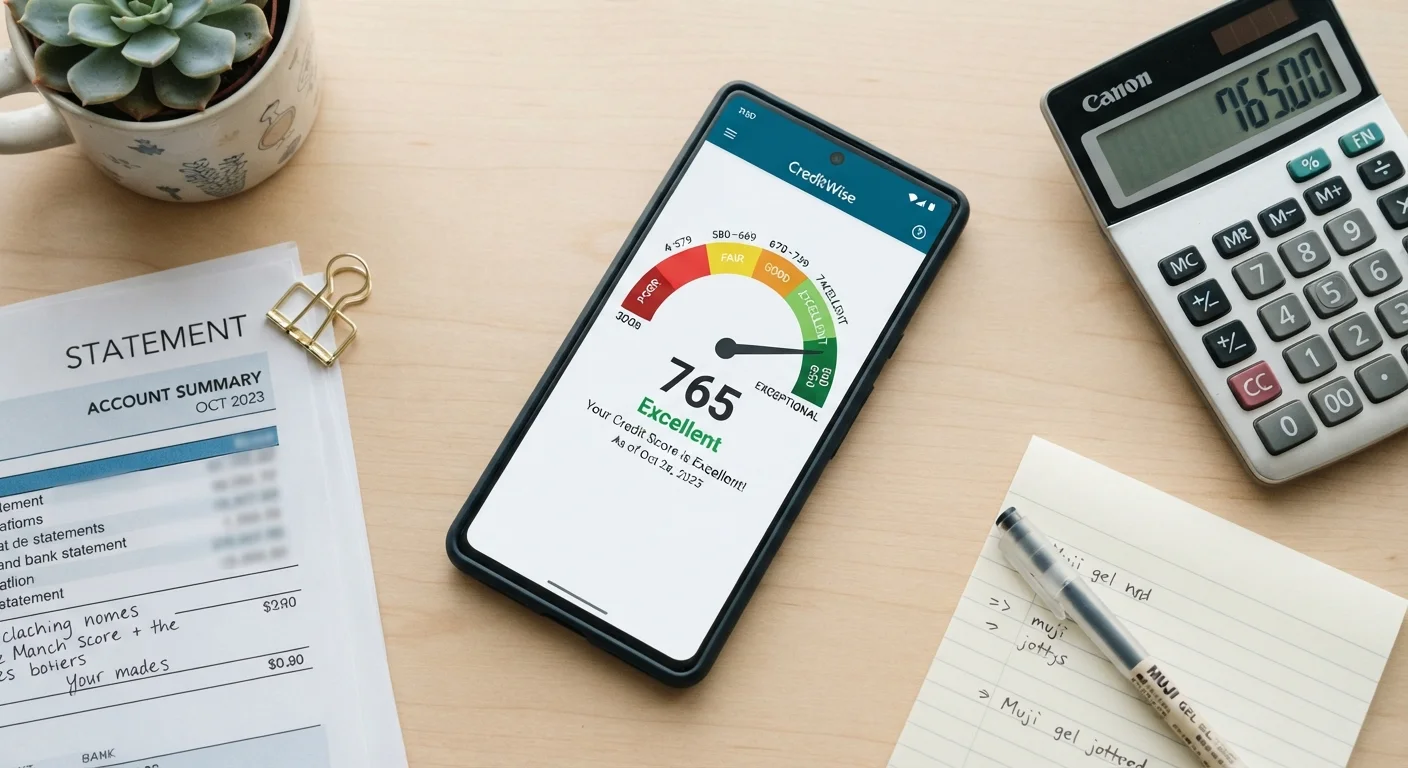
Most scoring models consider 670 and above a 'good' score, with 740+ considered 'very good' and 800+ 'exceptional.' Scores below 580 are generally classified as poor. These ranges may vary slightly between FICO and VantageScore models.
No. When you check your own score, it's counted as a 'soft inquiry,' which has no effect on your score. Only 'hard inquiries' - triggered when a lender pulls your credit to evaluate a loan or card application - can temporarily lower it by a few points.
It depends on what's dragging the score down. Consistently paying bills on time and reducing credit card balances can show improvement within a few months. Recovering from serious negatives like a bankruptcy or foreclosure typically takes several years.
No. Credit scores are built entirely from credit report data - how you've borrowed and repaid money. Your income, savings account balance, and investment assets are not included in any major scoring model.
Different lenders may pull data from different credit bureaus (Equifax, Experian, or TransUnion), and different scoring models weight that data differently. It's normal to have multiple scores, and they often differ by several points.
The content provided on our blog site traverses numerous categories, offering readers valuable and practical information. Readers can use the editorial team’s research and data to gain more insights into their topics of interest. However, they are requested not to treat the articles as conclusive. The website team cannot be held responsible for differences in data or inaccuracies found across other platforms. Please also note that the site might also miss out on various schemes and offers available that the readers may find more beneficial than the ones we cover.