

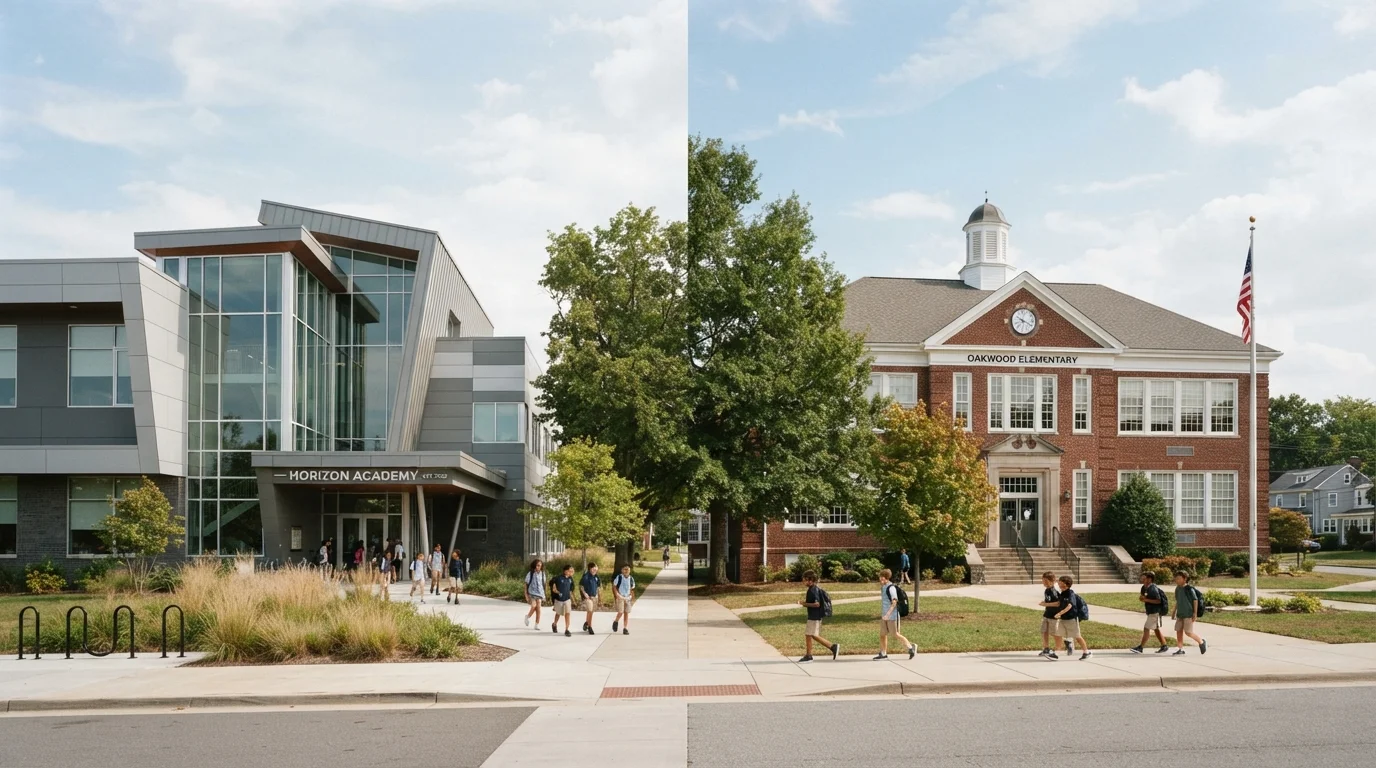
Option A
Traditional Public Schools
The universal, neighborhood-based option.
Best for: Families seeking a locally governed, geographically accessible school with broad curricular offerings and guaranteed enrollment.
Option B
Charter Schools
A publicly funded school with an independent operational model.
Best for: Families looking for a specific educational philosophy, instructional focus, or alternative structure within the public school system.
What Both School Types Have in Common
Despite their differences, charter schools and traditional public schools share a critical foundation: both are publicly funded and free to attend. Neither charges tuition. Both are required to administer state standardized assessments and - with some variation by state - must employ licensed teachers. Students at both types of schools have access to federally mandated protections, including civil rights protections and, in most cases, services under the Individuals with Disabilities Education Act (IDEA).
Understanding this shared ground matters because charter schools are sometimes mistakenly grouped with private schools. They are not the same. For a broader picture of where charter and public schools sit within the full range of schooling options, see The Schooling Landscape.
| Criterion | Traditional Public Schools | Charter Schools |
|---|---|---|
| Funding source | Public (taxpayer funded) | Public (taxpayer funded) |
| Tuition | Free | Free |
| Governance | Elected school board | Independent nonprofit board |
| Enrollment | Guaranteed by attendance zone | Lottery when oversubscribed |
| Curriculum flexibility | District-standardized | Greater autonomy per charter |
| Accountability mechanism | District & state oversight | Charter renewal or revocation |
| Transportation | Typically provided | Varies by school |
| Special education services | Full district infrastructure | Varies significantly by school |
How Charter Schools Differ: Governance, Flexibility, and Accountability
The defining feature of a charter school is its charter - a performance contract issued by an authorizing body (such as a school district, state board, or university) that grants the school freedom to operate outside many standard district rules. In exchange, the school is held accountable for meeting specific academic and operational goals. If a charter school fails to meet those goals, its charter can be revoked and the school closed.
This structure gives charter schools more flexibility in areas like curriculum design, school schedules, staffing decisions, and budget allocation. A charter school might run a longer school day, use a non-traditional grading system, or build its entire program around a single instructional philosophy - all with fewer bureaucratic constraints than a district school faces.
7,700+
Charter schools operating in the U.S.
According to the National Alliance for Public Charter Schools, over 7,700 charter schools served approximately 3.7 million students as of recent national data.
~29%
Charter schools outperforming local public schools in reading
CREDO research at Stanford found that roughly 29% of charter schools produced stronger reading growth than comparable traditional public schools, while a similar share performed worse.
Traditional public schools operate under the direct governance of elected school boards, which means decisions are made through a public process and reflect community priorities. This can be slower but ensures democratic oversight. Charter schools, by contrast, are typically governed by an independent nonprofit board, which may be more nimble but less directly accountable to the broader community.
Enrollment, Access, and Practical Realities
Enrollment works differently in each format. Traditional public schools admit all students who live within their designated attendance zone. There is no application process, no waitlist, and no selection criteria. Charter schools, because they are open to students across a broader geographic area, often receive more applications than they have seats. When this happens, federal law requires them to use a random lottery for admission - not academic screening or other selective criteria.
This lottery system means that access to a particular charter school is not guaranteed, even for families highly motivated to enroll. Location can also be a factor: charter schools are not distributed evenly across a district, and transportation is not always provided. Families should verify what transportation options exist before applying.
Special Education: Verify Before You Enroll
Charter schools are legally required to serve students with disabilities, but the depth of available services varies considerably from school to school. Some charter schools have well-developed special education programs; others have limited staff or resources. If your child has an Individualized Education Program (IEP) or a 504 plan, contact the charter school directly before applying to confirm they can meet your child's specific needs. Your local school district remains responsible for ensuring appropriate services are available.
For families just beginning to explore these choices, Choosing a Schooling Path for Your Child offers a useful starting framework. And if you want to compare both formats against other schooling types across dimensions like cost, flexibility, and parental involvement, Weighing Up Your Options provides a structured comparison.
Academic Quality and What the Research Shows
A common question families ask is: which performs better academically? Research on charter school outcomes is mixed. Some studies - including reports from Stanford University's Center for Research on Education Outcomes (CREDO) - have found that charter school performance varies considerably by state, operator, and school. Some charter schools produce strong academic gains; others underperform compared to comparable traditional public schools. The format itself is not a predictor of quality.
The same is true for traditional public schools. Performance varies significantly by district, school, and the resources available. Evaluating a specific school's performance data, teacher qualifications, and student support services is more informative than assuming one format is inherently stronger than the other. Both types of schools are required to publish annual report cards under federal law, making that data accessible to families.
If you are also weighing private school options alongside these two formats, Private Schooling: Separating Common Assumptions from Reality addresses several widely held but inaccurate beliefs about what private schools deliver.
The content provided on our blog site traverses numerous categories, offering readers valuable and practical information. Readers can use the editorial team’s research and data to gain more insights into their topics of interest. However, they are requested not to treat the articles as conclusive. The website team cannot be held responsible for differences in data or inaccuracies found across other platforms. Please also note that the site might also miss out on various schemes and offers available that the readers may find more beneficial than the ones we cover.