

Why Encoding Strategy Matters
Memory encoding is the initial stage at which new information is registered and processed into a form the brain can store. Not all encoding is equal - the depth and richness of processing at this stage strongly influence how retrievable a memory will be later. This is the foundation of what cognitive psychologists call levels of processing: shallow encoding (skimming or passive re-reading) tends to produce fragile memories, while deep encoding - connecting new material to existing knowledge, generating examples, or retrieving it actively - produces more durable traces.
Understanding which strategies actually work, and why, can transform how efficiently you study. The techniques below are drawn from cognitive and educational research. They are not magic shortcuts, but reliable methods for making the most of focused study time. To see how they fit into a broader session structure, Building a Study Session That Sticks offers a practical framework.
Encoding Is Only the First Step
Even the most effective encoding strategy benefits from follow-up. Memory consolidation - the process that converts a fresh encoding into a stable long-term trace - is partly dependent on sleep and on spacing review over time. For more on how rest supports what you've learned, see The Role of Sleep in Memory Consolidation. Combining strong encoding with spaced review produces more durable outcomes than either approach alone.
Six Encoding Strategies to Try
Elaborative Interrogation
Elaborative interrogation involves generating explanations for facts by asking yourself why or how something is true. Rather than reading that mammals are warm-blooded and moving on, you pause and ask: "Why does warm-bloodedness matter for survival?" This forces your brain to connect new information to prior knowledge, which cognitive researchers refer to as building meaningful associations.
The technique is especially effective when you already have some background knowledge on a topic, giving your brain more hooks to attach the new detail. Students who practice elaborative interrogation while studying factual material tend to recall significantly more than those who simply re-read the same content.
Asking 'why' while you study forces connections that passive reading simply cannot build.
The Method of Loci
One of the oldest documented memory techniques, the method of loci (also called the memory palace) asks you to mentally place pieces of information along a familiar physical route - your home, your commute, a well-known street. When you need to recall the information, you mentally walk the route and "pick up" each item.
Neuroimaging research suggests this approach works because it recruits spatial memory networks in the hippocampus, an area strongly associated with episodic recall. The method is particularly useful for ordered lists, speech outlines, and vocabulary sets. It requires upfront effort to build the spatial scaffold, but becomes faster with practice.
The memory palace converts abstract information into vivid spatial journeys the brain navigates easily.
Concrete Examples and Self-Generated Analogies
Abstract concepts encoded alongside concrete examples are retrieved more reliably than abstractions alone. When learning a principle - say, the law of diminishing returns - constructing your own example ("the fifth slice of pizza is less satisfying than the first") forces deeper processing than relying solely on a textbook illustration.
Cognitive scientists describe this as concreteness effects: the brain more readily encodes and retrieves information that can be pictured or experienced. Self-generating the analogy adds an additional layer of elaboration, making the encoding trace richer and more distinctive. This approach pairs naturally with elaborative interrogation.
Self-generated analogies engage deeper processing than any example a textbook can provide.
Interleaved Practice
Interleaving means mixing different topics or problem types within a single study session rather than completing one topic fully before moving to the next. For example, a math student might alternate between algebra, geometry, and statistics problems rather than blocking each subject separately.
Although interleaving often feels harder in the moment - a phenomenon researchers call desirable difficulty - it consistently produces stronger long-term retention and transfer compared with blocked practice. The process of switching between categories forces the brain to continuously retrieve and discriminate between concepts, strengthening each memory trace in the process. For a deeper comparison, see Interleaving vs. Blocked Practice.
The discomfort of interleaving is a reliable signal that meaningful encoding is taking place.
Active Recall and Retrieval Practice
Retrieval practice - deliberately pulling information from memory rather than reviewing it passively - is among the most consistently supported strategies in memory research. Flashcards, practice tests, and blank-page recall (writing everything you remember on a topic without looking at notes) all qualify.
Each act of retrieval modifies and strengthens the memory trace, a process known as reconsolidation. Notably, attempting retrieval even before you feel ready produces better long-term outcomes than waiting until material feels familiar. This is sometimes called the testing effect. To understand how it compares to re-reading, see Active Recall vs. Passive Review.
Struggling to retrieve an answer encodes it more durably than reviewing it without effort.
Dual Coding
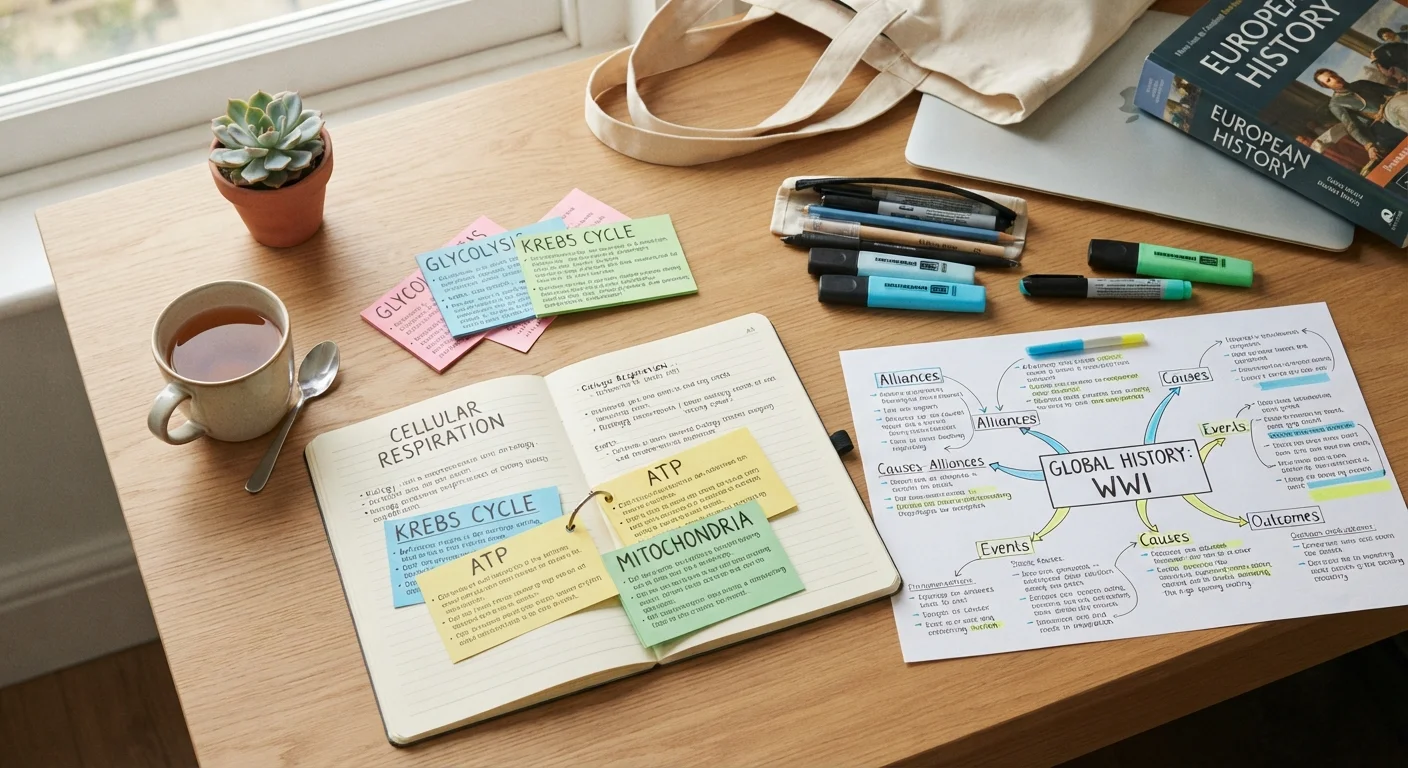
Dual coding combines verbal and visual representations of the same material. Drawing a diagram while taking written notes, or sketching a concept map after reading a chapter, engages two independent memory channels simultaneously. When one retrieval route is blocked, the other can still provide access.
Psychologist Allan Paivio's dual coding theory proposes that verbal and non-verbal systems operate in parallel and reinforce each other when activated together. Practically, this might look like annotating a timeline with small sketches, or pairing vocabulary definitions with a hand-drawn icon. It doesn't require artistic skill - the act of creating a visual is what matters, not its quality.
Pairing words with visuals gives your memory two separate paths back to the same information.
Match Your Strategy to the Material
Not every technique suits every content type. The method of loci excels with ordered or list-based information; elaborative interrogation fits conceptual material best; dual coding benefits visual or process-heavy topics. Diagnose what your material demands before choosing a method, and consider combining two complementary strategies in a single session.
Putting It Into Practice
Adding every technique at once is neither practical nor necessary. A reasonable starting point is to identify one or two strategies that match your current subject matter and learning goals, then build from there. Elaborative interrogation and retrieval practice, for instance, can be layered into almost any study session with minimal overhead.
Keep in mind that encoding strategies work best when combined with sound study architecture - managing cognitive load during sessions, spacing review across days using spaced repetition, and ensuring adequate sleep for consolidation. For a broader map of evidence-based study methods and where each fits, see Study Techniques for Every Learning Context.
The content provided on our blog site traverses numerous categories, offering readers valuable and practical information. Readers can use the editorial team’s research and data to gain more insights into their topics of interest. However, they are requested not to treat the articles as conclusive. The website team cannot be held responsible for differences in data or inaccuracies found across other platforms. Please also note that the site might also miss out on various schemes and offers available that the readers may find more beneficial than the ones we cover.