

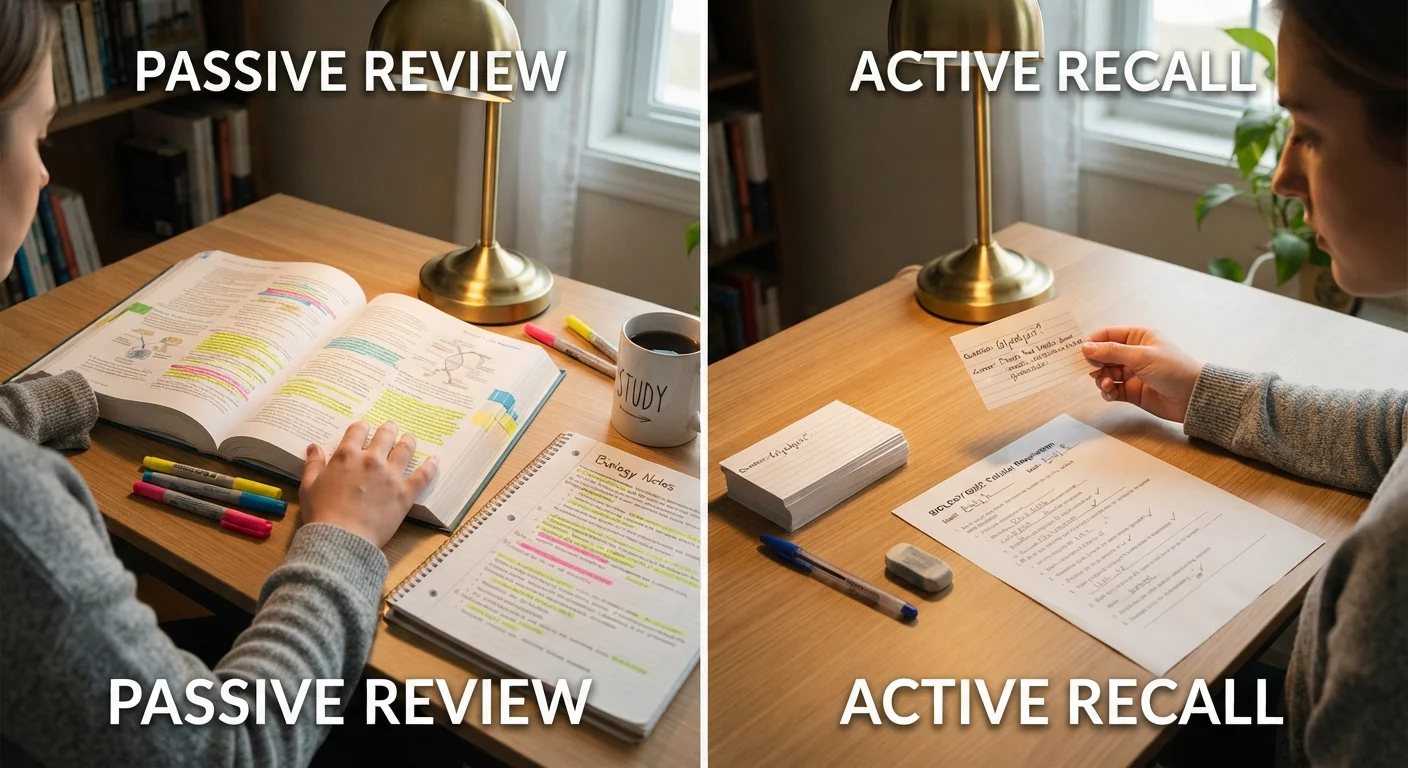
Option A
Active Recall
The effortful retrieval method backed by decades of cognitive research.
Best for: Learners who want durable, long-term retention of complex or high-stakes material.
Option B
Passive Review
The familiar, low-effort approach most students default to.
Best for: Quick orientation to new material before moving to more demanding study techniques.
What Each Method Actually Involves
Active recall is any study behavior that requires you to retrieve information from memory without looking at the source. Common forms include answering practice questions, using flashcards, closing your notes and writing down everything you remember, or explaining a concept aloud. The key feature is generation - your brain must produce the answer rather than recognize it.
Passive review, by contrast, involves re-exposing yourself to already-seen material without actively producing anything. Rereading textbook chapters, skimming highlighted notes, watching a lecture again, or reviewing a summary sheet all fall into this category. The material is present and visible; your task is simply to absorb it again.
The difference sounds minor, but the cognitive processes involved are fundamentally different - and that gap has major consequences for how well information is retained.
| Criterion | Active Recall | Passive Review |
|---|---|---|
| Core activity | Generating answers from memory | Re-reading or re-watching material |
| Cognitive effort required | High - effortful retrieval | Low - recognition-based |
| Long-term retention | Significantly stronger | Weaker; fades faster |
| Risk of fluency illusion | Low - errors are visible | High - familiarity mimics mastery |
| Best stage of learning | After initial exposure | First encounter with material |
| Pairs well with | Spaced repetition, practice testing | Active recall follow-up |
What the Research Says
The scientific case for active recall is substantial. A landmark study published in Science (Roediger & Karpicke, 2006) found that students who repeatedly tested themselves on material retained significantly more one week later than students who spent the same time rereading. The testing group recalled around 61% of material compared to roughly 40% for the re-study group - a difference that persisted over time.
This effect is known as the testing effect or retrieval practice effect: the act of retrieving information strengthens the memory trace in a way that simply re-exposing yourself to the information does not. Each successful retrieval attempt makes future retrieval faster and more reliable.
~50%
Retention gap after one week
In Roediger & Karpicke's 2006 study, retrieval practice groups outperformed re-study groups by roughly 50% on delayed recall tests.
2×
Retrieval vs. rereading on delayed tests
A review of retrieval practice research by Roediger & Butler (2011) found testing roughly doubled retention compared to passive restudy on longer-term assessments.
3 sessions
Typical practice tests needed for strong recall
Research on distributed practice suggests spacing at least three retrieval attempts over time produces more durable memory than a single massed review.
Why does passive review underperform? Cognitive scientists point to fluency illusion - material that has been read before feels familiar, and that familiarity is easily mistaken for mastery. Readers often confuse the ease of recognition with the ability to recall. This is explored further in When Rereading Your Notes Becomes a Trap.
Passive review is not entirely without value. Research suggests it is a reasonable way to gain initial exposure to material or to re-familiarize yourself with a broad topic before a testing session. The problem arises when it replaces - rather than precedes - active retrieval practice.
Practical Ways to Apply Active Recall
Shifting from passive to active study does not require elaborate tools. Some well-supported techniques include:
- Flashcards with spaced repetition: Writing questions on one side and answers on the other, then reviewing them at strategically increasing intervals. To understand why this pairing is so powerful, see The Science Behind Why Spaced Repetition Works.
- Blank-page recall: After reading a section, close the source and write or type everything you can remember. Then review what you missed.
- Practice testing: Use past exam papers, end-of-chapter questions, or self-generated quiz questions.
- The Feynman technique: Explain a concept in plain language as though teaching it to someone unfamiliar with the topic. Gaps in your explanation reveal gaps in your understanding.
For a structured approach to weaving these techniques into a full study session, Building a Study Session That Sticks offers a practical framework grounded in cognitive science. You can also explore a broader set of approaches in Memory Encoding Strategies Worth Adding to Your Study Routine.
Active Recall Works Even When You Get It Wrong
Research on retrieval practice shows that unsuccessful retrieval attempts - where you try to recall something but fail - can still improve later learning. The effort of attempting to retrieve an answer, even incorrectly, primes the brain to encode the correct information more deeply when it is subsequently reviewed. This means struggling with a flashcard is not wasted time; it is part of the process.
One often-overlooked factor in retention is sleep. Active recall consolidates learning during waking hours, but The Role of Sleep in Memory Consolidation explains how the brain further processes retrieved memories during rest - making adequate sleep a meaningful part of any evidence-based study plan.
The content provided on our blog site traverses numerous categories, offering readers valuable and practical information. Readers can use the editorial team’s research and data to gain more insights into their topics of interest. However, they are requested not to treat the articles as conclusive. The website team cannot be held responsible for differences in data or inaccuracies found across other platforms. Please also note that the site might also miss out on various schemes and offers available that the readers may find more beneficial than the ones we cover.