

How R-Value Is Measured and What the Numbers Mean
R-value stands for thermal resistance - it quantifies how strongly a material opposes the movement of heat from one side to the other. In the United States, R-value is expressed in units of ft²·°F·hr/BTU, though most homeowners simply work with the number itself.
A few reference points help put the scale in context:
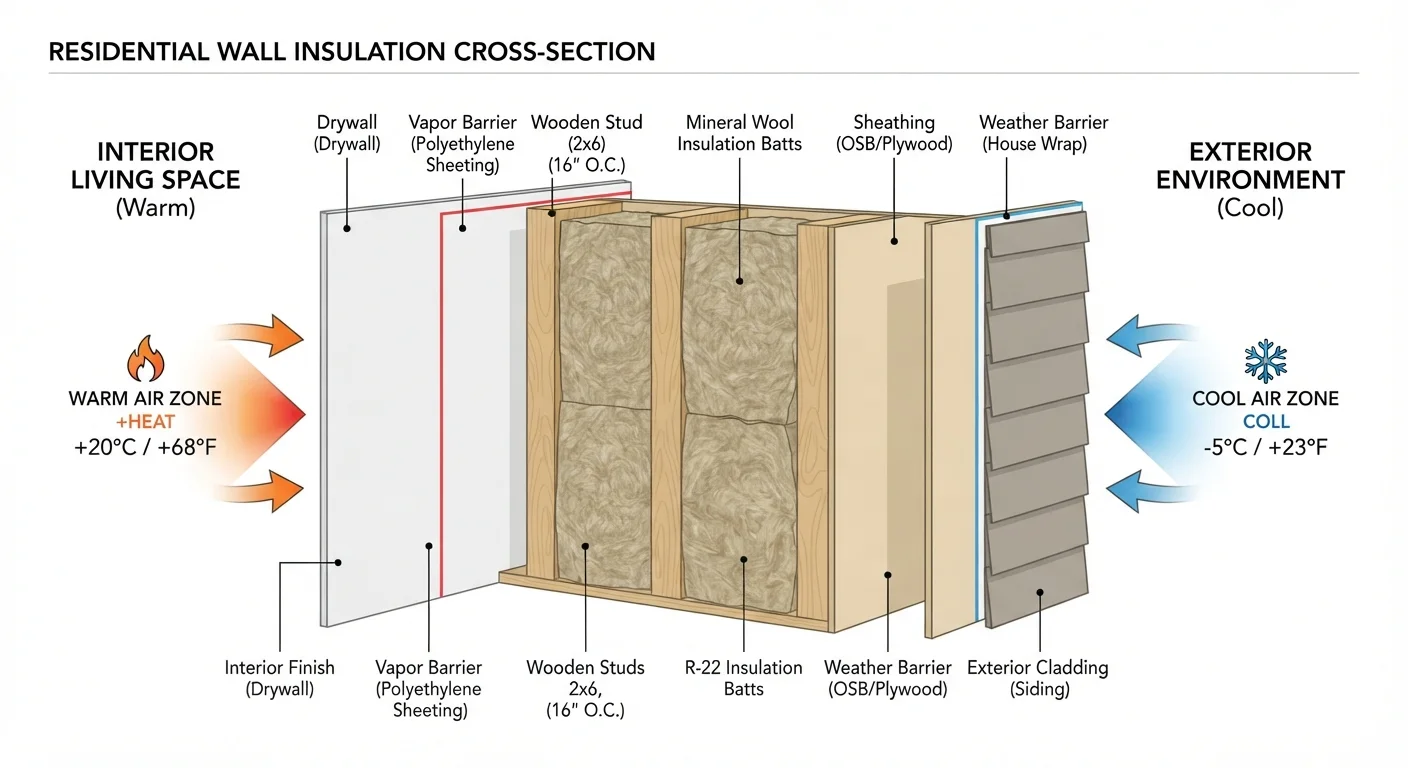
- R-13 to R-15: Typical for 2×4 exterior wall cavities filled with fiberglass batts
- R-19 to R-21: Common for 2×6 wall framing
- R-30 to R-60: Recommended for attics, depending on climate zone
Because R-values are additive, layering materials is a straightforward way to reach a target. A wall assembly might combine batt insulation inside the cavity with rigid foam on the exterior sheathing to meet or exceed code minimums.
R-49 to R-60
Recommended attic R-value for cold US climates
According to US Department of Energy guidelines for Climate Zones 5-8, covering much of the northern United States.
~15%
Estimated share of home heating lost through the attic
The DOE estimates that a poorly insulated attic is one of the most significant sources of residential energy loss in US homes.
R-3.7 per inch
Approximate R-value of cellulose blown-in insulation
Cellulose is a commonly used blown-in material; actual values vary slightly by density and product formulation.
Why Climate Zone Determines the Right R-Value for Your Home
The US Department of Energy divides the country into eight climate zones - from the hot, humid Gulf Coast (Zone 1) to the frigid upper Midwest and Alaska (Zone 7-8). Each zone carries recommended minimum R-values for different parts of the home: attics, walls, floors, and crawl spaces.
In warmer southern climates, the priority is keeping summer heat out, so insulation requirements are somewhat lower. In colder northern climates, preventing winter heat loss is critical, and higher R-values are required. A Zone 2 home in Florida might need only R-30 in the attic, while a Zone 6 home in Minnesota should aim for R-49 to R-60.
Climate Zone Maps Are Publicly Available
The US Department of Energy publishes a free, interactive climate zone map at energycodes.gov that lets homeowners identify their zone by ZIP code or county. This is the starting point for determining appropriate R-value targets for any part of your home.
Local building codes often adopt or exceed the DOE's recommendations. Always verify requirements with your local building department before starting an insulation project, particularly if permits are involved.
What Reduces Effective R-Value in Real-World Installations
The R-value printed on a package reflects lab-tested performance under ideal conditions. In practice, several factors can reduce how well insulation actually performs:
- Compression: Squeezing batt insulation into a space smaller than its designed thickness reduces its R-value proportionally.
- Gaps and voids: Even small air gaps around outlets, pipes, or improperly fitted batts allow heat to bypass the insulation entirely.
- Moisture: Wet insulation loses thermal resistance and can promote mold growth. Vapor barriers and proper air sealing help protect against this.
- Thermal bridging: Studs, joists, and other structural members conduct heat around the insulation. This is why a whole-wall R-value is always lower than the cavity R-value alone.
Air Sealing Before Insulating Pays Off
Before adding or upgrading insulation, seal air leaks around recessed lights, plumbing penetrations, and attic hatches with caulk or foam. Air movement carries far more heat than conduction through materials, so even high-R insulation underperforms in a leaky building envelope. Air sealing and insulation work best as a team.
For a deeper look at how different materials perform under real conditions, see our comparison of insulation types covering batts, blown-in, spray foam, and rigid board options.
Frequently Asked Questions
The US Department of Energy recommends attic insulation ranging from R-30 to R-60 depending on your climate zone. Colder climates in the northern US generally require higher values. Check the DOE's zone map or your local building code for the specific recommendation for your area.
A higher R-value means better thermal resistance, but it's not the only factor. Installation quality matters just as much - gaps, compression, or moisture intrusion can reduce real-world performance significantly. Choosing the right insulation type for your application is equally important.
Yes. R-values are additive when materials are layered. For example, combining R-19 batts with R-10 rigid foam board gives a total of approximately R-29. This is a common strategy when upgrading existing insulation or when space is limited.
Most insulation materials maintain their rated R-value for decades under normal conditions. However, compression, moisture absorption, or settling - particularly in blown-in insulation - can reduce effective performance over time. Periodic inspection helps confirm your insulation is still doing its job.
No, but they are related. Different materials achieve different R-values per inch of thickness. Spray polyurethane foam, for instance, achieves a higher R-value per inch than fiberglass batts, allowing for thinner installations in space-constrained areas.
The content provided on our blog site traverses numerous categories, offering readers valuable and practical information. Readers can use the editorial team’s research and data to gain more insights into their topics of interest. However, they are requested not to treat the articles as conclusive. The website team cannot be held responsible for differences in data or inaccuracies found across other platforms. Please also note that the site might also miss out on various schemes and offers available that the readers may find more beneficial than the ones we cover.