

Why Structure Helps - Without a Professional in the Room
Many people assume that eating well requires professional oversight or sophisticated tracking tools. In reality, the core principles of nutritional balance are well-established and accessible. What most people lack is not information but a repeatable system for applying that information week after week.
Meal planning acts as that system. By deciding in advance what to eat - and shopping accordingly - you reduce the number of in-the-moment food decisions that tend to default toward convenience over variety. Research consistently associates dietary patterns rich in whole foods, vegetables, legumes, and lean proteins with better health outcomes over time, though individual needs vary.
Pairing good nutrition with other healthy habits amplifies results. Consider how your eating patterns interact with your activity levels - the weekly movement routine guide offers a practical framework if you spend much of your day seated. And if time is your main barrier to eating well, our complementary piece on eating well on a tight schedule addresses that directly.
This Is General Information, Not Medical Advice
The guidance in this article is intended for generally healthy adults looking to improve dietary variety. It is not a substitute for personalized advice from a registered dietitian or healthcare professional. If you have a medical condition, food allergy, or specific nutritional need, please consult a qualified provider before making significant changes to your diet.
This article is for informational purposes only. It is general health education, not personalized dietary advice. Always consult a registered dietitian or qualified healthcare professional for guidance tailored to your individual health circumstances.
Getting Set Up: Tools and What to Expect
You do not need specialist equipment or a subscription service to plan a balanced week of meals. The essentials are minimal - something to write your plan on, a grocery list, and a general understanding of food groups covered in the steps below.
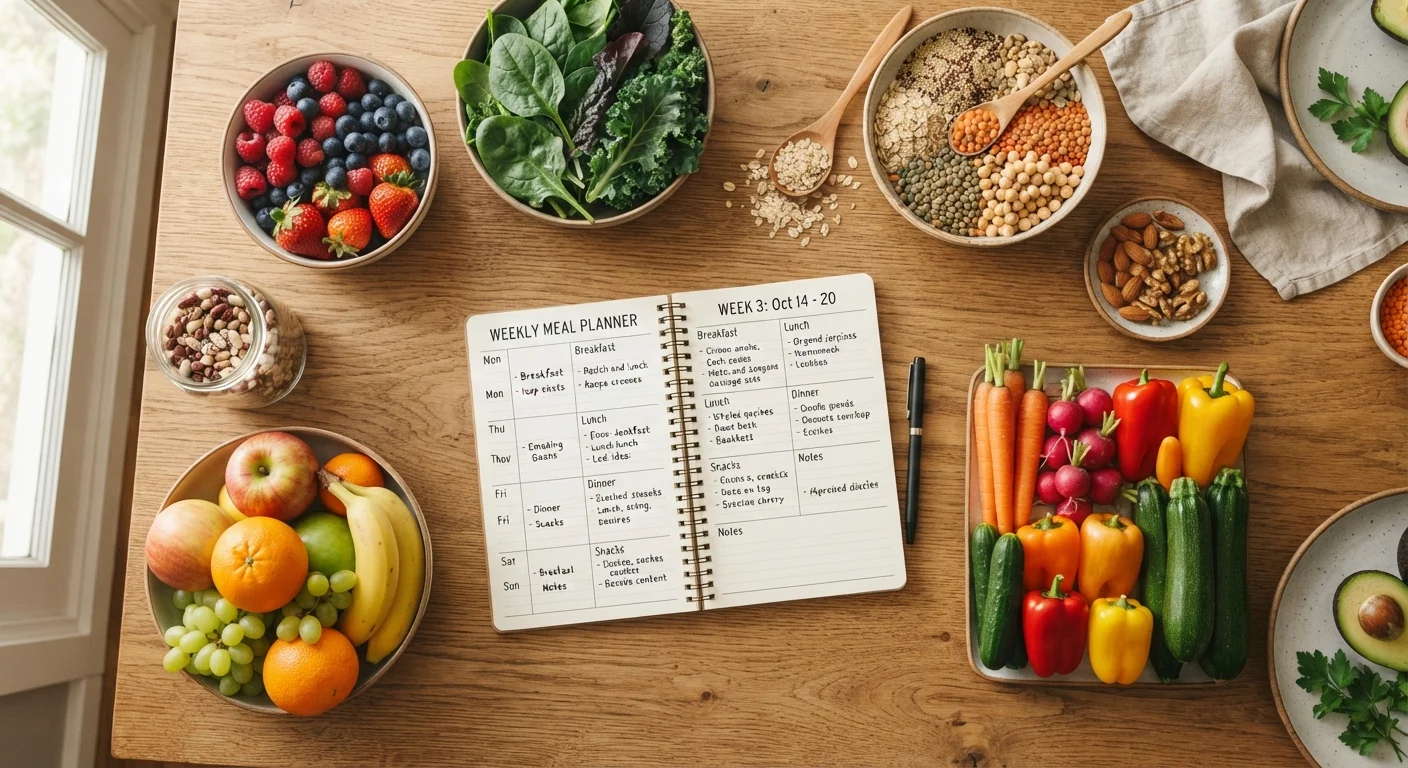
Weekly planner template or notebook
Maps out breakfast, lunch, dinner, and snacks across seven days in a visible, organized format.
Grocery list (paper or app)
Consolidates ingredients from your planned meals so shopping is efficient and nothing is forgotten.
Food storage containers
Supports batch cooking by allowing cooked grains, proteins, and vegetables to be portioned and refrigerated safely.
Kitchen scale or measuring cups
Helps with batch cooking portion awareness - not for calorie counting, but for consistent recipe scaling.
What you will need
The steps that follow are designed for a generally healthy adult without specific medical dietary requirements. If you have a chronic health condition, food allergy, or particular nutritional goal, treat these steps as a starting framework and work with a qualified professional to adapt them to your needs.
Keep a Running List of Meals You Enjoy
Before your first planning session, jot down 10-15 meals your household already likes. Familiar meals reduce planning resistance and mean you are more likely to follow through. You can gradually expand this list as your confidence grows.
The Seven Steps to a Balanced Week
Work through these steps once fully at first. After two or three weeks, the planning process becomes faster as you build a personal meal rotation. Most people find the first session takes 30-45 minutes; subsequent weeks shrink to 15-20 minutes as familiar choices and routines emerge.
Audit what you currently eat in a typical week
Before building a new plan, spend a few minutes writing down what you have actually eaten over the past week - meals, snacks, and beverages. Look for obvious patterns: are whole vegetables appearing daily, or mostly on weekends? Are you relying heavily on the same two proteins? This honest snapshot reveals where variety is already strong and where the gaps are, giving your planning a grounded starting point.
Understand the food group framework
A useful reference point for most adults is the plate model promoted by many national health bodies: roughly half the plate filled with vegetables and fruit, one quarter with whole grains or complex carbohydrates, and one quarter with a protein source, complemented by a small amount of healthy fats. This is a general proportion guide, not a rigid rule. Understanding it lets you self-assess any meal at a glance without tracking numbers. Incorporate variety within each group - rotating between different vegetables, grains, and proteins across the week naturally broadens the range of nutrients you consume.
Plan meals by category, not by day first
Rather than deciding Monday's dinner on its own, think in categories. Choose three to four protein sources for the week (for example, eggs, legumes, fish, and poultry). Select four to five vegetables you will rotate through. Pick two to three whole grain or starchy bases. Then slot these combinations into seven dinner slots, six to seven lunch slots, and breakfast options. This batch-thinking approach ensures variety is built in structurally, not left to chance each evening.
Identify one or two batch-cooking anchors
Batch-cooking a few versatile staples at the start of the week significantly reduces cooking effort on busy days. Cooked whole grains (such as brown rice, quinoa, or farro), a large pot of legumes or beans, and roasted vegetables can each serve multiple meals in different combinations. These anchors do not dictate the entire week's eating - they simply act as ready components that make assembling balanced meals faster and more reliable.
Build your grocery list from the plan
With your weekly meals mapped out, write a consolidated grocery list organized by section of the store - produce, proteins, grains, dairy or alternatives, pantry staples. Check what you already have at home first to avoid duplication. A plan-aligned list reduces impulse purchases that can derail dietary variety and is kinder to your weekly food budget. For more guidance on making grocery choices that support nutritional balance, see our nutritional audit for your weekly shop.
Build in intentional flexibility
Reserve one or two evenings in the plan as 'flexible' slots - marked for leftovers, simple assembled meals, or whatever is convenient that day. Life rarely matches a rigid plan, and building that reality in from the start prevents the plan from feeling like a failure the moment circumstances change. A flexible week with mostly whole foods is more sustainable than a perfect plan abandoned by Wednesday.
Review and adjust at the end of the week
Spend five minutes at the week's end noting what worked, what you skipped, and what you enjoyed. Did certain meals get made consistently? Were any food groups absent most days? Use these observations to refine next week's plan. Over time, this iterative process builds a personalized rotation of balanced meals that fits your actual life - which is far more valuable than any generic meal plan found online.
Avoid Overly Restrictive Approaches
Meal planning should add structure, not create anxiety. Rigidly eliminating entire food groups without clinical guidance can lead to nutritional gaps over time. Aim for flexibility - if one day doesn't go to plan, simply continue with your framework the next day.
If you find that structured planning still feels overwhelming given your schedule, the daily routine and emotional stability guide offers useful thinking on how predictable habits reduce cognitive load over time.
The content provided on our blog site traverses numerous categories, offering readers valuable and practical information. Readers can use the editorial team’s research and data to gain more insights into their topics of interest. However, they are requested not to treat the articles as conclusive. The website team cannot be held responsible for differences in data or inaccuracies found across other platforms. Please also note that the site might also miss out on various schemes and offers available that the readers may find more beneficial than the ones we cover.