

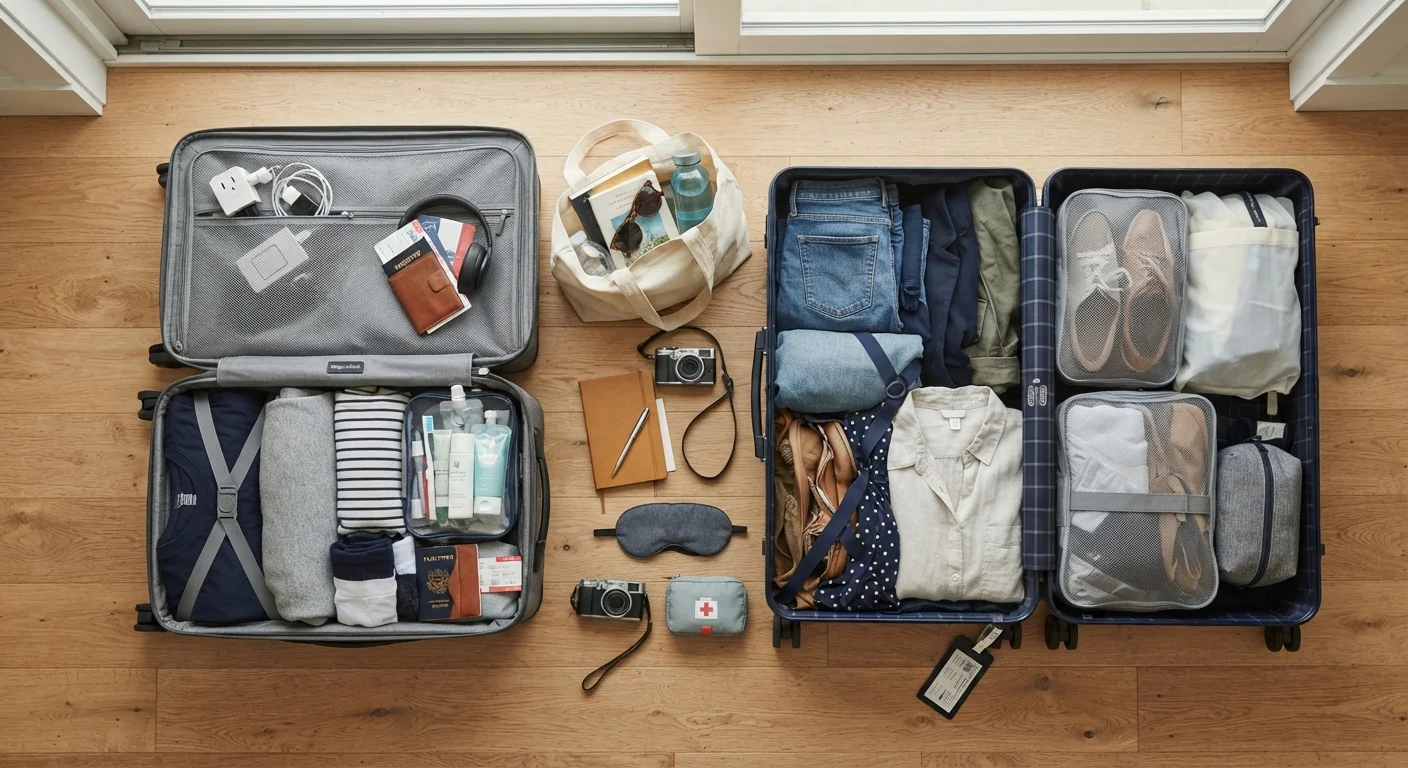
Option A
Carry-On Bag
The agile, airport-friendly choice for light packers.
Best for: Short trips, frequent flyers, travelers who value speed and flexibility at the airport.
Option B
Checked Bag
The spacious, stress-free option for longer journeys.
Best for: Extended trips, family travel, or any itinerary that demands a full wardrobe and gear.
What You're Really Deciding
Choosing between a carry-on and a checked bag isn't just a packing question - it's a travel strategy. The decision affects how long you spend at the airport, what you can bring, how much you pay, and how smoothly you move through your trip. For travelers planning multiple stops or a fast-paced itinerary, the pace of your trip will heavily influence which option makes sense.
Both options involve real trade-offs, and neither is universally superior. The smart move is understanding exactly what each one demands - and gives back - before you zip up your bag.
| Criterion | Carry-On Bag | Checked Bag |
|---|---|---|
| Typical fee (U.S. domestic) | Often free (varies by carrier) | $30-$40 per bag, each way |
| Size limit | ~22 x 14 x 9 inches | 62 linear inches; up to ~50 lbs |
| Liquid restrictions | TSA 3-1-1 rule applies | No liquid restrictions |
| Baggage claim wait | None | 15-45 minutes typically |
| Lost/delayed luggage risk | Very low | Present; varies by airline |
| Ideal trip length | 1-5 days | 6+ days or gear-heavy trips |
| Security screening | All contents X-rayed | Checked separately, less scrutiny |
The Case for Going Carry-On Only
Carry-on travel has a devoted following for good reason. You skip baggage claim, sidestep checked bag fees on most domestic routes, and dramatically reduce the risk of your luggage being lost or delayed. According to data from the U.S. Department of Transportation, airlines mishandle a meaningful percentage of checked bags each year - an inconvenience that carry-on travelers simply don't face.
The downsides are real, though. You're working within strict size limits (typically 22 x 14 x 9 inches on major U.S. carriers, though this varies) and the TSA's 3-1-1 liquid rule, which caps liquids at 3.4 oz per container in a single quart-sized bag. Certain items - full-size toiletries, sharp tools, some electronics - may need to go below or stay home. Overhead bin space is also competitive on full flights, and gate-checking your bag (which airlines may require when bins are full) removes most of the time advantage.
0.5%
Rate of mishandled checked bags
U.S. DOT Air Travel Consumer Reports have tracked mishandled bag rates hovering around this range in recent years, translating to millions of bags annually.
45 min+
Average baggage claim wait at busy airports
Travelers at major U.S. hub airports frequently report waits of 30-60 minutes from landing to bag retrieval, depending on airport, terminal, and time of day.
3.4 oz
TSA liquid container limit for carry-ons
TSA's 3-1-1 rule restricts all liquids, gels, and aerosols in carry-on bags to containers of 3.4 oz or less, all fitting in one quart-sized clear bag.
The Case for Checking a Bag
A checked bag buys you freedom - freedom to pack what you actually want without squeezing into airline-mandated dimensions. This matters enormously on longer trips, cold-weather getaways requiring bulky layers, beach vacations with snorkel gear, or any journey where you genuinely can't condense your needs into a 40-liter bag.
The main costs are literal and figurative. Most U.S. carriers charge $30-$40 per checked bag each way, though policies vary by airline, fare class, and loyalty status (always verify current fees with your carrier before booking). You'll also spend time at check-in and wait at baggage claim on arrival. On a tight connection, a checked bag can become a liability - if your first flight is delayed, your bag may not make it to the connecting flight even when you do. Travelers planning long-haul journeys should review our guide on hidden friction points of long-haul travel for more on how bag strategy intersects with connection risk.
Basic Economy and Budget Carrier Fees
Basic economy fares on many major U.S. carriers now restrict even carry-on bag placement to under-seat personal items only - meaning a standard carry-on may require a fee. Budget airlines may charge separately for both carry-on and checked bags. Always review the specific baggage policy for your fare class and airline before assuming one option is free. Policies change, and the fee structure that applied on a past trip may not apply today.
How Trip Context Should Guide Your Choice
Trip length is the most reliable factor. A rule of thumb many experienced travelers use: if you can pack for the trip in a carry-on, do it. If you genuinely can't - and that's an honest assessment, not a packing challenge - check a bag.
Your destination matters too. Urban city trips with laundry access or multiple hotel stays suit carry-on travel well. Remote destinations, all-inclusive resorts, or adventure itineraries often justify checked luggage. Solo travelers frequently find carry-on travel transformative: no waiting on others, no baggage claim stress, pure mobility.
Finally, consider your airline and route. Budget carriers often charge for carry-ons too - or assign overhead bin access by boarding group - so checking the specific fee structure for your ticket class is essential before assuming one option saves money. For broader pre-trip planning, the pre-departure checklist for international travel is a helpful reference for aligning your luggage plan with your full trip preparation. More trip planning guidance is available for any type of journey.
The content provided on our blog site traverses numerous categories, offering readers valuable and practical information. Readers can use the editorial team’s research and data to gain more insights into their topics of interest. However, they are requested not to treat the articles as conclusive. The website team cannot be held responsible for differences in data or inaccuracies found across other platforms. Please also note that the site might also miss out on various schemes and offers available that the readers may find more beneficial than the ones we cover.