

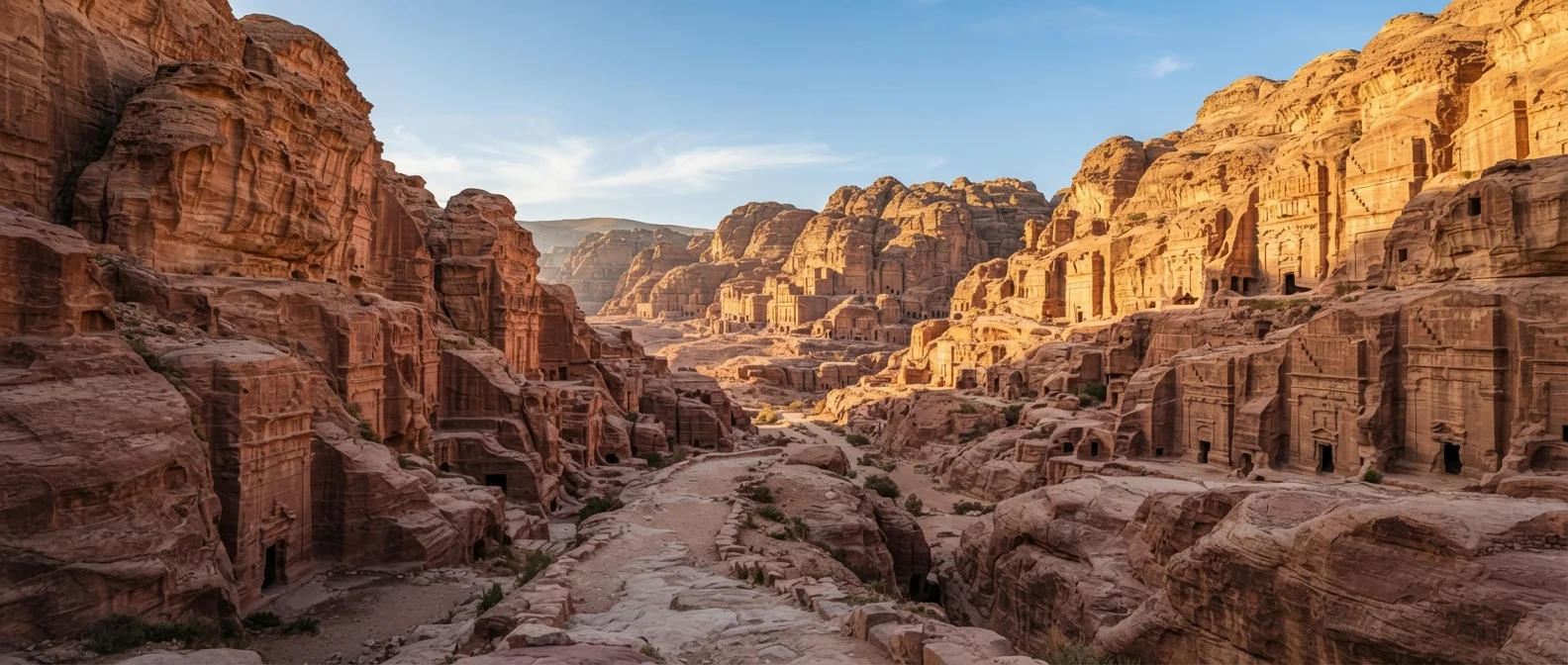
The Siq: Your First Clue That This Place Is Extraordinary
The journey into Petra begins before you ever see the Treasury. The Siq - a narrow, winding gorge stretching nearly a mile - is itself a feat of Nabataean engineering. Ancient builders channeled flash-flood water through clay pipes embedded in the canyon walls, protecting the city from flooding while delivering water to its residents. Look closely at the walls and you'll spot remnants of those channels still visible in the rock.
The Siq's sandstone walls soar up to 200 feet on either side, filtering sunlight into shifting shades of amber and rose. Small carved niches - called betyls - mark places where Nabataeans venerated their deities. By the time the gorge opens dramatically onto the Treasury facade, you've already walked through a living museum of ancient urban planning.
Slow Down in the Siq
Many visitors rush through the Siq to reach the Treasury quickly. Instead, pause to examine the carved water channels, the betyls in the walls, and the camel caravan relief near the entrance. The Siq alone contains significant archaeological detail that sets the historical stage for everything that follows.
What Actually Lies Beyond the Treasury
The famous Treasury (Al-Khazneh) was almost certainly a royal tomb, not a bank or storehouse as early legends suggested. Its two-story Hellenistic facade blends Greek architectural influence with distinctly Nabataean decoration - evidence of a trading culture that absorbed styles from across the ancient world.
Past the Treasury, the canyon opens into a wide basin containing Petra's true urban core. The Street of Facades lines the cliff walls with dozens of carved tomb entrances. Further along, a 6,000-seat rock-cut theater - later modified by Roman architects - confirms this was a city of significant population and cultural ambition.
The Colonnaded Street, Petra's central commercial artery, ran through a bustling market district. Substantial ruins of the Great Temple complex - covering roughly 7,560 square meters - anchor the city's civic heart, and ongoing excavations continue to reveal its full scope.
100+ sq mi
Total area of the Petra Archaeological Zone
The protected archaeological zone surrounding Petra covers over 100 square miles, encompassing the ancient city and its surrounding landscape.
~800
Individual monuments recorded at Petra
Archaeological surveys have recorded approximately 800 individual monuments at Petra, including tombs, temples, and inscriptions carved into the sandstone.
~85%
Portion of Petra still unexcavated
Archaeologists broadly estimate that the majority of Petra's built environment remains unexcavated beneath the desert surface, according to ongoing research at the site.
The Monastery: Petra's Other Masterpiece
Most visitors who see only the Treasury have missed Ad Deir - the Monastery - which is arguably more impressive in sheer scale. Carved into a mountaintop roughly 800 steps above the main valley, its facade stands about 150 feet tall and 150 feet wide, dwarfing the Treasury in raw dimension. The climb takes 30 to 45 minutes and rewards hikers with sweeping desert views and far fewer crowds.
The Monastery's function remains debated among scholars - it may have served as a triclinium (banquet hall for funeral rites) or a place of worship. Unlike the Treasury, visitors can actually step inside Ad Deir's single large chamber and appreciate the space Nabataean craftspeople carved entirely by hand.
Why So Few Visitors Reach the Monastery
Despite being one of Petra's most impressive structures, Ad Deir is often skipped because the climb requires real physical effort - roughly 850 rock-cut steps from the valley floor. Many organized tours don't allocate enough time for it. If your itinerary allows only one full day at Petra, factor in at least two additional hours specifically for the Monastery hike.
The High Places, Royal Tombs, and Hidden Quarters
Petra's topography created distinct neighborhoods at different elevations. The High Place of Sacrifice - reached by a separate staircase trail - sits atop Jebel Madbah and offers a commanding view of the entire archaeological zone alongside sacrificial altars, carved libation basins, and cisterns. The descent on the far side passes the Lion Triclinium and the Garden Tomb, making it a rewarding loop.
The Royal Tombs, carved into the Jebel al-Khubtha cliff face across from the main street, represent Petra's grandest funerary architecture. The Urn Tomb, the Silk Tomb, the Corinthian Tomb, and the Palace Tomb stand side by side, their facades striped with the multi-colored mineral deposits that give Petra its rose-red reputation. The Urn Tomb's interior was later converted into a Byzantine church in the 5th century, adding another layer to an already complex history.
Little Petra (Siq al-Barid), a smaller satellite settlement a short drive north of the main site, once served as a caravanserai - a stopping point for merchants. Its intimate scale and painted biclinium ceiling offer a quieter window into everyday Nabataean life, well away from the main site's foot traffic.
Planning a Visit That Does Petra Justice
Arriving with a single-day ticket and a plan to photograph only the Treasury means leaving the vast majority of one of the ancient world's great cities unseen. Petra rewards preparation. Comfortable, broken-in walking shoes are essential - the terrain is rocky, uneven, and sometimes steep. Carry water, as distances between shade and facilities are significant.
The site operates a free maps system at the visitor center, and licensed local guides are available for hire at the entrance. Early morning entry, before tour groups arrive, offers the most atmospheric experience at both the Siq and the Treasury. Visiting the Monastery in the afternoon catches the best light on its western-facing facade.
Always verify entry requirements, fees, and safety conditions through the Jordan Tourism Board or your government's official travel advisory service before making plans, as these can change.
This article provides general travel information for educational purposes. Entry requirements, site conditions, fees, and accessibility options can change; verify all details with official Jordanian tourism authorities and your government's travel advisory before visiting.
Frequently Asked Questions
Most travel experts recommend a minimum of two full days, and three days if you want to explore outlying areas like Little Petra or the High Place of Sacrifice. The main trail from the Siq entrance to the Monastery and back alone can take six to eight hours of walking.
No - the Treasury (Al-Khazneh) is simply the first major monument you encounter after walking through the Siq canyon. Beyond it lies a full ancient city with a Roman-style colonnaded street, royal tombs, a 6,000-seat theater, temples, and the massive Monastery carved high into the cliffs.
Spring (March-May) and autumn (September-November) offer the most comfortable temperatures for walking. Summer midday heat can be intense, while winter occasionally brings rain or snow. Always verify current seasonal conditions and travel advisories with official sources before booking.
Petra involves significant walking on uneven terrain. The route from the entrance to the Monastery includes roughly 850 rock-cut steps. Visitors with mobility concerns should consult the site's accessibility options, which include horse-drawn carriages on parts of the main route.
A guide is not required but is widely recommended. Licensed Jordanian guides can explain historical context that signage alone cannot convey, and they help visitors navigate efficiently across a site that covers an enormous area.
Yes, Petra charges a daily admission fee that varies depending on the number of days purchased. The Jordan Pass, which bundles a visa fee and Petra admission, is a popular option for international visitors - verify current pricing and entry requirements through official Jordanian tourism authorities before travel.
The content provided on our blog site traverses numerous categories, offering readers valuable and practical information. Readers can use the editorial team’s research and data to gain more insights into their topics of interest. However, they are requested not to treat the articles as conclusive. The website team cannot be held responsible for differences in data or inaccuracies found across other platforms. Please also note that the site might also miss out on various schemes and offers available that the readers may find more beneficial than the ones we cover.