

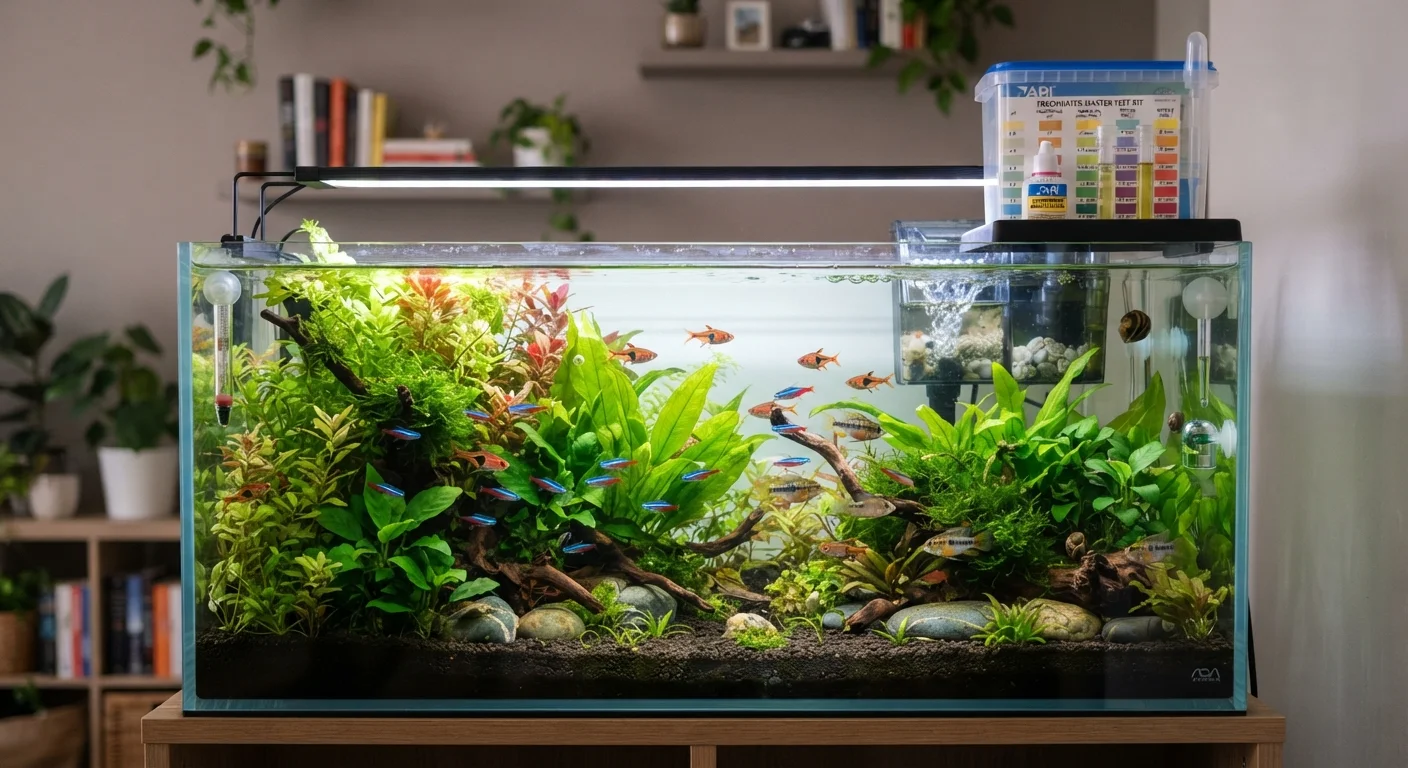
Core Water Parameters Every Aquarium Owner Should Know
Water quality is the single most important factor in fish health. Unlike cats or dogs, fish live entirely within their environment - so when that environment is off, fish suffer quickly and visibly. Understanding a handful of key parameters lets you catch problems before they become emergencies.
| Safe ammonia level | 0 ppm |
| Safe nitrite level | 0 ppm |
| Recommended max nitrate (community fish) | Below 40 ppm |
| Ideal pH range (most freshwater community fish) | 6.8 - 7.6 |
| Tropical fish temperature range | 74 - 80°F (23 - 27°C) |
| Recommended partial water change volume | 25 - 30% per session |
| Typical water change frequency (established tank) | Every 7 - 14 days |
For a deeper explanation of how ammonia and nitrite move through a tank ecosystem, see our guide on the nitrogen cycle in aquariums.
Key Parameters at a Glance
- Ammonia (NH₃): Produced by fish waste and uneaten food. Should read 0 ppm in an established tank. Any detectable level is harmful.
- Nitrite (NO₂): An intermediate byproduct of the nitrogen cycle. Also toxic; target is 0 ppm.
- Nitrate (NO₃): The end product of biological filtration. Less acutely toxic, but levels above 40 ppm stress most freshwater fish. Keep below 20 ppm for sensitive species.
- pH: Measures water acidity. Most community freshwater fish thrive between 6.8 and 7.6. Sudden swings are more dangerous than a stable reading slightly outside the ideal range.
- Temperature: Tropical freshwater fish generally prefer 74-80°F (23-27°C). Cold-water species like goldfish do better at 65-72°F (18-22°C).
Nitrogen cycle
The biological process by which beneficial bacteria convert toxic ammonia (from fish waste) into nitrite and then into the less-toxic nitrate. A fully cycled tank maintains 0 ppm ammonia and 0 ppm nitrite at all times.
ppm (parts per million)
The unit used to measure dissolved substances in aquarium water. In fishkeeping, ammonia, nitrite, and nitrate concentrations are all reported in ppm.
Beneficial bacteria
Colonies of nitrifying bacteria - primarily Nitrosomonas and Nitrospira - that colonize filter media and substrate, converting harmful ammonia and nitrite into nitrate.
Dechlorinator
A liquid water conditioner that neutralizes chlorine and chloramine in tap water, making it safe for fish and beneficial bacteria. It should be used every time new tap water is added to a tank.
Hardness (GH/KH)
General hardness (GH) measures dissolved calcium and magnesium; carbonate hardness (KH) measures the water's buffering capacity, which helps stabilize pH. Both matter for species-specific care.
Testing Routines: How Often and What to Use
Testing frequency depends on where your tank is in its lifecycle. A newly set-up tank is chemically unstable and needs frequent monitoring, while a mature, well-stocked tank is more forgiving.
Recommended Testing Schedule
| Tank Stage | Ammonia / Nitrite | Nitrate / pH |
|---|---|---|
| New tank (first 4-6 weeks) | Every 1-2 days | Every 2-3 days |
| Established tank (stable readings) | Once a week | Once a week |
| After adding fish or medicating | Daily for 1 week | Every 2-3 days |
Liquid reagent test kits are generally more accurate than dip strips and are a worthwhile investment for routine monitoring. Test strips are convenient for quick spot-checks but should not be your only tool.
Tap Water Variability Affects Results
Municipal tap water chemistry can vary by season and region, which influences your tank's pH and hardness. If your readings shift unexpectedly, test your tap water directly - the source, not the tank, may be the cause. Keeping a simple log of your weekly test results makes it easier to spot trends over time.
Filtration Types and What Each One Does
Filtration in an aquarium serves three distinct functions: mechanical (removing particles), biological (housing beneficial bacteria that process ammonia), and chemical (absorbing dissolved impurities). A good filter addresses all three.
Common Filter Categories
- Hang-on-back (HOB) filters
- Clip onto the tank rim and draw water up through a siphon tube. They provide mechanical and biological filtration and are easy to maintain. Well-suited for tanks up to about 55 gallons.
- Canister filters
- Sit below or beside the tank and pump water through a sealed canister packed with media. Offer high capacity and excellent biological filtration; preferred for larger or heavily stocked tanks.
- Sponge filters
- Air-driven filters ideal for small tanks, fry tanks, or quarantine setups. They provide gentle flow and strong biological filtration but minimal mechanical filtration.
- Internal power filters
- Submersible units that sit inside the tank. Compact and affordable, but can take up swimming space in smaller aquariums.
Regardless of filter type, never replace all filter media at once - doing so wipes out the beneficial bacteria colony. Rinse mechanical media in old tank water (not tap water) to preserve bacteria.
0 ppm
Target ammonia and nitrite in a cycled tank
Any detectable ammonia or nitrite in an established aquarium signals a water quality problem that requires immediate attention.
25-30%
Recommended partial water change per session
Regular partial changes keep nitrates low and replenish minerals without destabilizing tank chemistry through sudden shifts.
4-6 weeks
Typical new-tank cycling period
During this period, daily testing of ammonia and nitrite is recommended to monitor the developing bacterial colony.
Partial Water Changes: The Maintenance Task That Matters Most
No filter eliminates nitrates entirely - that requires regular partial water changes. This routine also replenishes trace minerals and dilutes any dissolved waste that accumulates over time.
General Guidelines
- Frequency: Most established freshwater tanks benefit from a 25-30% water change every 7-14 days. Heavily stocked tanks may need weekly changes.
- Volume: Avoid changing more than 30-50% at once unless responding to a water quality emergency. Large, sudden changes can stress fish by altering chemistry too quickly.
- Dechlorination: Always treat tap water with a dechlorinator before adding it to the tank. Chlorine and chloramine are toxic to fish and kill beneficial bacteria.
- Temperature matching: New water should be within 1-2°F of existing tank water. Use a thermometer to verify before adding.
Gravel vacuuming during water changes removes decomposing matter from the substrate - a key source of ammonia. Partial vacuuming of different sections each week is an effective, low-disruption approach.
Keeping an aquarium is a rewarding, lower-disruption form of pet ownership. Much like monthly cat care routines, consistency is more important than any single dramatic action. Build testing, filter maintenance, and water changes into a simple weekly schedule and your fish will thrive.
This article provides general information for educational purposes and does not substitute for advice from a qualified aquatics professional or veterinarian experienced in fish health.
The content provided on our blog site traverses numerous categories, offering readers valuable and practical information. Readers can use the editorial team’s research and data to gain more insights into their topics of interest. However, they are requested not to treat the articles as conclusive. The website team cannot be held responsible for differences in data or inaccuracies found across other platforms. Please also note that the site might also miss out on various schemes and offers available that the readers may find more beneficial than the ones we cover.