

How Tax Brackets Actually Work
Few personal finance misunderstandings cause as much unnecessary stress as the fear of moving into a higher tax bracket. The concern - that earning more could somehow leave you worse off - is understandable, but it rests on a fundamental misread of how the U.S. tax system is structured.
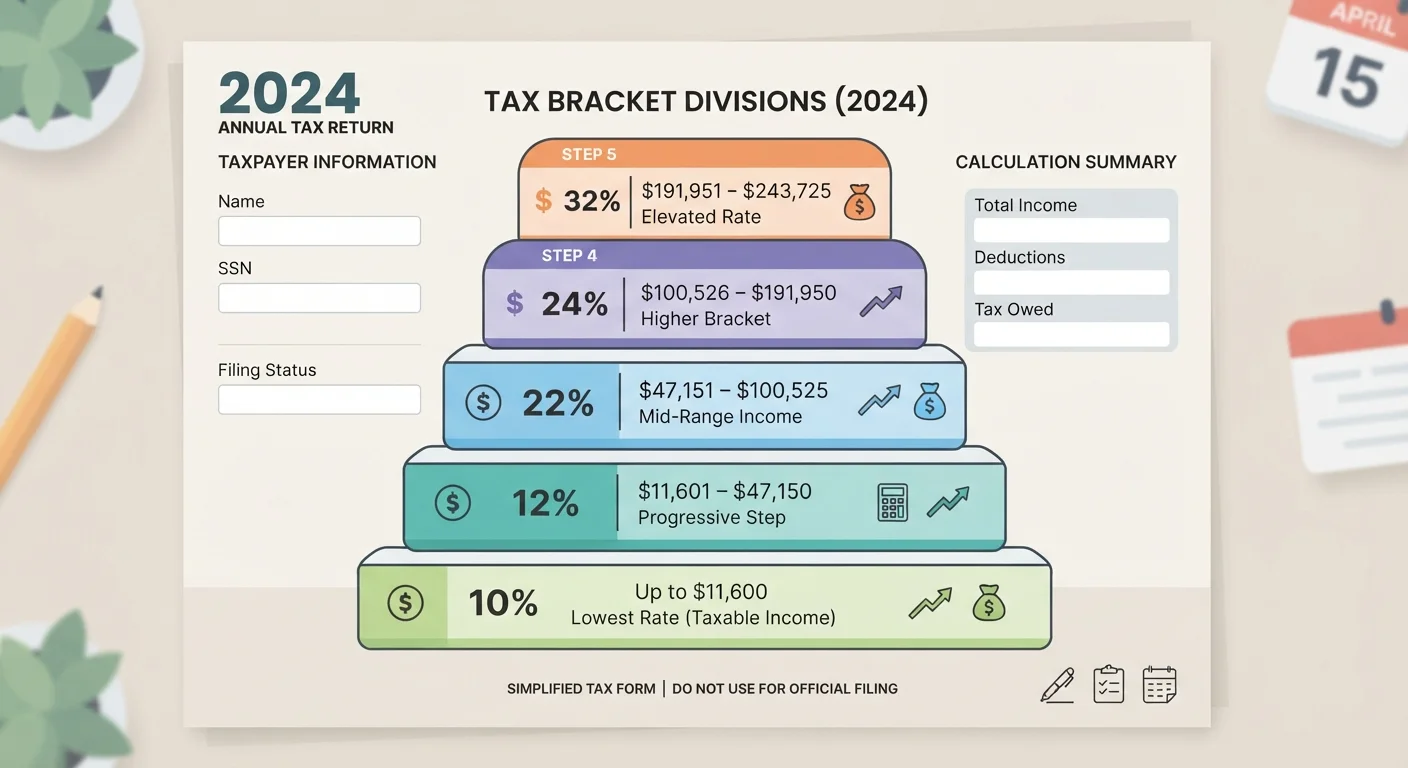
The federal income tax is marginal and progressive. That means different portions of your income are taxed at different rates, starting low and climbing only as your earnings rise. No single rate is ever applied to everything you earn.
Myth
If I get a raise that pushes me into a higher bracket, I'll take home less money than before.
Fact
Only the portion of your income that exceeds the bracket threshold is taxed at the higher rate. Your take-home pay will still increase.
The U.S. federal income tax uses a progressive, marginal rate system. Think of it as stacked buckets: income fills the lowest bucket first (taxed at the lowest rate), then spills into the next, and so on. A higher bracket rate only applies to the dollars that land in that bucket - not to every dollar you earned.
For example, if a single filer earns $47,000 and a $3,000 raise brings them to $50,000, only that $3,000 increment is taxed at the higher marginal rate. Every dollar earned before that threshold is taxed exactly as it was before the raise.
Myth
My tax bracket rate is what I actually pay on all of my income.
Fact
Your effective tax rate - total tax owed divided by total income - is typically well below your top marginal bracket rate.
Because lower portions of your income are taxed at lower rates, your effective tax rate is a blended, lower figure. For most middle-income households, the effective federal rate is significantly lower than their top marginal bracket.
To find your effective rate, divide your total federal income tax by your gross income. This is the more meaningful number for understanding your actual tax burden and for comparing your situation year over year.
Myth
Tax deductions and tax credits are basically the same thing.
Fact
Deductions reduce your taxable income; credits directly reduce the tax you owe - dollar for dollar.
A tax deduction lowers the amount of income that gets taxed. If you're in the 22% bracket and claim a $1,000 deduction, you save $220 in taxes. A tax credit, on the other hand, reduces your actual tax bill by its full stated value - a $1,000 credit saves you $1,000 in taxes, regardless of your bracket.
Credits are generally more valuable, dollar for dollar. Common credits include the Earned Income Tax Credit and the Child Tax Credit. Understanding this distinction helps you evaluate which deductions and credits are worth pursuing.
Myth
Everyone in the same income bracket pays the same amount of taxes.
Fact
Two people with identical gross incomes can owe very different tax amounts depending on deductions, credits, and filing status.
Gross income is just the starting point. Taxable income - what's actually subject to tax - is what remains after subtracting above-the-line deductions (such as student loan interest or contributions to a traditional IRA) and either the standard deduction or itemized deductions.
Filing status also matters significantly. Married couples filing jointly have wider brackets than single filers, meaning a greater share of their combined income falls into lower tax tiers. Two people earning the same salary can have meaningfully different tax bills based on these factors alone.
Myth
Contributing to a 401(k) or traditional IRA doesn't really affect your taxes.
Fact
Pre-tax contributions to retirement accounts directly reduce your taxable income, potentially lowering your effective tax rate.
Money contributed to a traditional IRA or a pre-tax 401(k) is deducted from your taxable income in the year you contribute. If you earn $55,000 and contribute $5,000 to a traditional 401(k), you are only taxed on $50,000.
This can pull income out of a higher marginal bracket entirely, lowering both your tax bill and your effective rate. It's one of the more straightforward ways working people legally reduce what they owe - while simultaneously saving for retirement. Consult a qualified financial professional or tax adviser to understand the limits and rules that apply to your situation.
Just as financial myths around tax brackets can hold you back, similar misconceptions can stall your broader money management. See how other common money misunderstandings play out in our look at budgeting myths that keep people from starting.
What This Means for Your Financial Decisions
Understanding marginal rates isn't just an academic exercise - it has practical consequences for how you approach raises, side income, and retirement planning.
Don't Confuse Marginal Rate with Effective Rate
Your marginal rate is the rate applied to your last dollar of income - not to everything you earned. Your effective rate (total tax divided by total income) is typically several percentage points lower. Quoting your bracket rate as what you 'pay in taxes' overstates your actual tax burden and can lead to poor financial decisions, such as turning down extra income.
When you know that a higher bracket only affects dollars above the threshold, you can stop viewing a raise as a potential liability and start seeing it for what it is: more money in your pocket. The same logic applies to freelance income, bonuses, or part-time work.
Pre-tax retirement contributions - like those to a traditional 401(k) - are one of the clearest tools available to reduce taxable income. If you are close to a bracket threshold, increasing your contribution could keep more of your income taxed at a lower rate. Always speak with a licensed tax professional or financial adviser before making changes based on your specific situation, as individual circumstances vary considerably.
Your Entire Income Is Never Taxed at One Rate
A common fear is that a raise will push all of your income into a higher tax bracket, costing you money overall. This is not how the U.S. federal income tax system works. Only the dollars earned above each threshold are taxed at the higher rate - the rest of your income is taxed at the same lower rates as before. Accepting a raise will not reduce your net pay.
This article is for general informational and educational purposes only and does not constitute personalized tax, legal, or financial advice. Tax laws are subject to change. Consult a qualified tax professional or financial adviser for guidance tailored to your individual circumstances.
The content provided on our blog site traverses numerous categories, offering readers valuable and practical information. Readers can use the editorial team’s research and data to gain more insights into their topics of interest. However, they are requested not to treat the articles as conclusive. The website team cannot be held responsible for differences in data or inaccuracies found across other platforms. Please also note that the site might also miss out on various schemes and offers available that the readers may find more beneficial than the ones we cover.