

Why Educational Philosophy Matters
When families explore schooling options beyond the conventional classroom, they often encounter a rich landscape of alternative educational philosophies. These frameworks aren't simply variations in scheduling or curriculum packaging - they reflect deeply different beliefs about how children learn, what childhood is for, and what schools should prioritize.
Understanding the core ideas behind each approach helps families move past surface-level impressions and ask more meaningful questions. As our guide to choosing a schooling path suggests, knowing what you value in an education is the essential first step. The six philosophies below represent some of the most influential and widely available alternatives in the U.S. today.
Montessori
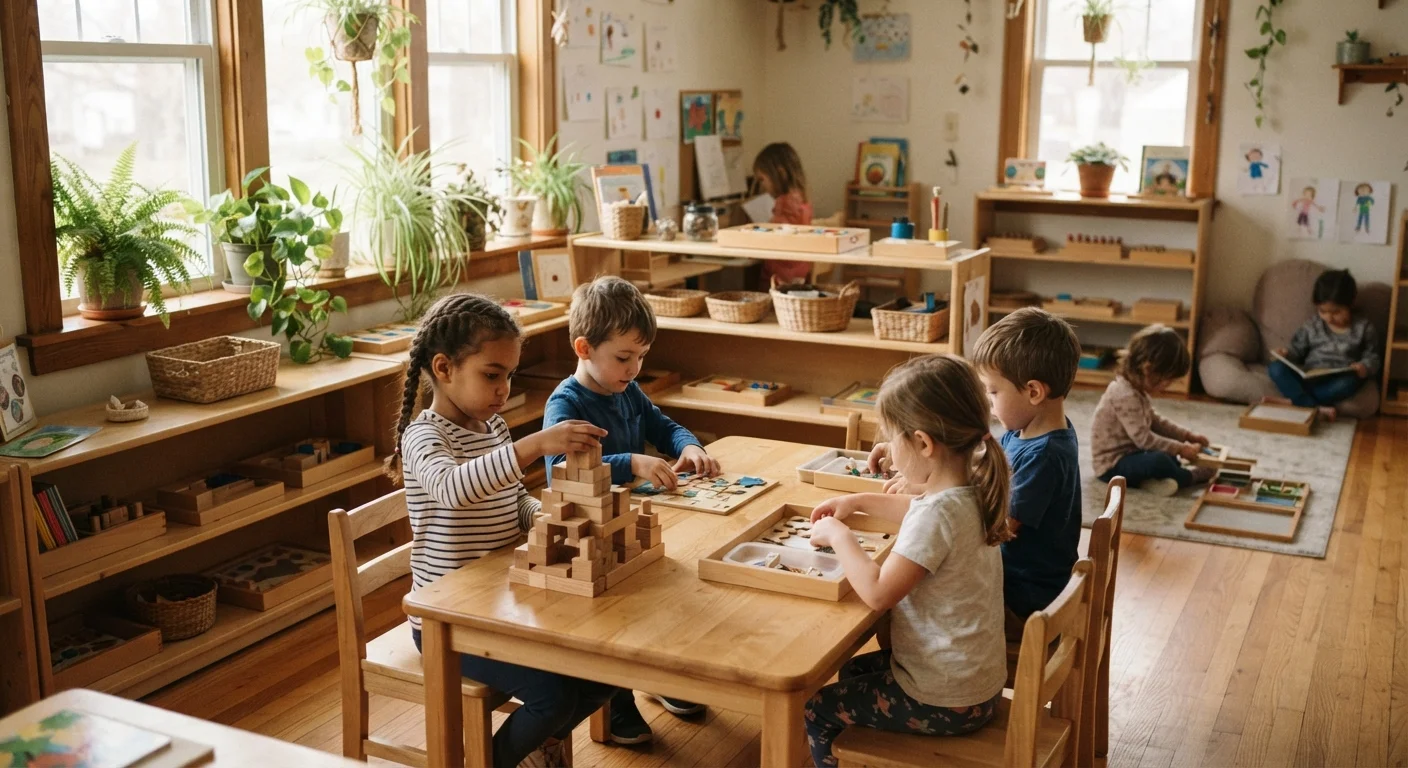
Developed by Italian physician and educator Maria Montessori in the early 1900s, the Montessori method is built on the principle that children are naturally curious and capable of directing their own learning when given the right environment. Classrooms are typically multi-age (often spanning three years), and children choose their activities from a carefully curated set of hands-on materials during extended, uninterrupted work periods.
Teachers act as guides rather than instructors, observing children and introducing new concepts when a child demonstrates readiness. Academic skills - reading, writing, math - are developed through manipulative materials before transitioning to abstract representation. Assessment is usually observational rather than test-based.
Children direct their own learning within a carefully prepared environment, guided by observation rather than instruction.
Waldorf (Steiner Education)
Founded by Austrian philosopher Rudolf Steiner in 1919, Waldorf education organizes learning around developmental stages it calls "seven-year cycles." In the early years, the emphasis falls on imaginative play, storytelling, and artistic activity rather than early academic instruction. Formal reading instruction, for instance, typically begins later than in conventional schools - usually around age 7.
Waldorf schools integrate arts into every subject: math lessons may involve movement and rhythm; history is explored through narrative and drama. A single class teacher often stays with the same group of students for multiple years, fostering deep relational continuity. Screen use is actively discouraged, particularly in the early grades.
Arts and imagination are woven into every subject, with academic formality introduced gradually as children mature.
Reggio Emilia
The Reggio Emilia approach originated in northern Italy after World War II and is most strongly associated with early childhood education (birth through age 6), though its principles have influenced elementary programs as well. Its central idea is that children have "a hundred languages" - meaning many ways of expressing thought - and that schools should document and build on those expressions.
Projects emerge from children's questions and interests, often extending over weeks or months. The physical environment is treated as a "third teacher," with carefully designed spaces that invite exploration. Documentation - displaying children's work with written observations - makes learning visible to children, families, and educators alike.
Learning emerges from children's own questions, with the environment itself treated as an active participant in education.
Democratic and Sudbury Schools
Democratic schools, of which the Sudbury Valley School (founded in 1968) is among the most cited examples, take child autonomy to its furthest institutional expression. Students of all ages decide how to spend their time each day - there is no required curriculum, no grades, and no mandatory classes. School governance is handled democratically, with students and staff holding equal votes on school rules and budget decisions.
Proponents argue this model builds genuine self-determination, intrinsic motivation, and civic responsibility. Critics raise questions about academic preparation for higher education. Research on long-term outcomes for Sudbury graduates is limited, and families considering this path are encouraged to investigate available evidence carefully.
Students govern their own time and the school itself, with no mandatory curriculum and equal voting rights for all members.
Project-Based and Expeditionary Learning
Project-Based Learning (PBL) and Expeditionary Learning (now rebranded as EL Education) are philosophies that structure academics around sustained, real-world investigations. Rather than covering subjects in isolation, students tackle authentic problems - designing a community garden, studying local water quality - that require integrating skills across disciplines.
These models maintain defined academic standards and formal assessment but present content through inquiry rather than direct instruction. EL Education places additional emphasis on character and service, incorporating fieldwork and community engagement as core components. PBL approaches are now used in many public schools and charter networks, making them among the most accessible alternative frameworks for families.
Sustained real-world projects replace isolated subject instruction, connecting academic skills to authentic questions and community contexts.
Unschooling
Unschooling is a home-based educational philosophy that rejects formal curriculum entirely, arguing that children learn most effectively when they pursue their genuine interests without adult-imposed structure. The term was popularized by educator John Holt in the 1970s. Unschooling families typically follow state homeschool laws, which vary considerably in their requirements across the U.S.
In practice, unschooling looks different in every household. Some families facilitate rich learning environments through travel, mentorships, and community resources; others take a more hands-off approach. Because unschooling depends heavily on family context and a child's individual drive, families considering it benefit from connecting with experienced unschooling communities and understanding their state's legal obligations. See the complete picture of schooling options for more context on how unschooling fits within the broader landscape.
Unschooling trusts children's natural curiosity as the primary engine of learning, with no imposed curriculum or structured schedule.
Finding the Right Fit for Your Family
Each philosophy described above has produced passionate advocates - and thoughtful critics. Montessori programs, for example, vary considerably in how faithfully they implement Dr. Montessori's original methods, since the name is not trademarked. Similarly, Waldorf schools share a common framework but can differ in cultural tone and community expectations. Visiting schools in person and speaking with current families remains the most reliable way to evaluate any program.
Questions to Ask When Visiting a School
Ask how teachers are trained in the school's philosophy and how they maintain fidelity to it over time. Find out how the school handles transitions - particularly for students moving into middle or high school from an alternative elementary program. Understanding assessment practices and how the school communicates progress to families will also help you evaluate the fit.
For a broader look at how these philosophies sit alongside public, charter, and home education options, see The Schooling Landscape and our side-by-side comparison of schooling formats. A quick-reference family guide is also available if you want concise definitions at a glance.
Access and Availability Vary Widely
Many alternative philosophy schools are private and charge tuition, which affects access for some families. However, Montessori and project-based programs exist within public charter networks in many states, often at no cost. When exploring options, it is worth checking whether your district or state offers publicly funded programs aligned with any of these philosophies.
The content provided on our blog site traverses numerous categories, offering readers valuable and practical information. Readers can use the editorial team’s research and data to gain more insights into their topics of interest. However, they are requested not to treat the articles as conclusive. The website team cannot be held responsible for differences in data or inaccuracies found across other platforms. Please also note that the site might also miss out on various schemes and offers available that the readers may find more beneficial than the ones we cover.