

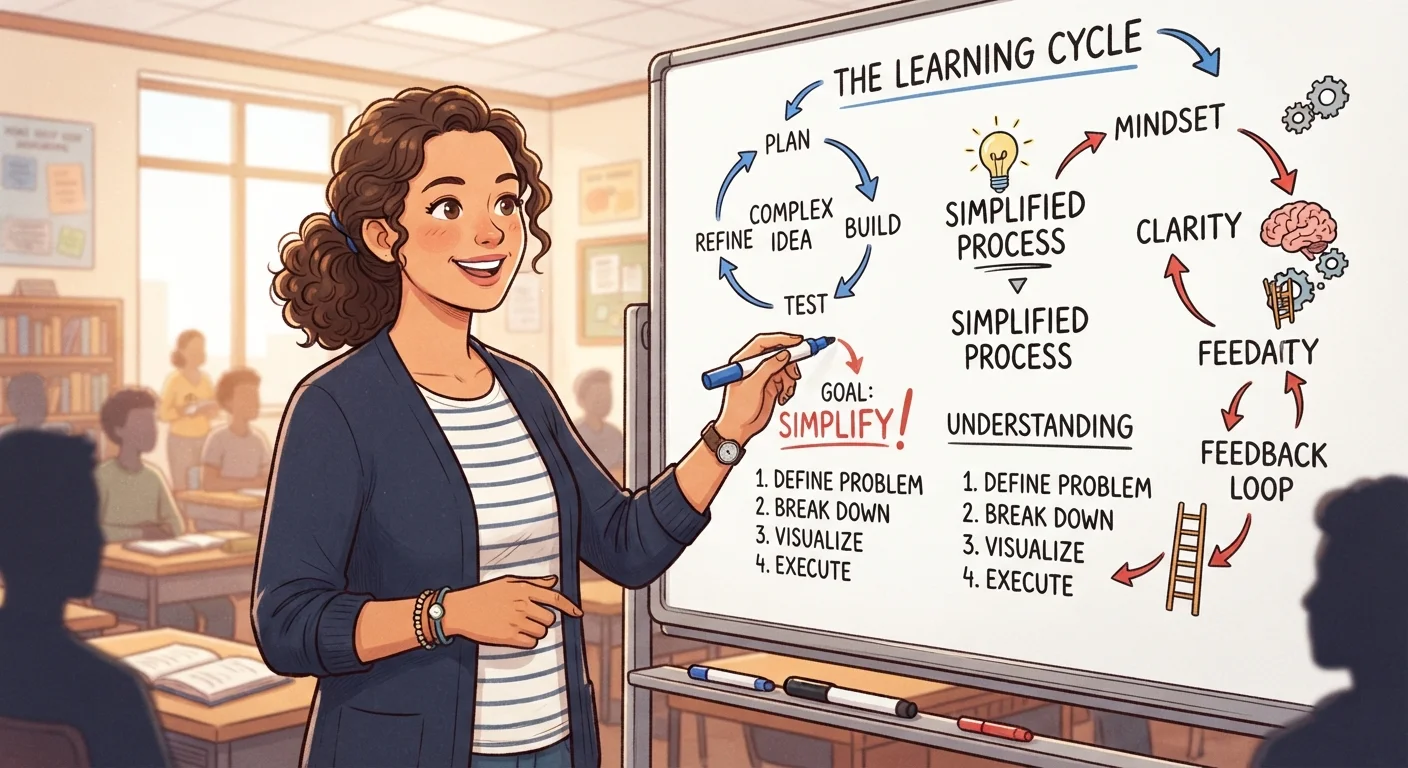
The Four Steps, Explained Simply
The Feynman Technique is often attributed to Nobel Prize-winning physicist Richard Feynman, who was known as much for his ability to explain complex ideas clearly as for his scientific contributions. The technique named after him breaks learning into four deliberate steps.
- Choose a concept. Pick a specific idea you want to understand - not a broad subject, but a focused concept. For example, not "chemistry" but "how covalent bonds work."
- Explain it in plain language. Write or say an explanation as if you were teaching it to someone with no background in the area. Avoid jargon, use analogies, and keep it as simple as possible.
- Identify your gaps. Wherever your explanation becomes vague, circular, or unconvincing, you have found a gap. These aren't failures - they are the most valuable output of the exercise.
- Review, refine, and repeat. Return to your source material to address each gap, then revise your explanation. Repeat until you can explain the concept clearly and completely without leaning on technical vocabulary as a crutch.
Write It Down, Don't Just Think It
Mentally rehearsing an explanation feels convincing but rarely exposes gaps the way writing does. Committing your explanation to paper - or saying it aloud and recording yourself - creates an external record you can evaluate critically. The act of producing language, rather than simply imagining it, is what triggers the gap-detection that makes this technique work.
This process works because it shifts learning from passive recognition to active generation - a distinction that learning science consistently links to stronger retention.
Why Simplicity Exposes Real Understanding
Jargon is a useful shorthand between experts, but it can also mask shallow understanding. When a learner rehearses a definition using the same technical terms from a textbook, they may feel confident without truly grasping the underlying logic.
The requirement to explain something in everyday language removes that safety net. If you cannot describe how a concept works using words a curious 12-year-old would understand, that is strong evidence you have memorized a definition rather than internalized an idea.
“If you can't explain it simply, you don't understand it well enough.”
— Albert Einstein, Theoretical physicist, widely attributed
This is also why analogy-making is so central to the technique. A well-constructed analogy forces you to identify the structure of a concept - what it resembles, how its parts relate - rather than simply recalling its surface features. Building that structural map is what makes knowledge transferable to new problems.
When to Reach for This Technique
The Feynman Technique is not the right tool for every learning task. Understanding where it fits helps you use your study time more effectively.
Use it when:
- You are studying an abstract or counterintuitive concept - thermodynamics, probability theory, grammatical cases in a foreign language.
- You are preparing to explain something to others, such as a presentation, exam essay, or professional discussion.
- You realize you have been reading material repeatedly without it sticking.
- You want to check your understanding before an assessment rather than after it.
Consider other approaches when:
- You need to memorize a large volume of discrete facts efficiently - spaced repetition tools may serve you better.
- You are at the very beginning of learning a topic and lack enough foundational knowledge to construct even a rough explanation.
For a deeper look at how session length and learning depth interact, see our article on microlearning vs. deep study - which explores when short-burst sessions work and when sustained focus is needed.
~50%
More information retained with active recall vs. passive review
Multiple studies in cognitive psychology, including work reviewed in Roediger & Karpicke (2006), consistently show retrieval practice produces substantially stronger long-term retention than re-reading.
4 steps
Core steps in the Feynman Technique
The method is intentionally simple: choose, explain, identify gaps, and refine - requiring no special tools or materials.
Putting It Into Practice
The technique requires only a blank page and honest self-assessment. Here is a practical starting point:
- Write the concept name at the top of a blank page.
- Below it, write everything you know about that concept - in your own words, not copied definitions.
- Read back what you wrote and circle every place where you used a term you could not define independently, or where a step in your explanation assumed knowledge you haven't explained.
- Look up what you need, then rewrite the explanation from scratch - not editing the original, but starting fresh. This forces integration rather than patching.
The discomfort of discovering gaps is a productive sign. Research on learning consistently shows that the effort of retrieving and reconstructing knowledge - even when it feels difficult - produces stronger long-term memory than passive review of notes or slides.
No Teaching Partner Required
You do not need an actual audience to use this technique. Writing your explanation as if for a reader, speaking it to an empty chair, or recording a voice memo all activate the same cognitive process. The key is committing to plain language and honest self-assessment - not performing for others.
Used regularly, the Feynman Technique becomes a reliable self-testing habit that builds both confidence and genuine mastery - two outcomes that reinforce each other over time.
Frequently Asked Questions
The four steps are: (1) choose a concept you want to learn, (2) explain it in plain language as if teaching a child, (3) identify where your explanation breaks down or becomes unclear, and (4) return to your source material to address those gaps, then simplify your explanation again.
They share similarities - both involve talking through a problem out loud - but they differ in purpose. The rubber duck method is primarily used by programmers to debug code by narrating it aloud. The Feynman Technique is a structured learning strategy focused on deepening conceptual understanding across any subject.
It is most effective for conceptual understanding rather than rote memorization. For isolated facts, dates, or vocabulary, flashcard-based spaced repetition may be more efficient. The Feynman Technique shines when you need to understand how or why something works, not just what it is.
It varies by concept complexity, but a single session typically takes 20 to 45 minutes. Simpler concepts may take less time; deeply technical topics may require multiple rounds of explanation and review spread across several sessions.
Yes, the technique is adaptable for a wide range of ages. Younger learners benefit from the "teach it back" format, and teachers often use it informally by asking students to explain concepts in their own words during class discussions.
The content provided on our blog site traverses numerous categories, offering readers valuable and practical information. Readers can use the editorial team’s research and data to gain more insights into their topics of interest. However, they are requested not to treat the articles as conclusive. The website team cannot be held responsible for differences in data or inaccuracies found across other platforms. Please also note that the site might also miss out on various schemes and offers available that the readers may find more beneficial than the ones we cover.