

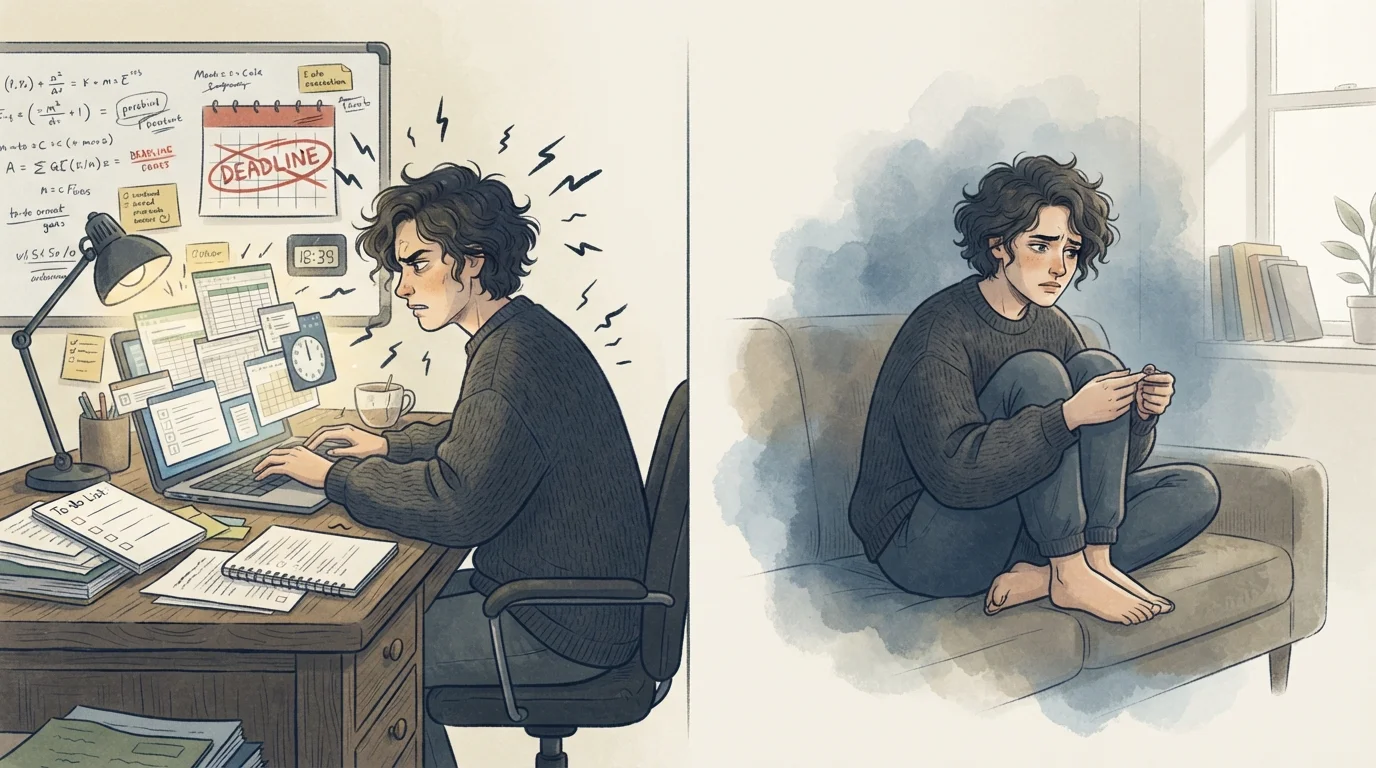
Option A
Stress
The identifiable, situation-driven response.
Best for: Understanding when an external pressure or demand is driving your emotional and physical tension.
Option B
Anxiety
The persistent, internally generated state of worry.
Best for: Recognizing when worry continues or intensifies without a clear or proportionate external trigger.
Why the Distinction Matters
Most people use the words stress and anxiety interchangeably, and it's understandable - both produce a racing heart, tense muscles, disrupted sleep, and a sense of being overwhelmed. But conflating them can lead to mismatched coping strategies that don't actually help. Knowing which experience you're having gives you a more useful starting point.
This article offers general health information to help you reflect on your own experience. It is not a substitute for professional diagnosis or treatment. If your symptoms are severe, prolonged, or affecting your daily functioning, please consult a qualified mental health professional.
| Criterion | Stress | Anxiety |
|---|---|---|
| Primary trigger | Identifiable external stressor | Internal worry, often without clear cause |
| Duration | Typically resolves with the stressor | Persists beyond or without a trigger |
| Physical symptoms | Tension, fatigue, elevated heart rate | Similar, plus frequent restlessness or dread |
| Sense of control | Usually feels actionable | Often feels uncontrollable or irrational |
| Proportionality | Generally matches the situation | Often disproportionate to actual threat |
| Primary coping approach | Problem-solving, prioritization, rest | Therapy, mindfulness, professional support |
What Stress Actually Is
Stress is the body and mind's response to an identifiable external demand - a looming work deadline, a difficult conversation, a financial pressure, or an unexpected life change. It follows a familiar arc: the stressor appears, tension builds, and when the stressor resolves, the feeling tends to diminish.
From a physiological standpoint, stress triggers the body's fight-or-flight system, releasing hormones like cortisol and adrenaline. This response is not inherently harmful - it can sharpen focus and drive action. Problems arise when stressors pile up faster than they resolve, leaving the nervous system in a prolonged state of activation.
A useful self-check: Can you name what is causing the feeling? If yes, and if you can imagine relief once that situation changes, stress is likely the better description.
~33%
US adults reporting extreme stress
The American Psychological Association's Stress in America surveys have consistently found roughly one-third of US adults report experiencing extreme stress levels.
31%
US adults experiencing anxiety disorder
The National Institute of Mental Health estimates that approximately 31% of US adults will experience an anxiety disorder at some point in their lives.
What Anxiety Actually Is
Anxiety is characterized by worry, fear, or apprehension that persists even when a concrete threat is absent or when the level of distress seems disproportionate to the actual situation. Where stress tends to be externally anchored, anxiety is more internally generated - the mind anticipates danger or catastrophe that may never materialize.
Anxiety exists on a spectrum. Occasional anxious feelings are a normal part of human experience. When anxiety becomes frequent, difficult to control, and begins to interfere with work, relationships, or everyday tasks, it may cross into clinical territory - including conditions like generalized anxiety disorder, social anxiety, or panic disorder. These are recognized mental health conditions that respond well to evidence-based treatment.
Practices like mindfulness and meditation are frequently explored as complementary tools for managing anxious thinking, though they work differently and are not equivalent to professional care.
When to Seek Professional Support
If anxious feelings are persistent, feel uncontrollable, or are affecting your quality of life, speaking with a licensed mental health professional is an important step. Anxiety disorders are among the most common and treatable mental health conditions. A therapist or psychologist can help clarify what you're experiencing and discuss evidence-based approaches such as cognitive behavioral therapy (CBT). Your primary care physician can also be a useful first point of contact.
Overlapping Symptoms and How to Distinguish Them
Both stress and anxiety share a significant symptom overlap: irritability, difficulty concentrating, muscle tension, sleep disruption, and fatigue. This overlap is precisely why self-reflection - rather than symptom-counting alone - is so important.
The most useful distinguishing questions are:
- Is there a clear trigger? Stress tends to have one. Anxiety often doesn't, or the trigger feels disproportionate to the response.
- Does it resolve when the situation resolves? Stress usually does. Anxiety often persists or shifts to the next worry.
- How long has it lasted? Short-term tension tied to circumstances points toward stress. Weeks of unrelenting unease without a clear cause warrants closer attention.
It's also worth noting that chronic, unmanaged stress can contribute to the development of anxiety over time - meaning the two can coexist and even reinforce each other. If you suspect your coping strategies aren't matching your actual experience, it may be worth exploring whether your current coping habits are still serving you.
This article is for general informational purposes only and does not constitute medical or psychological advice. Always consult a qualified healthcare or mental health professional for concerns about your personal wellbeing.
The content provided on our blog site traverses numerous categories, offering readers valuable and practical information. Readers can use the editorial team’s research and data to gain more insights into their topics of interest. However, they are requested not to treat the articles as conclusive. The website team cannot be held responsible for differences in data or inaccuracies found across other platforms. Please also note that the site might also miss out on various schemes and offers available that the readers may find more beneficial than the ones we cover.