

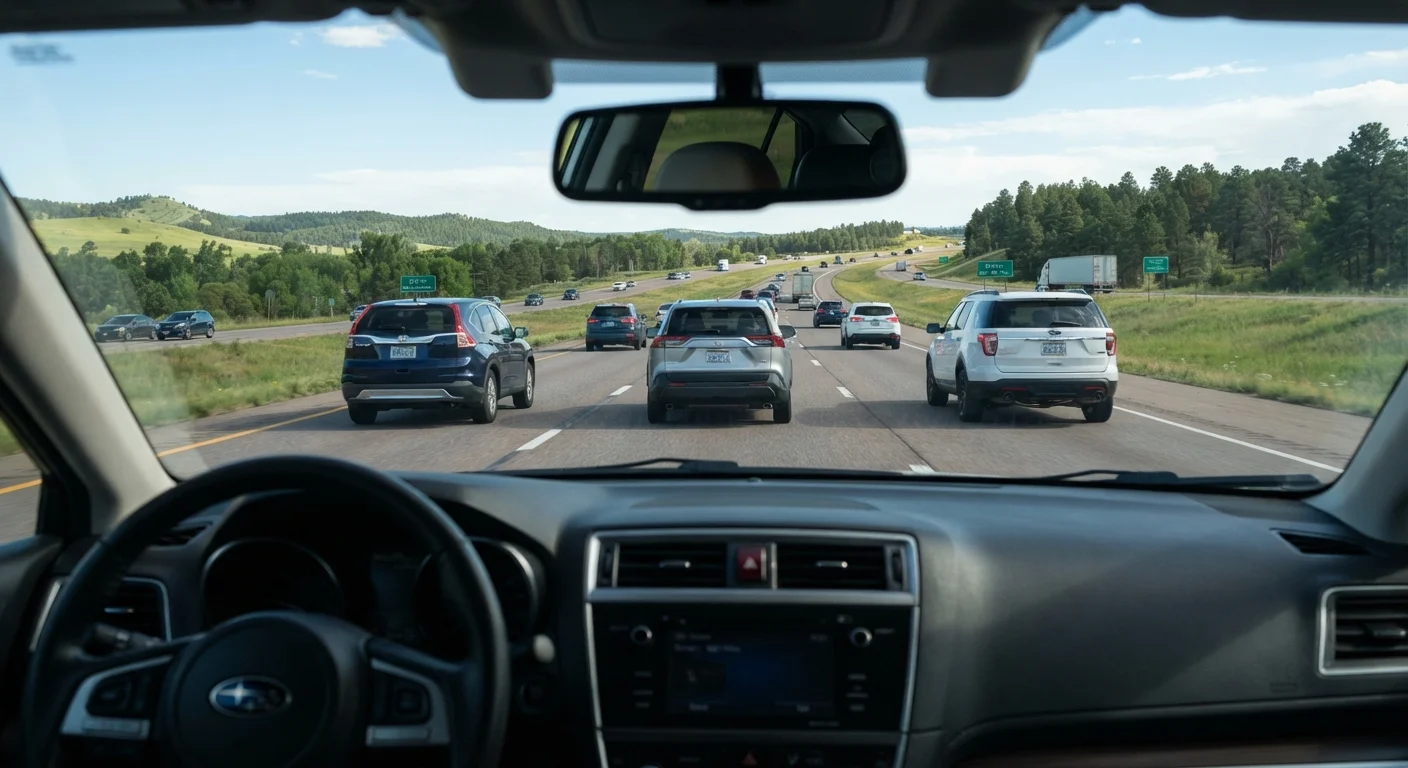
How the Two-Second Rule Works
The two-second rule gives drivers a simple, speed-independent way to gauge following distance. Rather than trying to estimate feet or car lengths - which vary by vehicle and speed - you measure time. Pick a fixed object on the road: a painted line, overpass, or road sign. The moment the rear bumper of the vehicle ahead passes it, begin counting. If your front bumper reaches that same point before two full seconds have elapsed, you're too close.
The beauty of this method is that it automatically scales with speed. At 30 mph two seconds equals roughly 88 feet; at 70 mph it's closer to 205 feet. You don't need to do the math - the rule does it for you in real time.
~29%
Share of crashes that are rear-end collisions
According to the National Highway Traffic Safety Administration, rear-end crashes consistently represent a significant portion of all U.S. traffic crashes each year.
1.5 seconds
Average driver reaction time
Research published in transportation safety literature places typical driver reaction time between 1.5 and 2.5 seconds, underscoring why a two-second minimum leaves little margin for error.
10x
Longer stopping distance on ice vs. dry pavement
Federal road safety guidance indicates that stopping distances can increase dramatically on icy surfaces, illustrating why the two-second rule must be extended significantly in winter conditions.
Why Two Seconds Is the Minimum, Not the Target
Two seconds represents the lower threshold under ideal conditions: dry pavement, good visibility, an alert driver in a well-maintained vehicle. In reality, most driving situations involve at least one factor that erodes your margin. Wet roads can double braking distances. Fog cuts perception time. A brief glance at a dashboard screen adds a fraction of a second of reaction time - and at highway speeds, that fraction translates to several car lengths of additional distance you'll need.
Traffic safety researchers consistently find that rear-end collisions are among the most common crash types on U.S. roads, and inadequate following distance is a leading contributing factor. The two-second rule, applied as a true minimum, works - but treating it as the ceiling rather than the floor is where many drivers go wrong.
Use Three Seconds as Your New Everyday Baseline
Several U.S. state driver's manuals now recommend three seconds as the standard following distance for normal conditions, reflecting the realities of modern traffic speeds and driver distraction levels. Starting at three seconds - rather than two - gives you a slightly larger buffer before conditions force you to adjust further. It's a small habit shift that meaningfully improves your margin of safety.
When - and How Much - to Extend Your Following Distance
A practical way to think about following distance: start with three seconds as your everyday baseline, and add more as conditions warrant. Here's how specific situations should shape your gap:
- Rain or wet roads: Increase to at least four seconds. Water reduces tire grip significantly, especially in the first few minutes of a shower when road oils rise to the surface.
- Snow or ice: Extend to eight to ten seconds. Stopping distances on ice can be ten times longer than on dry pavement.
- Fog or reduced visibility: Add enough distance so that you could fully stop within the distance you can see ahead - which may far exceed any time-based calculation.
- Towing a trailer: The added weight dramatically increases stopping distance. Three to four extra seconds is a reasonable starting point.
- Fatigue or distraction: If you're tired, your reaction time slows. Give yourself the extra buffer you need rather than relying on reflexes that aren't at full capacity.
Making the Habit Stick
The two-second rule is only useful if it becomes automatic. Drivers who consciously check their following distance in good conditions will reach for that same habit when conditions deteriorate. A few practical approaches help:
Use checkpoints every time you drive - not just on unfamiliar roads or in bad weather. Choose a fixed reference point and run the count whenever you're in traffic. Over time, the appropriate gap starts to feel natural rather than calculated.
Be aware of pressure from following drivers. Tailgating behind you can tempt you to close your gap with the vehicle ahead. Resist that impulse. Your gap protects you; you cannot control what the driver behind you does.
Finally, recognize that the two-second rule is about giving yourself choices. A larger buffer means more time to react, more options to steer around a hazard, and a greater chance that a sudden stop ahead doesn't turn into a collision.
Frequently Asked Questions
When the vehicle ahead passes a fixed landmark - like a sign or overpass - start counting 'one-one-thousand, two-one-thousand.' If you reach the same landmark before finishing the count, you're following too closely and need to ease back.
Yes. At higher speeds your vehicle covers more ground in two seconds, so the physical gap increases automatically. However, reaction time stays the same - meaning higher speeds actually make the two-second minimum even more critical to maintain, and many safety experts recommend three or more seconds on expressways.
Extend to three or four seconds in rain, snow, fog, heavy traffic, or when you're fatigued. Also increase distance when towing a trailer, driving a larger vehicle, or following a motorcycle or cyclist.
Yes - it is a standard component of driver education in the United States and is referenced in many state driver's manuals. Some manuals now recommend three seconds as the baseline for modern traffic conditions.
The three-second rule is simply a more conservative version of the same concept, adding an extra second of buffer. It is increasingly recommended as a baseline because modern traffic moves faster and drivers face more distractions than when the two-second rule was first popularized.
The content provided on our blog site traverses numerous categories, offering readers valuable and practical information. Readers can use the editorial team’s research and data to gain more insights into their topics of interest. However, they are requested not to treat the articles as conclusive. The website team cannot be held responsible for differences in data or inaccuracies found across other platforms. Please also note that the site might also miss out on various schemes and offers available that the readers may find more beneficial than the ones we cover.