

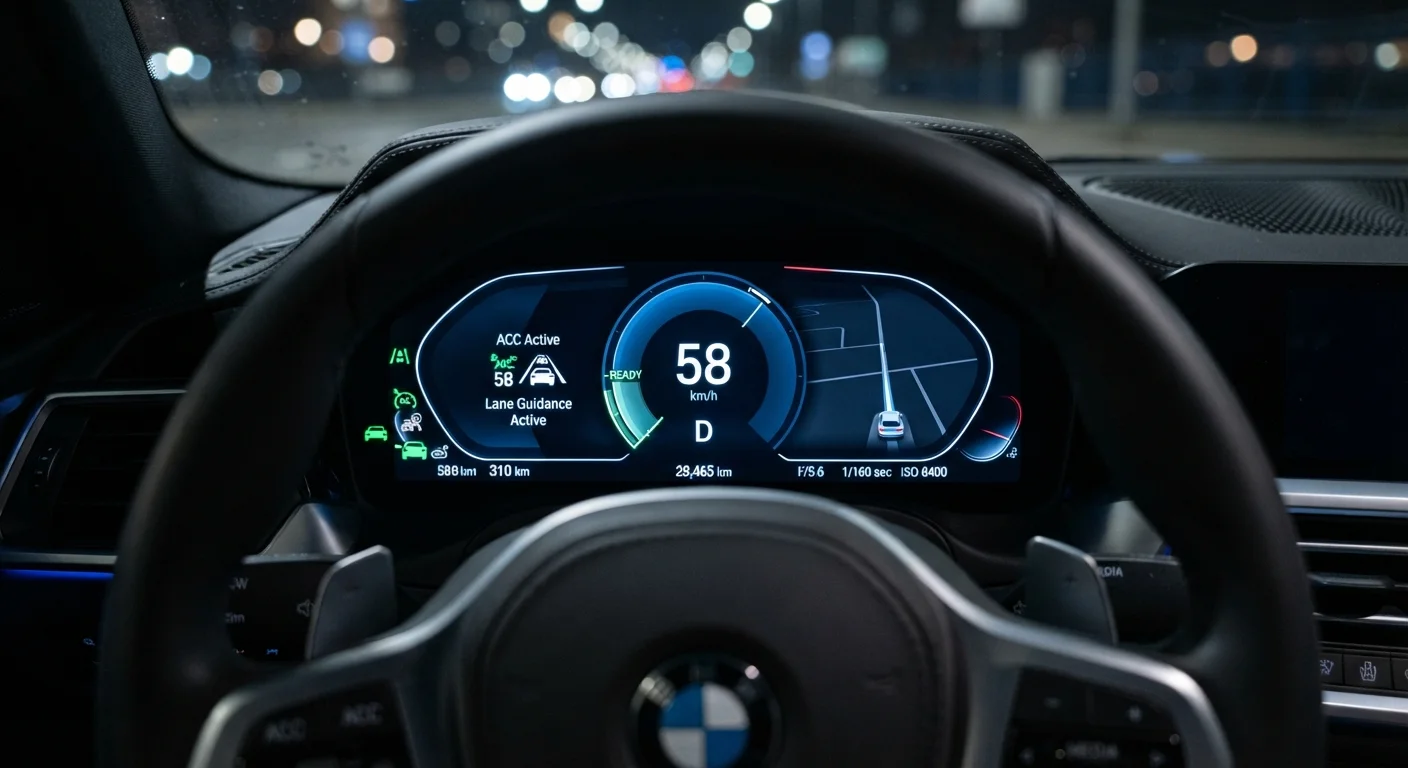
Option A
Speed Limiter
The boundary-setter that keeps you from exceeding a chosen maximum.
Best for: Drivers who want a safety cap on their top speed, especially in school zones, work zones, or when new to a vehicle.
Option B
Cruise Control
The steady-state system that holds a target speed automatically.
Best for: Drivers on long highway stretches who want consistent speed without continuous foot pressure on the accelerator.
How Each System Works
Speed limiters and cruise control are both speed-management tools, but they operate on fundamentally different logic - one sets a ceiling, the other holds a floor.
A speed limiter restricts your vehicle from accelerating beyond a driver-defined or manufacturer-defined maximum. The engine's output is electronically capped at that threshold. In most passenger vehicles, you can set this limit yourself through the driver information display. Some limiters offer slight resistance through the accelerator pedal when you're approaching the cap, while others simply cut power before that point. In an emergency, most systems allow a brief override by pressing the pedal firmly past the resistance point.
Cruise control works differently. Rather than setting a ceiling, it actively maintains a specific speed you've selected - typically set via steering wheel controls. Once engaged on a highway, the system manages throttle input automatically so the vehicle sustains that exact speed without any foot input from the driver. Traditional cruise control doesn't respond to vehicles ahead of you; that's where adaptive cruise control (ACC) enters the picture. ACC uses radar or camera sensors to detect the gap to the vehicle in front and adjusts speed accordingly - slowing down and even stopping in some systems, then resuming when traffic clears.
Understanding this distinction matters for how you use each system responsibly. As our editorial piece on driver attention and cognitive load explains, automating a physical task doesn't reduce the need for mental engagement behind the wheel.
| Criterion | Speed Limiter | Cruise Control |
|---|---|---|
| Primary function | Caps maximum speed | Maintains a target speed |
| Driver foot input required | Yes - driver still accelerates | No - system manages throttle |
| Best road type | Urban, suburban, variable limits | Open highway, consistent flow |
| Responds to traffic ahead | No | Yes (adaptive versions only) |
| Emergency override | Usually possible with firm pedal press | Disengages via brake or button |
| Suitable in bad weather | Generally yes | Not recommended |
| Fatigue reduction | Minimal | Moderate to significant on highways |
When to Use One Over the Other
The right tool depends on the driving environment, not personal preference alone.
Speed limiters are most useful in:
- Urban areas with frequently changing posted limits
- School zones and hospital zones where strict compliance matters
- Situations where a driver wants a safeguard against distraction-related over-acceleration
- Fleet or family vehicle settings where a consistent cap adds a layer of accountability
Cruise control is most useful in:
- Long interstate or highway driving with steady traffic flow
- Situations where maintaining a consistent speed helps fuel efficiency
- Reducing physical fatigue on extended trips
It's worth noting that cruise control - standard or adaptive - should generally not be used in heavy rain, snow, or icy conditions. The system can't detect road surface conditions, and disengaging it quickly when traction becomes unpredictable can be difficult. In those conditions, direct throttle control from the driver is always the safer approach.
~17%
Fatality reduction linked to speed management
The National Highway Traffic Safety Administration (NHTSA) reports that speeding is a contributing factor in roughly 29% of all traffic fatalities annually in the US, underscoring the value of speed management tools.
40%+
New US vehicles with standard ACC
Industry estimates suggest adaptive cruise control has become standard or widely available on a growing share of new vehicles sold in the US market, though exact figures vary by model year and segment.
Neither system is a substitute for situational awareness. Both require the driver to keep hands on the wheel, eyes on the road, and attention on the full driving environment.
The content provided on our blog site traverses numerous categories, offering readers valuable and practical information. Readers can use the editorial team’s research and data to gain more insights into their topics of interest. However, they are requested not to treat the articles as conclusive. The website team cannot be held responsible for differences in data or inaccuracies found across other platforms. Please also note that the site might also miss out on various schemes and offers available that the readers may find more beneficial than the ones we cover.